

Industrial computer
Computing power for AI
According to many experts, the potential of artificial intelligence in the manufacturing environment is enormous. Preconfigured or AI-adapted computer solutions make it easier to get started with the new technology.

The areas of application for artificial intelligence in industry are diverse. For example, in combination with camera systems and radar for data acquisition, robots can take on important tasks in the flow of goods as autonomous transportation and logistics systems - wherever goods need to be physically transported. Artificial intelligence, machine learning and deep learning methods play a key role here.
Cameras and sensors record data in a robot's environment in real time; an AI solution evaluates this immediately and then calculates the precise speed and route of the robot. Ultimately, it doesn't matter whether the robot is used in industrial, automotive or pharmaceutical production. It always relies on AI, or more precisely machine learning. In essence, such robot scenarios are about collecting data, interpreting it and making decisions automatically. Through intelligent data analysis, AI applications in production can make statements about the condition of machines, detect irregularities or unusual events at an early stage and thus significantly improve predictive maintenance. The first AI solutions are also already being used in quality control to find the causes of defects in the production process. In other cases, solutions support quality control and fault diagnosis during final acceptance, for example through automatically operating camera systems that meticulously record every millimeter of a machine.
Further application scenarios for AI, machine learning and deep learning can be found in semiconductor production, for example, where costs, quality and time-to-market are crucial. During final quality control, silicon wafers undergo a process that detects errors and enables changes to be made in production. In the past, this testing process was laborious and error-prone - each production result was examined with the human eye. The use of software algorithms to detect defects on millions of high-resolution digital images of the wafers makes it possible to detect defects earlier, faster and with greater accuracy.
Rapidly deployable AI solutions
Until recently, manufacturing companies had to procure the hardware and software required for AI projects as individual components and then spend a great deal of time and effort combining, configuring and optimally coordinating them. Nowadays, there are specially validated package solutions that can be deployed quickly - including the necessary computing, storage and network capacities as well as the appropriate AI frameworks and libraries for machine learning and deep learning. For example, deep learning solutions for automated quality management in the manufacturing industry can consist of solutions from servers and Nvidia graphics processors.

The EMC PowerEdge C6420 servers from Dell are suitable for high-performance computing and AI directly on the machines. They offer maximum density, scalability and energy efficiency per unit on a modular 2U/8S platform.
© Dell EMCOne possible application scenario is extended predictive maintenance, which detects assembly errors at an early stage. HPC servers such as the 'Dell EMC PowerEdge C4140', whose integrated Nvidia Tesla graphics processors and Intel Xeon Scalable processors are particularly suitable for complex machine learning and deep learning application scenarios in image processing, are used here.
In deep learning, a neural network is trained by receiving data from sensors or cameras as input. This teaches the neural network to correctly recognize images with a very low error rate, for example. This requires a large number of arithmetic operations. In a processor or GPU (Graphics Processing Unit), each arithmetic operation is performed on an ALU (Arithmetic Logic Unit). In the set of operations, there are some that are used more than others. If such operations are not fast enough on general ALUs, suppliers build specialized ALUs for a specific operation. Nvidia, for example, has introduced tensor cores that can perform such operations much more efficiently than general ALUs.
There are other specific features that make GPUs suitable for deep learning, such as using many small cores that are slower than ALUs. Although each individual core is slower than a CPU, high speed is achieved through parallel processing. Another feature is the high-bandwidth GPU memory, which is ideal for streaming data. The latency is much higher than that of a single CPU, but again, the parallelism of the streams improves performance when the bandwidth is higher.
Manufacturing companies can obtain a wide range of starting points and ideas for projects by analyzing and evaluating the work of the Nvidia Deep Learning Institute, in which Dell EMC is also involved. Use cases involving perception, for example, are interesting. Among other things, scientists are researching the further development of factory robots and their interaction with human colleagues. The participating companies are also working on innovations at the intersection of high-performance computing, artificial intelligence and data analytics.
Flash memory for AI
In order to supply the deep learning solutions with the large amounts of data required, manufacturing companies need all-flash scale-out NAS storage solutions, for example. These provide storage capacities for setting up data lakes and thus offer the basis for carrying out extensive analyses - for example with the Hadoop Distributed File System (HDFS). Hadoop is a cost-effective solution for storing and processing big data, especially semi-structured and unstructured data from various sources such as documents, videos and images of all kinds.
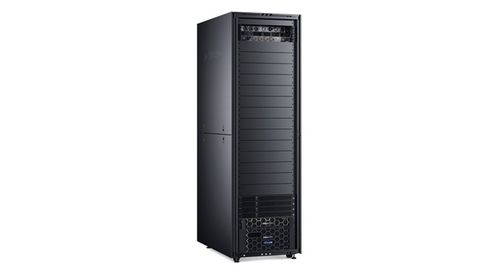
A deep learning solution developed by Dell EMC and Nvidia is based on PowerEdge servers from Dell EMC and Nvidia Tesla V100 graphics processors with Tensor computing units.
© Dell EMCThe strength of Hadoop is the use of 'schema on read'. With a data warehouse, you usually need to know what the tables look like before they are loaded. Hadoop is able to pull data from any source or type; only then do users figure out how they want to organize the data. Companies therefore use Hadoop as a cost-efficient 'warehouse' for all types of data. This type of storage is often referred to as a Hadoop Data Lake. However, the Hadoop Map Reduce Engine for parallel processing of large amounts of data is not suitable for iterative processing, as is often required for data analytics. Hadoop is therefore best suited for batch processing.
The storage systems also offer parallel, high-performance access to all data in the storage system, which is important for applications in the field of machine learning and deep learning. This plays an important role in the use of AI frameworks such as TensorFlow or Caffe.
There will also be ready-to-use solutions for machine learning based on Hadoop in the foreseeable future. They are based on servers with scalable storage performance and include data science and framework optimization for rapid commissioning. This enables the expansion of existing Hadoop environments for machine learning. For example, the Cloudera Data Science Workbench and the open source unified data analytics engine Apache Spark can be used for fast and secure self-service data collection in the company.
Author:
Fisnik Kraja is Solution Consultant High Performance Computing and Machine Learning at Dell EMC.
Important tools for deep learning
The following frameworks and libraries can help users build and implement AI solutions:
- BigDL: a distributed deep learning library for Apache Spark that runs on Spark or Hadoop clusters. This is an optimized library with functions that are executed very efficiently on the computer core. The library comes from Intel, so these operations are optimized for operation on Intel CPUs.
- Caffe: a deep learning framework developed by the Berkeley Vision and Learning Center (BVLC); Caffe is suitable for deep learning and image recognition, for example. Developers can get started quickly with existing models.
- Intel MKL-DNN (Math Kernel Library for Deep Learning Networks): an open source performance library for accelerating deep learning frameworks on Intel architectures.
- Intel MLSL (Machine Learning Scaling Library): a library that enables efficient implementation of communication patterns.
- Intel Neon: a Python-based and Intel-optimized deep learning framework for neural networks such as AlexNet, Visual Geometry Group (VGG) and GoogLeNet; Neon works well with Intel MKL (Math Kernel Library). The library offers CPU-optimized implementations and uses the vectorization and parallelization functions of the Intel architecture.
- Nvidia cuBLAS library: a GPU-accelerated implementation of the BLAS (Basic Linear Algebra Subroutines) standard. With the cuBLAS APIs, developers can accelerate their applications by implementing compute-intensive operations on a single GPU or distributing the workload across multiple GPUs.
- Nvidia cuDNN (CUDA Deep Neural Network Library): a GPU-accelerated library for deep neural networks. cuDNN works with deep learning frameworks such as Caffe, Caffe2, Chainer, Keras, Matlab, MxNet, TensorFlow and PyTorch.
- Nvidia NCCL (Collective Communication Library): provides routines optimized for high bandwidth over PCIe and NVLink.
- TensorFlow: a software library for numerical calculation using data flow graphs.


You might also be interested in
Quo vadis image processing?
Innovations in the fields of artificial intelligence and embedded vision as well as special processors and development environments for image processing open up a broader spectrum for the technology. An overview.
 read more...
Autonomous thanks to artificial intelligence
Machine vision for reliable quality assurance via plug & play and without a great deal of specialist knowledge - conventional image processing systems are generally a long way from this ideal. A German-Israeli start-up wants to change this.
read more...A direct comparison of solutions
The topic of machine learning raises a number of questions: Which data should be analyzed using which methods? What role does the user play in the data analysis process? And what about the real-time capability, explainability and reliability of the...
read more...The benefits of artificial intelligence for sensor technology
With the technologies and processes of deep learning, industrial sensor technology is on the verge of a far-reaching leap in functionality. Image-based sensors in particular are a field with great potential.
read more...Which gripper for which application?
Advances in the field of end-of-arm tooling (EoAT) make it possible: grippers and sensors are becoming increasingly intelligent and easier to operate. This expands the range of applications for collaborative robots and quickly pays for itself.
read more...Artificial intelligence requires computing power
The integration of AI in industrial applications is increasing the need for computing solutions that can cope with the complexity of the tasks involved. In addition to the CPU, processors specialized in AI algorithms and large amounts of data are...
read more...More usability through AI?
Flexible and cost-transparent booking of temporarily required resources - a promise that cloud providers often fail to keep: Although the offerings are comprehensive and powerful, they are just as confusing and lack transparency in terms of price. A...
read more...The arrival of AI in mechanical engineering
The number of real AI projects in mechanical and plant engineering is still very limited. This will soon change with a new generation of engineers and, above all, with the market launch of corresponding development tools.
read more...Computer-based vision for robotic systems
Computer-based vision is becoming increasingly important for robotic systems. But how can hard real-time applications and time-sensitive networking be combined with vision systems and artificial intelligence (AI)?
read more...