
Belden
SPE - the status quo
The standardization of Single Pair Ethernet is driven by application priorities. How can industry-specific diversification be handled in practice?
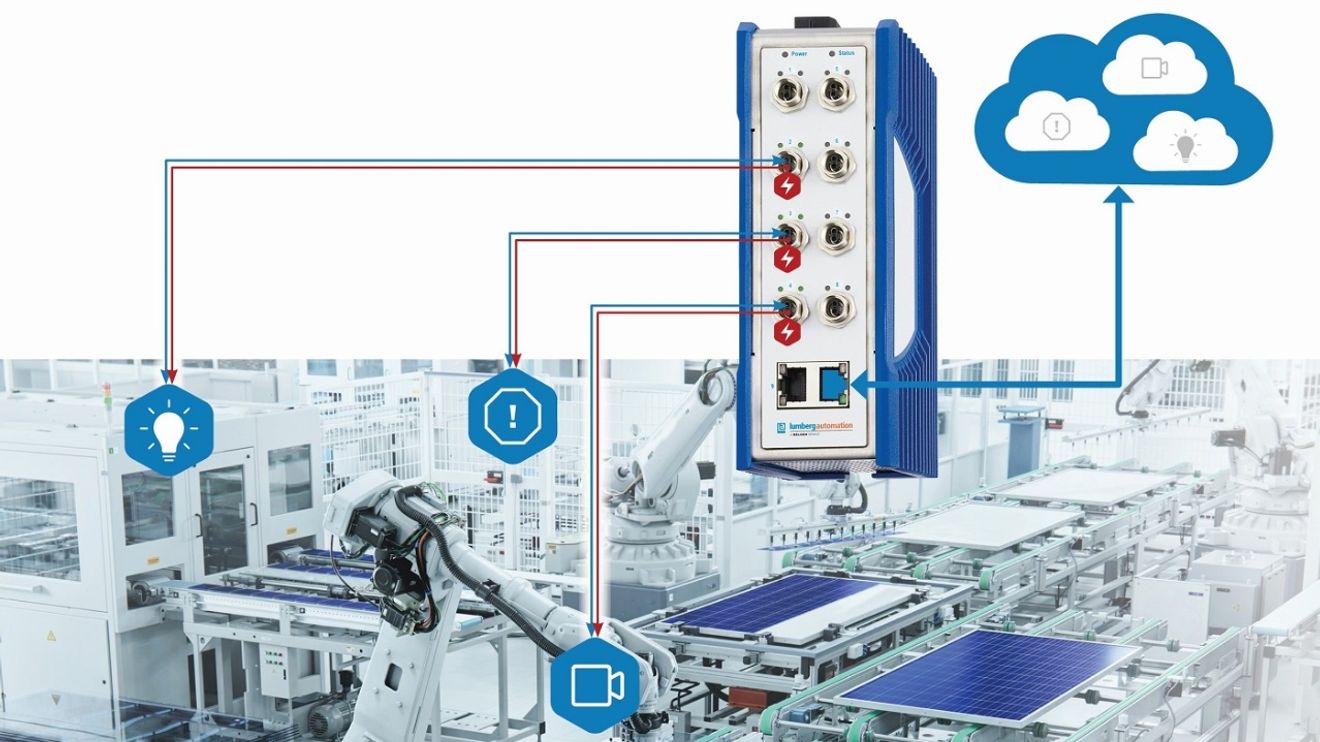
Single-pair Ethernet (SPE) - Ethernet over copper cable with a twisted pair of wires - is a technology for the physical layer that is being standardized by the IEEE 802.3 working group through several projects for various combinations of segment lengths and bandwidths. What is special about these projects is that - in contrast to earlier Ethernet projects - they follow a specific application focus and take industrial environmental requirements into account in their specifications for the first time. For example, the first projects 802.3bw at 100 Mbit/s and 802.3bp at 1 Gbit/s, which were published in 2015 and 2016, were driven by the automotive industry's need for space-saving, lightweight and cost-efficient Ethernet cabling in vehicles. These projects therefore specified 15 m segments with unshielded cables, deviating from the established generic 100 m definitions for copper cables.
Other industries such as discrete manufacturing and transportation beyond automotive - such as agricultural machinery and trucks - were to be served by the addition of a 40 m segment with shielded cables in 802.3bp, but chip manufacturers largely ignored this segment in the specification of SPE transceivers as sales volumes were dominated by demand from the automotive industry.
Application focus
The different application focuses are also reflected in the IEEE 802.3cg standard for 10 Mbit/s published in 2019. In addition to an unshielded 15 m automotive segment 10BASE-T1S, this standard specifies a 1000 m segment 10BASE-T1L, which uses shielded cables and was primarily driven by the process industry. By defining two signal levels, 10BASE-T1L also enables use in potentially explosive atmospheres and thus formed a suitable basis for the development of Ethernet-APL for this industry, which was published in 2021 after the addition of further specifications, for example on conformity tests. The combination of the segment length of 1000 m and the bandwidth of 10 Mbit/s as well as the power supply scheme via the data line defined by Ethernet-APL is ideal for bridging the relatively large distances between instruments such as sensors for recording pressures, temperatures and flows and an aggregation point or control room, while at the same time transmitting data with high bandwidth - compared to traditional fieldbuses. This enables value-added services such as predictive maintenance in addition to data acquisition. It should also be mentioned that the power supply via the data line in Ethernet-APL deviates from the specifications in 802.3bu and 802.3cg (Power over Data Line, PoDL) in order to implement intrinsic safety in accordance with IEC 60079-11 and follows the definitions from the new IEC TS 60079-47 for an intrinsically safe 2-wire Ethernet system (2WISE).
Development of industry-specific segments continues

The ongoing 802.3dg to 100 Mbps project, which is expected to be completed in 2025, is also characterized by different application focuses. For the process industry, a 500 m segment with 100 Mbps is a good complement to 10BASE-T1L for instruments with higher bandwidth requirements. For discrete manufacturing, which traditionally focuses on 100 Mbps, a 100 m segment would be sufficient to provide an alternative to existing multi-pair Ethernet solutions. In addition to the different ranges, the requirements of the two sectors differ in another key aspect: the permissible latency, which must be low, especially for motion control applications in discrete manufacturing. This requirement has an influence on the essential specification in 802.3dg as to whether forward error correction (FEC) must be provided to achieve the required bit error rate, as defined for 10BASE-T1L. FEC is necessary from a process automation perspective, as sufficient transmission quality cannot be guaranteed over a distance of 500 m due to electromagnetic interference. However, the FEC increases the latency and should therefore be avoided from the point of view of discrete manufacturing, which could be achieved by reducing the distance to 100 m and selecting a suitable coding method. Whether the FEC will be specified as an optional feature or whether there will even be two segment definitions is not yet foreseeable at the time of writing this article. What is certain, however, is that there will also be diversification by sector.
SPE in the process industry
The comprehensive specification of Ethernet-APL, including conformity tests for data and power transmission, enables the development of end devices - from instruments and switches - and market access for these. Cable requirements are specified for both existing and new cabling via IEC 61156 with wire diameters from AWG 26 (0.14 mm2) to AWG 14 (2.5 mm2), whereby the cables with AWG 18 to AWG 14 are primarily intended for the realization of the "trunk", i.e. for the connection of APL field switches with the APL power switch. The Ethernet APL specification also contains specifications for connectors as well as screw and clamp terminals. Corresponding specifications can be adopted or adapted for the 100 Mbit/s segment from 802.3dg.
SPE in hybrid manufacturing
Ethernet-APL combines the requirements of the process industry for communication technology with the challenges of potentially explosive environments. In addition, such systems also exist with non-hazardous environments, for example in the food and beverage industry. The requirement for intrinsic safety does not apply here, and PoDL in the form specified by 802.3cg - today also referred to as SPoE (Single-Pair Power over Ethernet) - can therefore be used. Depending on the power consumption of the connected end device and the resulting SPoE class, wire diameters of up to AWG 18 and sometimes AWG 16 are required for longer distances. SPoE according to 802.3cg is directly applicable to the 100 Mbit/s segment from 802.3dg due to its reference to maximum loop resistances.
SPE in discrete manufacturing
For discrete manufacturing, the 10 Mbit/s segment from 802.3cg represents an alternative to IO-Link for connecting sensors and actuators. It is up to the user to make a choice for their individual application based on the advantages of SPE, for example Ethernet to the sensor, range, bandwidth and IO-Link - unshielded cables, lower costs for the end device - provided that a sensor with both options is available.
With the 100 Mbit/s segment from 802.3dg - assuming the realization of an acceptable latency - SPE then also forms an alternative for Multi Pair Ethernet, i.e. in the classic application area of Industrial Ethernet.
Further areas of application for SPE
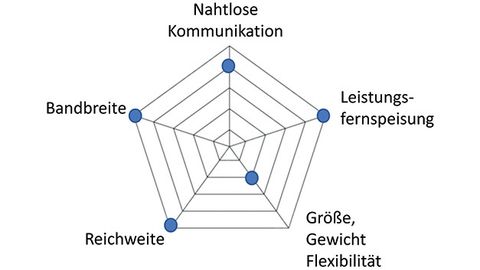
In addition to the process industry and discrete manufacturing, other possible application areas for SPE include building automation, including the optimization of technical building equipment and building monitoring, warehouses with their high racks and conveyor belts, freight and passenger trains. In all cases, the advantages of SPE compared to currently used technologies must be examined and evaluated against the background of customer requirements - and especially so-called pain points. In principle, an evaluation can be carried out using the following five technical features and a spider web diagram (Fig. 2):
- Seamless communication: a transparent Ethernet-based network enables IP-based communication between the end nodes. Heterogeneous networks require gateways to link network segments that limit the visibility and accessibility of the end nodes.
- Bandwidth: Data throughput, for SPE currently 10 Mbit/s to 1000 Mbit/s at various distances to be realized.
- Range: Distances to be realized, related to the bandwidth - often also referred to as bandwidth-range product.
- Remote power: Possibility of transmitting power via the data cores or additional cores of a hybrid cable.
- Physical properties such as size, weight or flexibility of the cable due to smaller cross-sections.
Some advantage combinations can also be achieved using non-SPE Ethernet systems, such as 1+2+3 using Ethernet via fiber optics and 1+2+4 using Ethernet via copper wires. The advantages of SPE only become apparent when another highly relevant feature is added; 1+2+3+4, for example, represents the advantageous combination of Ethernet-APL. In areas with limited space, the combination 1+2+5 is relevant. As a result, either the 1000 Mbit/s/40 m segment, the 10 Mbit/s/1000 m segment or the 100 Mbit/s segment could be suitable.
SPE and TSN

SPE enables strong growth in Ethernet-capable devices and open network structures. In particular, the replacement of specialized gateways and the use of switches allows different traffic types with different Quality of Service (QoS) requirements to be mixed. For example, SPE surveillance cameras for processes and building security can use the same infrastructure as sensors and actuators integrated in the control process. However, especially with slower bandwidths and mixed traffic classes, it is difficult to meet the desired QoS requirements. Previous industrial Ethernet protocols are also affected by this, which is why TSN development was started in IEEE 802.1.
Time Sensitive Networking (TSN) is a series of extensions to Ethernet standards that aim to enable deterministic communication over Ethernet networks. TSN provides mechanisms to ensure the transmission of data with strict timing and low latency, making it ideal for real-time applications in various industries. Like Multi-Pair Ethernet, SPE also benefits from these enhancements:
- Improved determinism: TSN introduces mechanisms that make the transmission of time-critical packets more deterministic than with previously available prioritization schemes. Uniform time synchronization also brings advantages for control processes and for the network-wide analysis of sensor data and logs.
- Robustness and reliability: New and standardized redundancy and filter mechanisms promote robustness for critical network segments and specific applications.
- Transparency and scalability: Ethernet networks have the great advantage that theoretically all devices can be addressed directly. At the same time, the subdivision into individual TSN configuration domains offers the advantage of clear assignment and application-specific configuration to ensure scalability.
Diversification of TSN through profiles

To keep the complexity of the new standards as low as possible, various industry-specific TSN profiles are being developed. The IEC/IEEE 60802 TSN profile is specifically designed for automation in discrete manufacturing and forms a solid basis for its implementation in industrial environments. The IEEE 802.1DG Automotive profile and the IEEE 802.1DP Aerospace profile extend the applicability of TSN to the specific requirements and challenges in the automotive and aviation sectors. In addition to reducing complexity, specific properties for the individual sectors are also being standardized. For example, the current version of the IEC/IEEE 60802 profile defines uniform network management using NETCONF and uniform topology detection using LLDP.
Manufacturers seek synergies
An example of a procedure in accordance with point c is an activity in a Profinet working group that aims to supply devices from Ethernet APLs whose power supply is not SPoE-compliant using switches with SPoE interfaces. A corresponding prototype implementation is currently being carried out by Belden on the basis of a Lumberg Automation Beetle SPE Light Managed Switch and will be presented at the Profibus & Profinet International stand at Hannover Messe 2024.

The diversification that begins with the standardization of industry-specific SPE variants in IEEE 802.3 and subsequently manifests itself through the consideration of customer requirements from different industries can be made manageable by manufacturers by:
- Identifying cross-industry commonalities,
- designing devices modularly with the aim of maximizing the reusability of components for different areas of application and/or
- expanding standards so that devices also meet the requirements of other industries.
You can also read this article on page 54 in the e-paper of our 4/24 issue
Read more about Belden here.


You might also be interested in
Smart control cabinets thanks to new Ethernet/IP technology
Rockwell Automation is launching an Ethernet/IP control cabinet solution. The aim of this further development is to meet the growing demand for smarter, faster and better networked production processes.
 read more...
SPE switch for cost-efficient cabling
Single Pair Ethernet (SPE) is making its way into the ICP Germany portfolio. The 'ITPS-141TX' is a 5-port unmanaged SPE switch.
read more...Unmanaged SPE switch
The new unmanaged switch '10Base-T1L SPE' from Weidmüller offers a range of one kilometer and power transmission with class A Profinet conformity.
read more...Solutions for more interoperability in the industrial Internet
In Industry 4.0, sub-processes are being integrated ever more deeply and access to data is being improved in order to optimize workflows. Communication in the infrastructure plays a decisive role, and seamless integration and interoperability are...
read more...The top articles in July 2024
Innovative spirit and entrepreneurial thinking characterize the most-read articles from July. Find out more about competitive advantages through AI, click through award-winning developments and read more about model-based design and quantum sensor...
read more...New management for Asia-Pacific business
Mabel Low takes over the position of Managing Director and Corporate Regional Manager at Harting Singapore Pte. Ltd.
read more...TSN - backbone for virtualized control systems?
It is currently a major vision: the virtualization of control systems. This and the next article in this series will address this topic. The decisive prerequisite and content of this article is the connectivity of the control system right down to...
read more...SPE - The cost and benefit aspects
Single Pair Ethernet is a technological extension of the Ethernet standard with a lightweight two-wire connection solution. But where can its use actually be expected for economic reasons? What hurdles still need to be overcome?
read more...Industrial Ethernet dominates
Every year, HMS Networks conducts a market analysis of industrial networks. The latest study shows that the market for industrial networks is continuing to expand, with expected growth of 7% in 2024.
read more...