

Advertorial
Solutions for more interoperability in the industrial Internet
In Industry 4.0, sub-processes are being integrated ever more deeply and access to data is being improved in order to optimize workflows. Communication in the infrastructure plays a decisive role, and seamless integration and interoperability are particularly important.

Industrial communication networks are currently becoming increasingly complex and the number of devices in decentralized networks is growing.
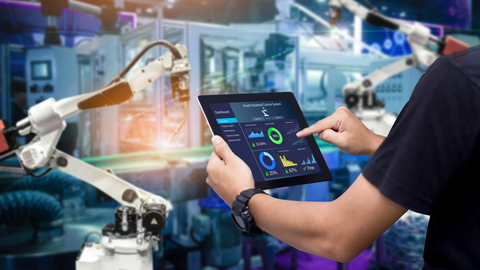
Modularity, flexibility and mobility with new connection solutions and wireless devices.
© TE ConnectivityDriven by the Industrial Internet of Things (IIoT) and machine-to-machine (M2M) communication, the trend in Industry 4.0 is increasingly moving towards decentralized solutions. Wired connection solutions and wireless devices enable new applications and functions. Modularity, flexibility and mobility are currently the most important keywords in the manufacturing industry.
A recognizable trend is data processing and transmission from and to any device (cloud/edge computing). In the future, decentralized systems - based on clusters or subsystems - will take over real-time communication. The increasing interactions between these subsystems will lead to a merging of IT (information technology) and OT (operational technology).
Reliable connectivity and good data continuity from the sensor to the cloud is now more important than ever. Technological innovations such as Single Pair Ethernet (SPE), 5G and interfaces at PCB level are becoming increasingly important in order to better support interactions between subsystems.
The RJ45 is no longer the first choice
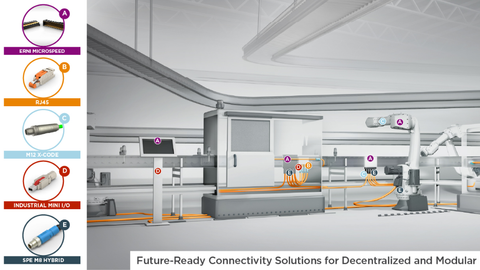
Ethernet connectors from TE for virtually seamless M2M communication and a future-oriented, largely barrier-free system from the sensor to the cloud.
© TEMany of the bus systems currently in use only transmit signals with a delay and therefore do not offer any options for real-time decisions. Field devices such as sensors and actuators are often unable to communicate directly with other network participants, as analog technologies and fieldbuses do not "speak the same language" as (high-speed) Ethernet. Gateways are then usually used, but this is a suboptimal solution due to additional installations and costs. It is therefore necessary to rethink and use new technologies that avoid these problems.
The RJ45 connector is the most commonly used connection for data communication today and is considered the standard communication interface for industrial applications. While a standard RJ45 connection was sufficient in the past, RJ45 interfaces are now reaching their limits as a connection standard due to increased requirements for industrial communication.
The usual 2- or 4-pair Ethernet cables are also considered unwieldy today when it comes to bringing Ethernet-based communication to the last corner of production, possibly to the gripper on the robot and to the tool. At the same time, the demand for dust and water-resistant connection solutions with IP67 protection that are suitable for harsh industrial environments is increasing. This does not mean that standard interfaces such as the M12-D or M12-X coded and the RJ45 are being completely replaced. The different connector technologies complement rather than replace each other.
New connection solutions are becoming more and more widespread
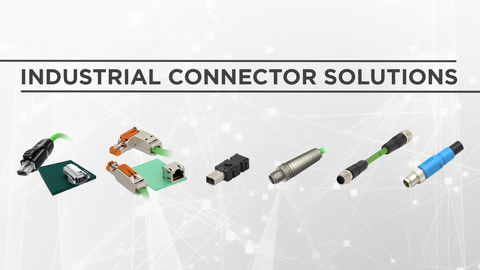
TE's solution portfolio of connectors covers almost all requirements for end-to-end connectivity in the industrial environment from the edge to the cloud.
© TE ConnectivityFar greater opportunities can be unlocked when small, robust and powerful connectors that require less material are used to optimize production environments. High data rate communication modules are becoming smaller and smaller and are expected to be easily integrated into machines. TE Connectivity 's (TE) Mini I/O and SPE connectors, for example, are ideal for such applications.
Hybrid Single Pair Ethernet and the switch from standard Gigabit Ethernet and fieldbus systems to SPE are also currently considered a major breakthrough in improving M2M communication and providing greater interoperability. TE has been one of the innovation drivers in the SPE Industrial Partner Network from the very beginning and has been actively involved in standardization as part of the committee work. The SPE standard enables virtually barrier-free communication of field devices through all levels of automation and communication.
SPE closes the communication gap at field device level and makes M2M communication more transparent. It is a connectivity solution for the simultaneous transmission of energy and data - a good basis for advancing the IIoT. Hybrid SPE technologies enable a forward-looking, future-oriented approach, reduce cabling costs and save valuable company resources.
SPE ecosystem continues to grow
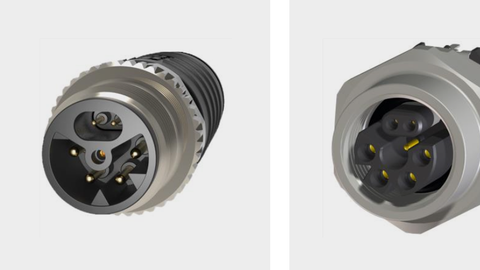
TE has also recently launched SPE hybrid connectors in the M12 form factor in accordance with IEC 63171-7.
© TE ConnectivityTE's shielded M8 hybrid connectors and hybrid cables enable data transmission up to 1 Gbps and power up to 400W. TE also offers active and passive network components such as splitters and switches within its SPE ecosystem to support flexible expansion of the network infrastructure by adding network components, for example for multi-drop topologies with up to 8 network nodes at distances up to 25 meters.
TE's active SPE network components support both the M8 and the new M12 connectors. An M12 connector can transmit a higher voltage and current than an M8 connector due to its larger size. TE offers M12 hybrid connectors in accordance with IEC 63171-7 for applications with high-speed data rates up to 1 Gbit/s (600 MHz) and power classes up to 9.6 kW, 16 A and 600 V. This means that more powerful devices can now also be operated with SPE connectivity.
With TE's M8 and M12 SPE solutions, engineers can implement M2M communication with virtually no data loss, decentralize computing power and transmit data more efficiently and transparently to the edge. The long-requested continuity from the field devices to the cloud is now becoming a reality. In addition, the widespread use of M8 and M12 connections in the industry enables simple and fast integration of the new SPE connections in the identical format.
Conclusion
SPE is a further step towards better exploiting the potential of Industry 4.0. The lean, lightweight yet powerful SPE networking solution offers companies the opportunity to digitize at field level. Specialists at TE are focused on bringing a wide range of hybrid technologies to market for complete automation and control, including potential applications with M17, M23 and even M40 form factors. At the same time, TE is working on intelligent connectors with additional features to help engineers, manufacturers, and fulfillment and distribution centers achieve their digitization and automation goals.
Further information on TE's industrial SPE hybrid connectors and network components can be found HERE.
Follow TE Connectivity on social networks too


You might also be interested in
Smart control cabinets thanks to new Ethernet/IP technology
Rockwell Automation is launching an Ethernet/IP control cabinet solution. The aim of this further development is to meet the growing demand for smarter, faster and better networked production processes.
 read more...
SPE switch for cost-efficient cabling
Single Pair Ethernet (SPE) is making its way into the ICP Germany portfolio. The 'ITPS-141TX' is a 5-port unmanaged SPE switch.
read more...Unmanaged SPE switch
The new unmanaged switch '10Base-T1L SPE' from Weidmüller offers a range of one kilometer and power transmission with class A Profinet conformity.
read more...The top articles in July 2024
Innovative spirit and entrepreneurial thinking characterize the most-read articles from July. Find out more about competitive advantages through AI, click through award-winning developments and read more about model-based design and quantum sensor...
read more...New management for Asia-Pacific business
Mabel Low takes over the position of Managing Director and Corporate Regional Manager at Harting Singapore Pte. Ltd.
read more...TSN - backbone for virtualized control systems?
It is currently a major vision: the virtualization of control systems. This and the next article in this series will address this topic. The decisive prerequisite and content of this article is the connectivity of the control system right down to...
read more...SPE - The cost and benefit aspects
Single Pair Ethernet is a technological extension of the Ethernet standard with a lightweight two-wire connection solution. But where can its use actually be expected for economic reasons? What hurdles still need to be overcome?
read more...Industrial Ethernet dominates
Every year, HMS Networks conducts a market analysis of industrial networks. The latest study shows that the market for industrial networks is continuing to expand, with expected growth of 7% in 2024.
read more...The path to open systems
The use of Single-Pair Ethernet (SPE) is particularly useful in combination with norms and standards that define the system properties beyond the physical connection technology and thus enable open and interoperable systems.
read more...