
Perinet
Production data directly into the IT
Process automation in the Industry 4.0 environment requires all important information about the production process in real time. Smart sensors enable a direct 'online' connection between OT and IT, even in the brownfield.
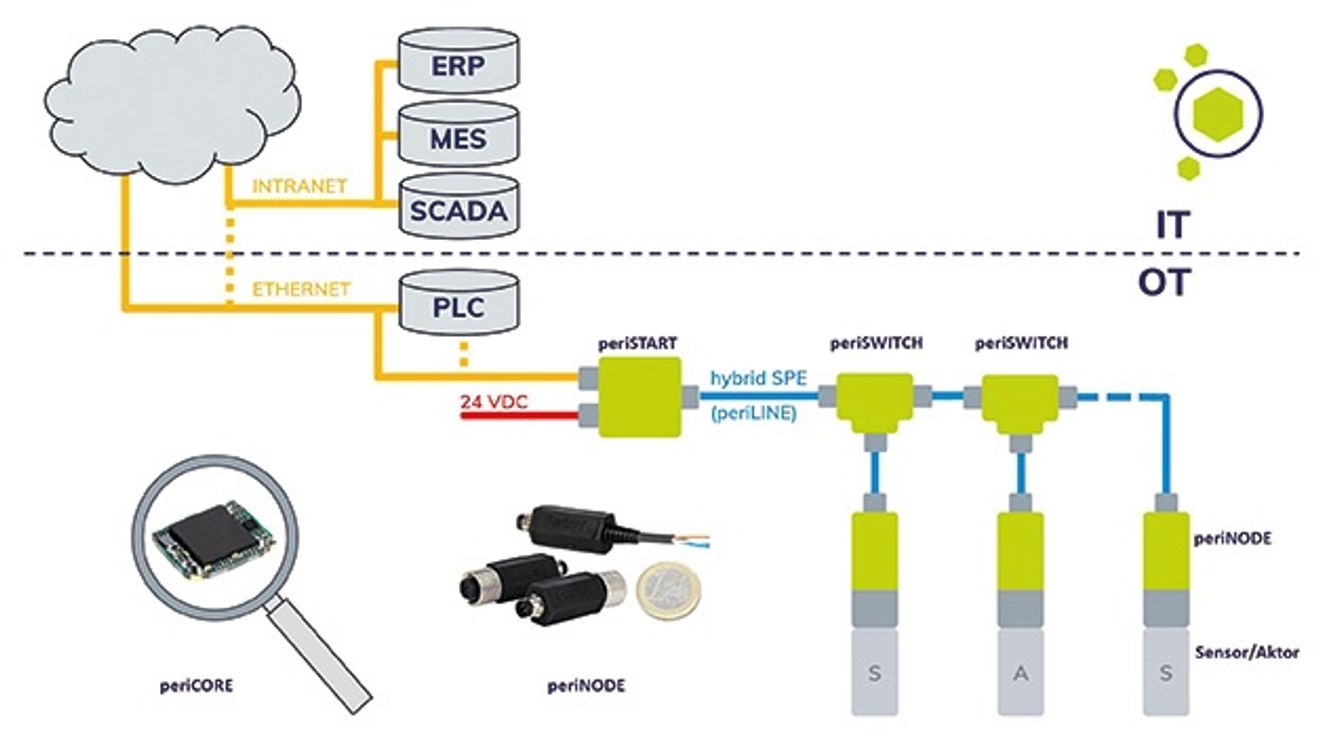
Newly planned systems - greenfield - in automation and production technology are easy to connect to IT in the age of Industry 4.0. They communicate in service-oriented architectures (SOA) such as OPC/UA with powerful interfaces via intranet or internet from the control level (PLC) directly with the upper levels of information technology (IT). These three upper levels of the information pyramid include Enterprise Resource Planning (ERP), Manufacturing Execution System (MES) and process visualization/control (HMI/SCADA). The systems at these levels have been communicating with each other for years via the Internet Protocol (IP), which is part of the classic Ethernet or Internet for internal and external company networking. Detailed replicas of the machines in software as digital twins can be operated directly via these interfaces or supplied with data directly from the systems.
The challenge of existing systems
However, the majority of systems in the field consist of brownfield systems that do not yet have these capabilities. However, these systems also require extensive data on operating statuses and material flows for optimum operation. With continuous monitoring of the corresponding machine data, additional value-added functions such as predictive maintenance or specific billing models (pay-per-use) can be implemented. This rarely requires a complete, complex digital twin to be created; in many cases, it is sufficient to report the key information about operating statuses and production progress back to the relevant planning and control software in a timely manner.
Ideally, the sensors, actuators and assemblies required for this already exist. Otherwise, they can - and must - be retrofitted. However, even if suitable sensor elements already exist, their measured values can rarely be read out directly. Instead, the data must be converted not only physically but also at protocol level using gateways. The use of existing bus systems for connecting additional sensors often fails due to a lack of connection options, insufficient maximum bus lengths or low data rates. This can be remedied by installing additional smart sensors.
'Smart sensors' are complete microsystems ('sensor nodes') that can read, store and process analog measured values from their integrated sensor. The current measured value is either displayed directly or converted into an electronically processable format. Unfortunately, smart sensors are currently still relatively expensive and only available for a few sensor functions. To make matters worse, most sensor manufacturers have developed their own interfaces and user interfaces for operation and configuration, which can make the operation and maintenance of networks with smart sensors from different manufacturers complicated.
On the bus side, the market offers various fieldbus interfaces, meaning that a more or less complex gateway is required for the transition to the 'normal', TCP/IP-based IT inter- or intranet. To make matters worse, the cabling between the smart sensors is also relatively expensive and inflexible - and often involves additional cabling for the power supply. Single Pair Ethernet (SPE), which is increasingly gaining a foothold in industrial and building automation, promises to provide a remedy here.
Data highway Single Pair Ethernet
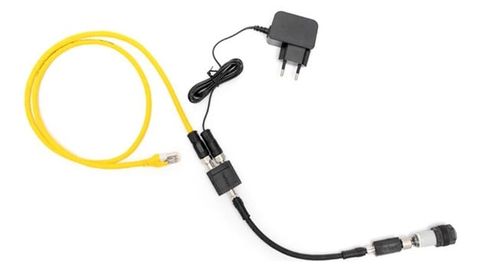
In the simplest case, a starter kit consists of a 'dumb' sensor, a Perinode sensor interface containing the smart communication module, a Peristart media converter, a power source and two Ethernet cables - a hybrid SPE cable to connect the components and another Ethernet cable for connection to a standard Ethernet network, an edge computer or a gateway.
© Wencke Lieber PhotographyAs a directly IP-compatible variant, SPE has now established itself as the standard in harsh industrial environments, not least thanks to small bending radii and small cable diameters. Another advantage is that existing cables can also be used: In addition to shielded and unshielded Cat5 connections, even simple twisted cables ('bell wire') allow successful communication with SPE. In practice, connection lengths are possible that go far beyond the data of the current (2023) SPE specifications. When using 100BaseT1, for example, maximum segment lengths of up to 300 m (Cat5) or up to around 100 m (bell wire) are possible. With the hybrid version of SPE with an additional wire pair, practically any topology and an electrically isolated, interference-free power supply for additional electronics with up to 400 W can be realized. SPE is therefore ideal for both old and new networks as a basis for networking sensor nodes at field level. However, there is still one drawback: the number of integrated sensor solutions that can be connected directly to an Ethernet-based network is still limited, and the few available sensors with a (single pair) Ethernet interface are relatively expensive.
Bridge between SPE and sensors
The SPE communication module from Perinet aims to remedy this situation by acting as an intelligent gateway that bridges the gap between SPE and almost any type of sensor. It is currently available in two different designs: as a SOC board (Pericore) or embedded in a 4-pin SPE M8 round connector or adapter (Perinode). Different adapter versions are available to suit the respective sensor connections: with 4-pin M12 sensor plug (A-coded) for Pt100 sensors, with 4-pin M12 sensor plug (A-coded) for 0 to 10 V voltage interfaces or with four connection cables for GPIO interfaces. Regardless of the design of the modules, they can be addressed and configured via the SPE connection using any web browser.
In addition to level and protocol conversion, the integrated ARM SoC offers further smart functions thanks to its integrated microserver and a 256-bit encryption module: Sensor signals can be converted into digital data records that can be used directly by IT and can also be pre-processed, consolidated, converted into data and temporarily stored. This significantly reduces the amount of data to be transmitted. The ability for time and event-controlled communication enables the implementation of standard and proprietary protocols. With the locally available computing and storage options, sensors can be calibrated and calibrated with little effort, whereby in most cases it is sufficient to configure the ready-to-use pre-configured 'Pericore' or 'Perinode' systems using low-code.
Plug and Play

The operating system itself, including the local web server (microserver), is provided and maintained by Perinet. This includes the complete network functionality, firmware management and all security functions from certificate management to 256-bit end-to-end encryption. For special adaptations, the modules can also be expanded with your own electronics on the hardware side. On the software side, a ready-made development environment with debugger, board support packages and reference implementations support your own developments. This means that commercially available sensors can be made 'smart' with little effort and connected directly to the IT system via SPE. The Perinet Smart Nodes Pericore and Perinode communicate directly and securely with the respective IT system via standardized IP packets without media discontinuity or additional gateways. The 'PKI2go' software solution enables the application of zero-trust security concepts right down to field level. This means that data is protected right from the sensor.


You might also be interested in
Siemens continues to grow and starts buyback
With a record order backlog, higher free cash flow and a new share buyback program of up to €6 billion, Siemens is continuing its growth trajectory in the second quarter of 2026.
 read more...
KIT is a national leader in quantum technologies
Whether enormous computing power, ultra-precise sensors or cutting-edge encryption: quantum technologies promise ground-breaking applications. An international ranking by the think tank European Centre for International Political Economy (ECIPE)...
read more...House of Digital Transformation (HoDT)
Application center for AI and quantum computing
The vision of the planned innovation center for artificial intelligence and quantum computing in Frankfurt is to bring future technologies into commercial application. Following the pre-opening of the center in collaboration with the start-up...
read more...New Management Board strengthens digitization in the SME sector
The Industry 4.0 initiative SEF Smart Electronic Factory e.V. confirms Gerd Ohl, Prof. Dr. Gerrit Sames and Ulrike Peter on the Board of Directors. Uwe Jörk was newly appointed. Focus: practical digitalization, use of AI and automation for SMEs.
read more...Deutsche Telekom and Nvidia launch one of Europe's largest AI factories
With the Industrial AI Cloud in Munich, Deutsche Telekom and Nvidia are creating one of the largest AI factories in Europe. Companies can train AI models, carry out simulations and access 10,000 GPUs.
read more...Kubermatic and Flecs simplify app management
Kubermatic and Flecs will work together in the future to make industrial applications easier to provide and production environments more flexible to control.
read more...Dassault Systèmes takes over Ascon Qube technology
Dassault Systèmes is strengthening its strategy for virtual twins and integrating Ascon Qube technology into its Delmia portfolio. The acquisition is intended to provide companies with more flexible and AI-supported production control.
read more...SMEs drive key technologies forward more than corporations
The digital transformation of German industry is making tangible progress - but it is not onlylarge corporations that are focusing on future technologies such as artificial intelligence (AI), the Industrial Internet of Things (IIoT) and autonomous...
read more...Measuring the performance of AI agents
Pendo has introduced 'Agent Analytics', a solution that makes the performance of AI agents measurable.
read more...