
International ranking
KIT is a national leader in quantum technologies
Whether enormous computing power, ultra-precise sensors or cutting-edge encryption: quantum technologies promise ground-breaking applications. An international ranking by the think tank European Centre for International Political Economy (ECIPE) puts Karlsruhe, with the Karlsruhe Institute of Technology (KIT) as the central player, at the top of the list nationwide. The city is ranked seventh worldwide and second within the EU.
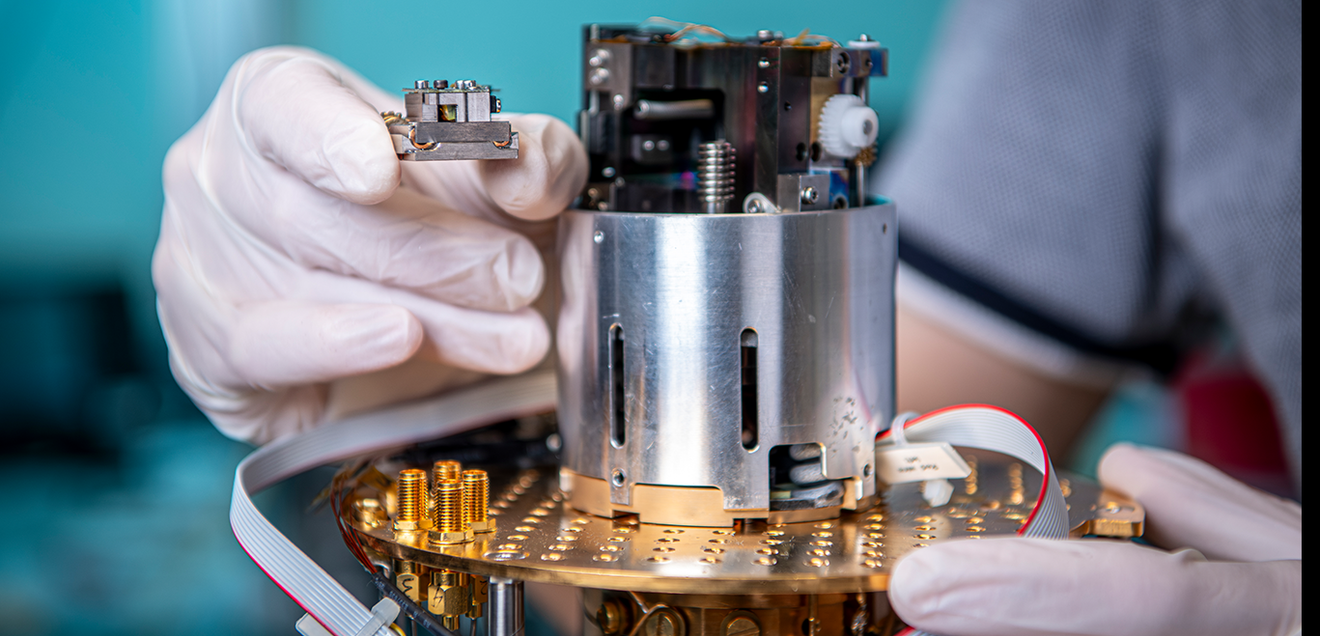
"The classification as the most important quantum cluster in Germany and the second strongest in the European Union underlines the national and international appeal of our location," says Professor Oliver Kraft, Vice President Research, Teaching and Academic Affairs at KIT. "It confirms our long-term approach of closely interlinking basic research, application-oriented development and industrial implementation."
According to the ECIPE ranking, the quantum location Karlsruhe is characterized in particular by its high mediation power. It highlights the KIT as a "Top Research Collaborator". In the sub-category "external collaborations", the city is ranked first worldwide, and third in the overall ranking of all collaborations. In addition, the study attests the quantum cluster in Karlsruhe second place for its ability to build bridges between otherwise separate scientific and technological communities ("bridging power"). According to the authors, this is the first international ranking that compares quantum locations according to market focus, cooperation and degree of maturity. Around 130 locations worldwide were analyzed.
Quantum research at KIT
Quantum technology research at KIT covers a broad spectrum - from basic research on quantum materials to the development and realization of application-oriented systems for future technologies. Key topics include quantum materials and their integration into functional devices, including quantum spintronics and molecular quantum spin systems, superconducting quantum circuits and hybrid quantum architectures that couple spins, photons and superconducting circuits, and with which the researchers transfer, test and further develop quantum keys.
One of the most significant breakthroughs of recent years has been the discovery of a new class of optically addressable molecular spins with exceptional optical coherence. To demonstrate the potential of these systems for quantum communication, the KIT researchers have set up a 20 km long fiber optic link between the North Campus and the South Campus of the KIT, which the researchers use to transmit, test and further develop keys. They also want to set up a quantum network that will enable quantum computers to be linked, among other things. In parallel, the scientists are researching the optical readout of quantum systems and the coupling of molecular nanostructures with photons - decisive steps on the way to scalable quantum architectures.


You might also be interested in
A quantum computer that performs calculations using oscillations
When it comes to storing information, quantum computers have so far run up against technical limitations. Instead of electromagnetic storage, researchers are now using mechanical vibrations. Their vibrating memory can store significantly more...
 read more...
Smart chips for greater energy efficiency
In the AI lighthouse project "eki", a research team led by the University of Paderborn has been working on improving the energy efficiency of AI systems and developing methods that can reduce the energy consumption of AI by up to 90 percent. Special...
read more...Despite heat and dust in the field
The embedded computer 'NRU-160-FT' from Neousys can be installed in dustproof or waterproof housings and uses their walls to dissipate heat.
read more...Edge AI HPCs for Vision AI and GenAI
Advantech has announced the 'AIR-410' and 'AIR-420', next-generation compact Edge AI high performance computers (HPCs). Combining AMD Ryzen 7000/8000/9000 series processors, scalable GPU support and Advantech's 'Edge AI SDK' software, the systems...
read more...House of Digital Transformation (HoDT)
Application center for AI and quantum computing
The vision of the planned innovation center for artificial intelligence and quantum computing in Frankfurt is to bring future technologies into commercial application. Following the pre-opening of the center in collaboration with the start-up...
read more...Bachmann electronic at the SPS 2025
Panel PC with scalable equipment
Bachmann is launching a new product family of panel PCs onto the market: the 'PPC1200' will replace the established 'OT1200' in the course of 2026.
read more...Partnership for modular and secure edge solutions
Bosch Rexroth and Advantech are cooperating on edge solutions and offering a ready-to-use platform for industrial applications. Customers benefit from the combination of Bosch Rexroth's open and app-based operating system 'ctrlX OS' with ecosystem...
read more...Embedded PC for edge AI
Bressner is expanding its embedded portfolio with the 'Nuvo-11531' series from Neousys Technology.
read more...Functional Safety - Works!
With the certified safety modular system from Neuron Automation, OEMs can implement functionally safe control solutions faster, more flexibly and more cost-effectively - from hardware and firmware to the application. Functional safety 'in time', 'in...
read more...