

Ethernet / Fieldbuses
Market shares of industrial networks 2019
Industrial Ethernet and wireless networks continue to grow rapidly, while fieldbuses declined for the first time in 2019. This is the conclusion reached by HMS Industrial Networks in its annual evaluation of the network market.
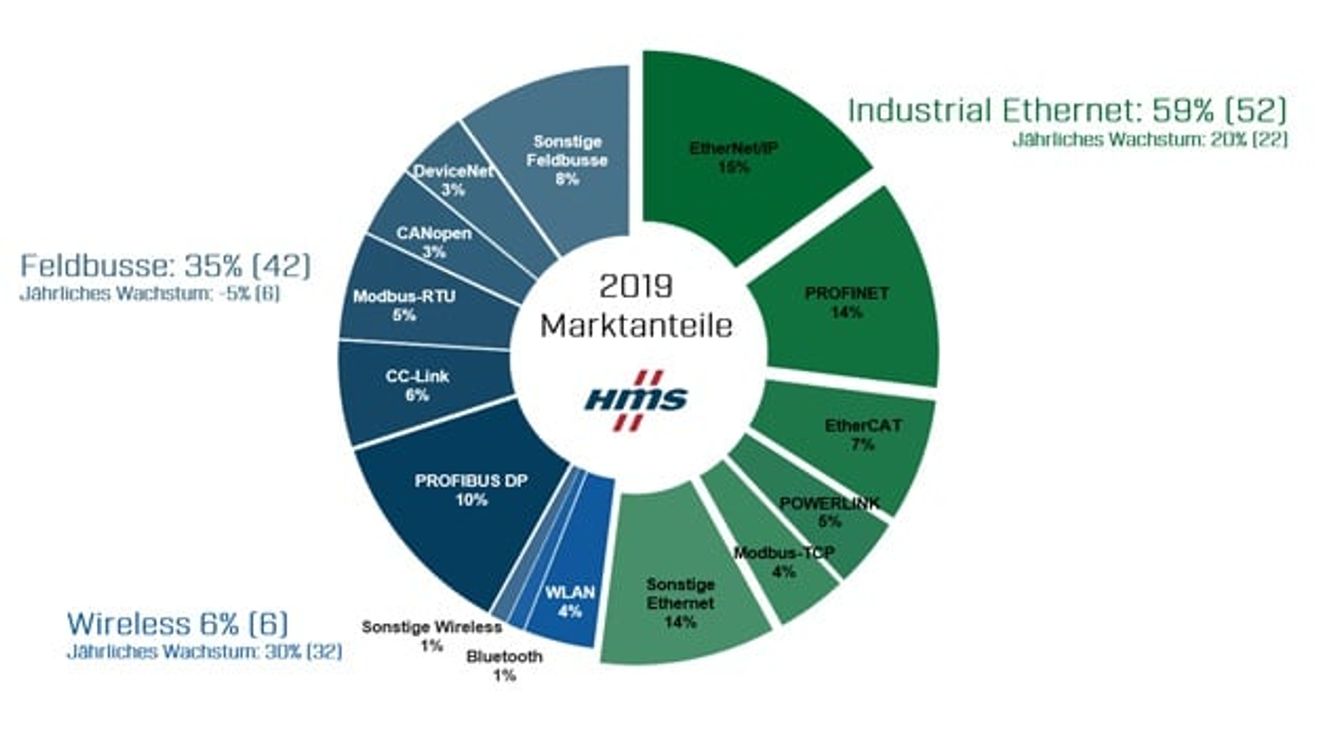
The number of industrial devices connected to industrial networks continues to rise. HMS expects the number of new nodes to increase by around 10% in 2019. Industrial Ethernet is therefore growing by 20% (previous year: 22%) and now accounts for 59% of newly installed nodes (previous year: 52%), while fieldbuses account for 35% (previous year: 42%). At 15%, EtherNet/IP is still the most common network, closely followed by Profinet at 14%. Ethercat is also widespread with a market share of 7%, Ethernet Powerlink with 5% and Modbus-TCP with 4%, all of which are showing stable growth. Wireless technologies continue to develop strongly and account for 6% of the market (previous year: 6%).
The study includes HMS estimates for 2019 based on newly installed nodes in the factory automation sector in 2018. A node is defined as a machine or device that is connected to an industrial network. The figures are a consolidated view of HMS based on its own sales statistics, the insights of colleagues in the industry and the overall perception of the market.
Industrial Ethernet vs. fieldbuses - an assessment
"The transition to Industrial Ethernet is continuing. The main drivers for this are that users need high performance on the one hand and want to connect factory installations with IT systems or IIoT applications on the other," says Thilo Döring, Managing Director of HMS in Germany. "For the first time, we are observing that traditional fieldbuses are declining in terms of new installed nodes. In Industrial Ethernet, we are seeing good growth in many networks - both in the established networks such as EtherNet/IP, PROFINET, EtherCAT, POWERLINK and Modbus-TCP and in the networks that we have grouped together in the 'Other Ethernet' category. This fragmented Ethernet picture is very interesting. It shows that Industrial Ethernet was never standardized into a single network - something many predicted back in the 1990s when Ethernet-based networks emerged. As with fieldbuses, which network is most suitable in each case depends on the industrial application, among other things."
Wireless technologies continue to gain ground
According to HMS, wireless technologies recorded growth of 30% (previous year: 32%). WLAN is the most widespread wireless technology, followed by Bluetooth. "Wireless is increasingly being used by machine builders and system integrators to implement innovative automation architectures. Users can reduce cabling costs and implement new solutions for connectivity and control," says Thilo Döring and adds: "We are also seeing increasing activity around mobile technologies worldwide - for example private LTE/5G networks - which can pave the way for smart and even more flexible production in factories."
Regional differences
EtherNet/IP and Profinet are leading in Europe and the Middle East. Profibus is also still widely used there. Ethercat and Ethernet Powerlink are also frequently used. The US market is dominated by CIP networks, with a clear shift towards EtherNet/IP. Ethercat continues to gain market share there. In Asia, no network is the market leader, but Profinet, EtherNet/IP, Profibus, Ethercat, Modbus and CC-Link are widely used. The Ethernet version CC-Link IE Field also continues to gain in importance.


You might also be interested in
News from the area of networking
What is currently happening in the fieldbus, Ethernet and wireless sectors? Computer&AUTOMATION has compiled new products in a picture gallery.
 read more...
What comes with Single Pair Ethernet?
Single Pair Ethernet - SPE for short - is a hotly debated topic in industrial data transmission. Why is this Ethernet variant such an important component of future automation technology?
read more...The industry plans (too little) with 5G
German industry sees great opportunities in the upcoming 5G mobile communications standard. And yet, in the opinion of the digital association Bitkom, too few companies are still dealing with the actual 5G supply.
read more...Data transmission / architecture
5G transmission masts of the future made of wood?
The new 5G wireless standard aims to make communication and data transmission faster and more efficient. One prerequisite for this is sufficient transmission masts. The TU Kaiserslautern has investigated how these can be integrated inconspicuously...
read more...Data pipeline ASi-5
High data width, short cycle times, improved integration of intelligent sensors and actuators using IO-Link and cloud connectivity via OPC UA - ASi-5 makes AS-Interface fit for the requirements of digitalization.
read more...The face of the FLC initiative
At SPS IPC Drives 2018, the OPC Foundation presented the 'Field Level Communication' initiative - FLC for short. Since the Hannover Messe, the initiative has had a director, Peter Lutz, who explains the background to the OPCF's new management...
read more...Upgrading HART devices for fieldbuses
A fieldbus interface that can be integrated into devices and configured via a script enables analog transmitters with a HART interface, for example, to be upgraded cost-effectively for operation on Foundation Fieldbus and Profibus PA.
read more...Second test laboratory in China
At the end of May 2024, the China-based company Nanjing Loyst Industrial Networks was recognized as a new IO-Link test lab. This brings the number of IO-Link test labs worldwide to four.
read more...Second Test Lab in China
At the end of May 2024, the China-based company Nanjing Loyst Industrial Networks was recognized as a new IO-Link test lab. This brings the number of IO-Link test labs worldwide to four.
read more...