
Industrial networks 2021
Market distribution worldwide
HMS Networks collects data on the market for industrial networks as part of an annual study. According to this year's study, the market for industrial networks is expected to grow by 6% in 2021 despite the coronavirus pandemic.

According to the study, the market for industrial networks appears to have stabilized again. HMS expects the market to grow by 6% overall in 2021. With growth of 8%, the market share of Industrial Ethernet continues to increase. Industrial Ethernet now accounts for 65% of the global market for newly installed nodes in factory automation (64% in the previous year).
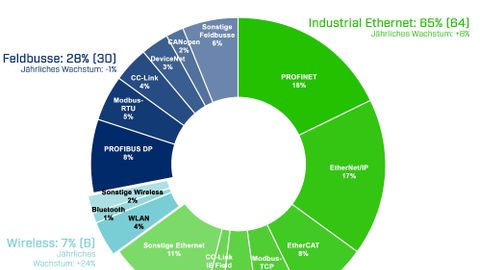
Market shares of industrial networks 2021 from the perspective of HMS Networks - Fieldbuses, Industrial Ethernet and Wireless
© HMS Industrial NetworksEtherNet/IP and Profinet are competing for the largest market share. This year, Profinet has an 18% market share, ahead of EtherNet/IP, which has a 17% market share. EtherCAT is also gaining ground worldwide and now has a market share of 8%, which corresponds to the leading fieldbus Profibus. It is followed by Modbus TCP with a market share of 5 %. Together with the Modbus-RTU fieldbus, Modbus technologies now account for 10 % of the market. This demonstrates their continued importance for factory installations around the world.
Downward trend in fieldbus halted
The downward trend in fieldbuses observed by HMS in recent years now appears to have almost come to a halt. With a decline of only 1% in 2021, as factories increasingly rely on existing technologies in uncertain times such as the pandemic. The market share for fieldbuses is currently 28% of all newly installed nodes (30% in the previous year). Profibus is the leading fieldbus with a market share of 8%, followed by Modbus-RTU and CC-Link with shares of 5% and 4% respectively.
Wireless technology fixed size
Wireless networking technologies continue to grow rapidly at a rate of 24%. Currently, the market share of wireless technologies is 7%. However, this does not yet reflect the full impact of 5G in factories. With continued activity around wireless technologies as the foundation for the next stage of smart manufacturing, HMS expects demand for wirelessly connected devices and machines to continue to grow and become part of the less wired, more flexible automation architectures of the future.
Regional differences
EtherNet/IP and Profinet are the leading technologies in Europe and the Middle East, closely followed by Profibus and EtherCAT. Other popular network technologies are Modbus (RTU/TCP) and Ethernet Powerlink. In contrast, EtherNet/IP dominates the US market and EtherCAT's market share continues to grow there. In the fragmented Asian market, Profinet and EtherNet/IP are leading, followed by CC-Link/CC-Link IE Field, Profibus, EtherCAT and Modbus (RTU/TCP).


You might also be interested in
Breaking the 100 million barrier
The total number of Profibus and Profinet products installed in systems has exceeded an impressive threshold of 104 million. Profinet has reached its highest annual figure to date with 7.3 million products launched on the market.
 read more...
Industrial Ethernet continues to gain ground
The market share of Industrial Ethernet in terms of newly installed nodes in factory automation has risen to currently 64%. Fieldbuses, on the other hand, fell from 35% to 30%, while the market share of wireless technologies remained stable at 6%.
read more...Hans Seifert to Become Chief Sales Officer
Sigmatek has appointed Hans Seifert as Chief Sales Officer (CSO). His area of responsibility includes international sales, marketing, application engineering, and support.
read more...CC-Link certification for modular I/O system
Weidmüller has received the CC-Link Partner Association (CLPA) certificate for its modular I/O system 'u-remote'. This makes u-remote the first modular I/O system with official CC-Link IE safety certification for CC-Link IE TSN.
read more...Profibus & Profinet International
MTP Specification 2.0 published
Profibus & Profinet International (PI) announces the official release of the Module Type Package (MTP) Specification 2.0. The MTP 2.0 standard creates the basis for true cross-industry interoperability as well as more flexibility and efficiency...
read more...New analog input modules
MicroControl is launching the next generation of compact analog input modules. The new modules are µCAN.4.ai-BOX for voltage/current, µCAN.4.sg-BOX for strain gauge sensors and µCAN.4.ti-BOX for temperature sensors.
read more...Profibus & Profinet International
Profinet leads the field in industrial Ethernet protocols
A recent analysis by the market research institute Omdia confirms that Profinet is the leading technology in the field of industrial Ethernet protocols. In addition to its broad market penetration, Profinet's consistent focus on security is...
read more...Dual leadership in Shanghai
Stefan Becker has been appointed Managing Director of Eckelmann Automation Technology in Shanghai and will manage the subsidiary together with Zhongwei Huang.
read more...Smart control cabinets thanks to new Ethernet/IP technology
Rockwell Automation is launching an Ethernet/IP control cabinet solution. The aim of this further development is to meet the growing demand for smarter, faster and better networked production processes.
read more...