
Technology & Finance
Investments in next generation technology
Economists agree: drastic measures are needed to put a stop to runaway inflation. Bold and targeted investment decisions in next-generation technology innovations are needed right now.

The impending winter is putting society and the economy under considerable stress. This particularly affects Germany as a business location with its high energy dependency on Russia and its strong value creation in the production sector. Economist Monika Schnitzer, an economist at LMU Munich, recently emphasized in the 'Handelsblatt Disrupt' podcast that although the economy is being put in a headlock by high energy costs, the energy shortage could lead to a "significant boost in efficiency" in the medium to long term. Efficiency through innovation is the order of the day. The economic upheavals and the permanent stress associated with them can be broken down into six challenges: Wars and military conflicts; climate neutrality, digitalization and artificial intelligence; the battle for resources and raw materials; inefficiencies in production, transport and energy, as well as supply chain and technological self-sufficiency. The sword of Damocles of physical and cyber-physical attacks on European infrastructure hangs over all of this.
More and more targeted investment by the state and industry therefore seems necessary. However, the sharp rise in interest rates is dramatically restricting the ability of highly indebted countries to act. German industry in particular is putting the brakes on investments. A survey by consulting firm EY of 760 CEOs worldwide, including 100 from Germany, concludes that large companies in this country have cut back on around 50 percent of their investments and almost 40 percent have had to withdraw from certain markets altogether.
Disruptive technological "game changers"
A look at the balance sheets of German companies shows that they are still dominated by 'hard assets', i.e. machinery, equipment and buildings. American and Asian companies, particularly in the fast-growing and promising tech sector, have lighter balance sheets, represented by their strong position in brands and patents. As early as 1981, investor Warren Buffett came to the conclusion in the wake of the then double-digit inflation rates and the US Federal Reserve's tough interest rate policy that the companies best able to overcome an interest rate crisis were those with two important characteristics: the ability to raise prices and to gain new business activities and sales with little capital investment. His investment advice can be summarized in one sentence: Invest in 'asset-light' managed companies with high pricing power. In 1981, these were companies like Coca-Cola and Procter & Gamble. Today, in the 21st century, these are tech companies like Apple, Alphabet and Microsoft. In order to survive, Europe must make the transition from the steel industry to quantum computing.
GitLab - leading productivity platform
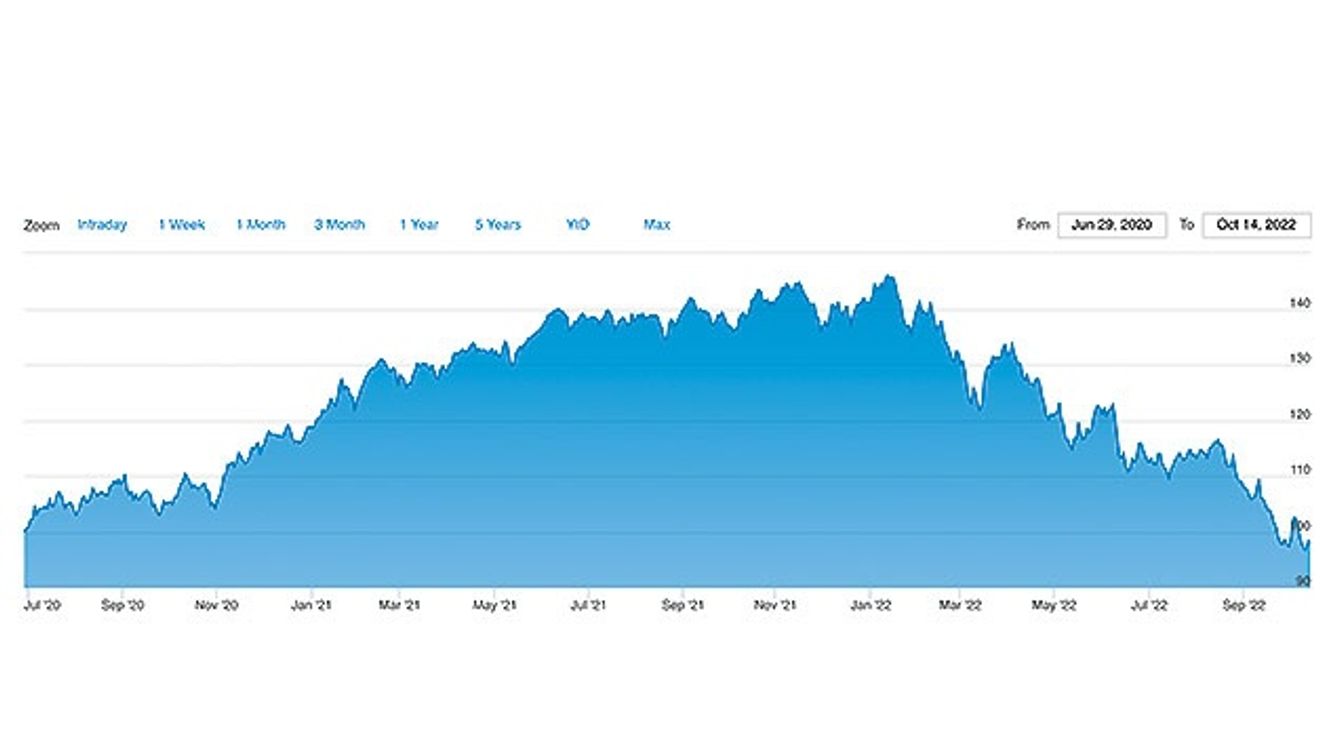
With the Solactive Quantum Computing Performance Index (ISIN: DE000SL0AVD4) from Vontobel, investors can invest in 20 shares of companies in the quantum computing sector via an index certificate. The index covers the entire value chain from the quantum software and hardware platforms and quantum application industries.
© Solactive/Thomas RappoldMarc Andreessen, inventor of one of the first internet browsers and now a venture capitalist in Silicon Valley, came up with the essay "Software is eating the world" ten years ago. Today, it is clear what he meant: sooner or later, every company has to become a software company if it wants to survive in the long term. Founded in 2014, the developer platform GitLab already generates revenues of more than 500 million dollars and is considered an 'asset-light' company par excellence. A total of 1,700 employees in 65 countries work for the company; there is no company headquarters. GitLab is considered one of the most important 'remote only' companies in the world. Large corporations such as Airbus, Goldman Sachs and UBS use the development and collaboration platform for accelerated project management and professional software development. Software development 4.0 takes place in agile processes that are orchestrated by the platform.
In my view, the big tech topics of our time are artificial intelligence, cybersecurity, quantum & cloud computing, open source software and IoT. But the truly disruptive superstructure in the tech sector is the mega-topics of quantum computing and the 5G/6G communication standards. Quantum computing promises unlimited computing power in a simplified way, while 5G/6G promises unlimited bandwidth. Until now, both aspects have always been limiting factors in (information) technology development.
Nobel Prize for quantum technology

The author:Thomas Rappold is a technology investment expert, FinTech entrepreneur and international bestselling author.
© I&S Internet & SecurityAt the beginning of October, the three physicists Alain Aspect, John Clauser and Anton Zeilinger were awarded the Nobel Prize for their "groundbreaking experiments with entangled quantum states". In fact, the three physicists have disproved Einstein, who assumed that quantum mechanics was not a theory with fixed formulas. "The results have paved the way for new technologies based on quantum information," said the jury in its statement. The Nobel Committee's decision could be just as groundbreaking as the award in 1956 to physicists Bardeen, Shockley and Brattain for the discovery of the transistor effect. Transistors are still the backbone of modern semiconductor technology today, but they are reaching their physical limits: Ever finer structures have to be found in order to fit even more transistors into a smaller space. Quantum computing, on the other hand, promises almost unlimited computing power. Quantum computers are around 158 times faster than the fastest supercomputers currently available. Given our global challenges in the areas of digitalization, decarbonization and problems in global supply chains, the enormous computing power of quantum computing could help to better manage these challenges. Experts from the Boston Consulting Group predict a market volume of one trillion dollars in the coming decades. Cybersecurity solutions based on quantum encryption, the development of new drugs, the optimization of logistics, supply chains and also in the area of risk management and portfolio optimization for financial service providers are likely to be among the most important application scenarios.


You might also be interested in
Data economy powered by TSN, OPC UA and 5G
While the stock market rankings were dominated by oil companies ten years ago, companies in the digital industry are now setting the pace. But for data to flow and create added value, pipelines in the form of standardized communication protocols are...
 read more...
Society 5.0 - Defying demographics with technology
The biggest challenges are digitalization, decarbonization and demographics. While the former enjoys a great deal of media attention, demographic change is overshadowed, even though it is the key to a prosperous economic future.
read more...ODVA, OPC Foundation, PI and VDMA
Specification for interoperable energy management published
Precise energy consumption data is needed to achieve climate-neutral production. A consortium has now published a specification for interoperable and efficient energy management in industrial automation and process automation.
read more...Manage and secure assets
In today's fast-paced industrial environment, it is essential that production processes run smoothly and efficiently. However, one critical aspect that is often overlooked is the importance of PLC backup and restore procedures.
read more...OPC UA from the cloud to the sensor
OPC UA is also establishing itself as a standard for the exchange of process data between controllers. The next step is now to extend the concepts developed for the controller-to-controller use case for the controller-to-device and device-to-device...
read more...Update brings support for TIA V19
Delta Logic has updated the 'Accon OPC UA Server' software to version 1.4.0.0. The new features include support for TIA Portal projects of version V19 and for the latest firmware for CPUs of the Siemens S7-1200 and S7-1500 controllers.
read more...Automation meets innovation
SPS - Smart Production Solutions will take place in Nuremberg from November 12 to 14. Once again this year, organizers and exhibitors will pick up on the trends in the automation industry and present suitable solutions. The introduction of IT into...
read more...The e-paper of issue 9/2024
The hype surrounding AI is inspiring, but the reality requires a sober approach to the technology. Computer&Automation 9/24 looks at topics relating to AI & security, the EU AI Act, secure IIoT projects and OPC UA FX "From the cloud to the...
read more...The e-paper of issue 08/2024
How can data centers be cooled for AI? How successful is malware programmed with WormGPT? And how can virtualized control systems be integrated into production using TSN? Computer&Automation issue 08/2024 provides answers to these questions and...
read more...