
The end of the Shaper ...
... and the triumph of TSN plus OPC UA
The Shaper group of companies was committed to the goal of establishing TNS plus OPC UA as 'the' communication standard - from the sensor to the cloud. Now that the work for this path has been transferred to the OPC Foundation, the group of companies is disbanding.

The Shaper group of companies was formed in 2016. The aim of the companies was to establish TNS plus OPC UA as 'the' communication standard - from the sensor to the cloud. Now that the decision has been made to place the necessary work for this with the OPC Foundation, the group of companies is disbanding. But what can these companies - which have been campaigning for this solution approach for years - show at this year's SPS IPC Drives in terms of TSN plus OPC UA exhibits? What technological roadmap will they be pursuing in detail? Computer&AUTOMATION asked some of the companies.
Answers from Oliver Kleineberg, Belden
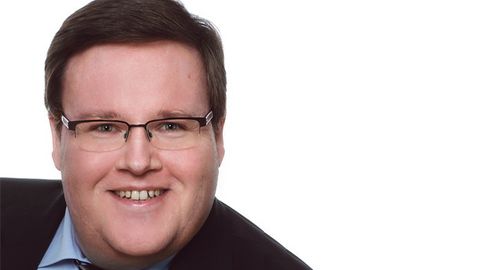
Oliver Kleineberg, Global CTO at Belden, answers the question.
When did your company decide that you would rely on TSN plus OPC UA? Will you keep a door open to this technological solution in parallel?
Oliver Kleineberg: For an infrastructure provider like Hirschmann, the answer is clearly twofold. In other words, we see TSN and OPC UA as individual solution components. We have been actively promoting TSN in the IEEE 802 since 2010 as one of the very early pioneers and have made a significant contribution to its specifications. As a manufacturer of Industrial Ethernet switches, it is important to us that open communication mechanisms are used and TSN closes a significant gap in the area of open, real-time Ethernet communication.
OPC UA primarily affects end device manufacturers, but also has an impact on switch management. We will fully support OPC UA via TSN. However, we will also ensure that we enable all users to connect existing Industrial Ethernet networks to TSN networks with our infrastructure devices and enable migration in the long term
What are you already presenting on this topic at SPS IPC Drives 2018?
Oliver Kleineberg : We will be presenting a range of TSN innovations at SPS IPC Drives 2018: The world's first Industrial Ethernet Switch Octopus II with TSN and IP67 protection class as well as our new TSN-capable, compact switch for the DIN rail, the Bobcat.
With the already known TSN-capable RSPE and the Octopus II, we will be showing in a demo together with controllers from National Instruments how automatic network configuration with TSN will work in the future and how resources for TSN communication streams can be provisioned as required. The configuration of TSN can be observed live on a graphical instrument panel.
What is your roadmap in this regard for the next few years?
Oliver Kleineberg: TSN and OPC UA are firmly integrated into our long-term product roadmap. For new products, we will ensure that we increasingly use TSN-capable switching chips. The Bobcat Switch as the successor to the well-known Hirschmann Railswitch family is the first step in this direction. In some cases, we will also work with FPGAs in which our self-developed TSN logic operates.
Our network management solutions will gradually be equipped with comprehensive features for TSN configuration and monitoring, as TSN can only be fully utilized in large networks and systems with the right tools.
Answers from Thomas Brand, Bosch Rexroth

Thomas Brand, Product Owner Communication Solutions at Bosch Rexroth, answers.
When did your company decide that you would rely on TSN plus OPC UA? Will you keep a door open to this technological solution in parallel?
Thomas Brand: Bosch Rexroth has been involved in the TSN testbed of the Industrial Internet Consortium (IIC) and in a community of interest on OPC UA and TSN with other providers from the very beginning - i.e. since 2016. We are delighted that we can now also develop OPC UA plus TSN as a future solution for the field level in the OPC Foundation. We see no need for another TSN-based solution, especially as we have now agreed on a common set of application profiles including motion and safety with other automation providers. This has created the basis for interoperability, which now needs to be detailed and developed in the OPC Foundation. The aim must be to harmonize simple, fast and future-proof connectivity as an optimal solution for mechanical engineering and end customers across manufacturers. Until OPC UA plus TSN in conjunction with the common application profile has established itself on the market, we will continue to support multi-Ethernet connectivity in our products.
What are you already presenting on this topic at SPS IPC Drives 2018?
Thomas Brand: All Rexroth controllers that we are presenting at our stand are equipped with OPC UA Client/Server as standard. Bosch Rexroth is demonstrating that the course for the factory of the future has already been set today: With networkable system solutions and components, open standards and intelligent software solutions for machine manufacturers and end users.
We will be presenting a prototype of OPC UA and TSN in the TSN demonstrators of the IIC in Hall 6, Stand 360, and the OPC Foundation in Hall 5, Stand 347. Sercos International will be showing how TSN interacts with sercos in Hall 5, Stand 130.
What is your roadmap in this regard for the next few years?
Thomas Brand:The publisher-subscriber principle is the prerequisite for real-time capable, cyclic communication with OPC UA and TSN. We will be integrating Pub-Sub into our products next year. Building on this, we will offer OPC UA over TSN for communication between controllers before it is introduced at field level.
Answers from Stefan Bina, B&R

Stefan Bina, Product Manager Industrial IoT Network Solutions at B&R Industrial Electronics, answers the question.
When did your company make the decision to rely on TSN plus OPC UA? Will you keep a door open to this technological solution at the same time?
Stefan Bina: The fundamental decision for OPC UA and TSN was finally made at B&R back in 2015. At that time, we also held initial discussions with potential technology partners and drew up an internal development roadmap that we have been pursuing ever since. For us, OPC UA TSN is the protocol of choice for industrial communication in the Industrial IoT. A plan B is not necessary from our point of view.
What are you already presenting on this topic at SPS IPC Drives 2018?
Stefan Bina: We are presenting our OPC UA TSN bus controller. An early prototype of this field device was already on display last year. It is now a near-series device that is already being tested in pilot applications. We are also involved in various testbeds. There will also be something on show at the EPSG stand: drives in five separate Powerlink networks will be synchronized in hard real time via a shared OPC UA TSN network.
What is your roadmap in this regard for the next few years?
Stefan Bina: We will gradually integrate OPC UA TSN into our system. Starting with the bus controller, we will move on to controllers and industrial PCs, right through to drives and safety. Thanks to the Companion Specification for OPC UA and Powerlink, it will also be possible to easily combine devices with Powerlink and OPC UA TSN in a shared real-time network.
Answers from Sebastian Hilscher, Hilscher
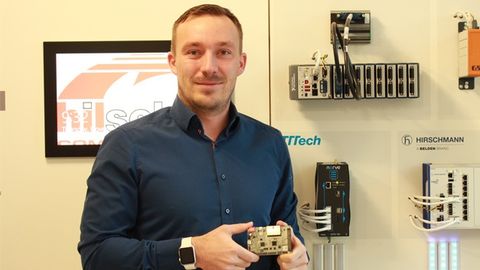
Sebastian Hilscher, Division Manager Development at Hilscher, answers the question.
When did your company decide that you would rely on TSN plus OPC UA? Will you keep a door open to this technological solution in parallel?
Sebastian Hilscher: About a year and a half ago, we were approached by the Shapers about their initiative. We have been a member of this group ever since. As Hilscher, we are a technology supplier for industrial communication technology and we see OPC UA TSN as a promising candidate for communication from the sensor to the cloud. However, we cannot commit ourselves to a single standard, but will cover the broad market of solutions. Therefore, in addition to OPC UA on TSN, we will also support other TSN solutions, as well as existing fieldbus and Real-Time Ethernet standards.
What are you already presenting on this topic at SPS IPC Drives 2018?
Sebastian Hilscher: We are presenting some innovations in the area of OPC UA. For example, we are one of the first companies to present the first version of the IO-Link and Profinet Companion specification live. In the area of TSN, we have been working in the LNI4.0 and IIC testbeds for some time now. We have implemented the IEEE 802.1Qbu standard in our netX SoCs for this trade fair. Thanks to our flexible communication unit, which already supports Profinet IRT, Ethercat Device and Ethernet/IP with DLR, we can easily extend this to TSN. For example, we are represented in the testbeds with our netX 52, hundreds of thousands of which are already in use on the market.
What is your roadmap in this regard for the next few years?
Sebastian Hilscher: We are currently limited to 100 Mbit with our technology, which is sufficient for I/Os, sensors and drives and will probably continue to be used in the field for a long time to come due to the lower power loss. However, with TSN we are also seeing the trend towards Gigabit Ethernet, and we at Hilscher are also facing up to the challenge and will be presenting a solution in the future.
Answers from Martin Müller, Phoenix Contact

Martin Müller, Vice President of the I/O and Networks business unit at Phoenix Contact, answers.
When did your company decide that you would rely on TSN plus OPC UA? Will you keep a door open to this technological solution in parallel?
Martin Müller: For us, there wasn't a single day on which everything converged and a decision was made in-house in favor of TSN plus OPC UA. Phoenix Contact has been actively involved in the various national and international standardization committees for many years. In this respect, it was clear to us relatively early on that technologies would be specified here that, taken together, have the potential to fulfill all requirements for industrial communication and thus change the future of automation in the long term. That's why Phoenix Contact began early on to promote the idea that we should develop a uniform international standard together and not again a specific solution for each fieldbus organization. We hope that another 'fieldbus war' will be avoided on the basis of these new technologies. Today, the chances of this happening are better than ever before! In addition to OPC UA plus TSN, we are also getting a solution for wireless transmission technology with 5G as well as single-pair Ethernet technologies - SPE for short - and advanced physical layer technologies - APL for short - for connecting simple field devices and process technology. That's why we believe that we don't need a plan B.
What are you already presenting on this topic at SPS IPC Drives 2018?
Martin Müller: As the technologies are currently in the specification phase, it is not yet possible to show finished products. Nevertheless, we will be looking to talk to our customers as part of a technology presentation and discuss their requirements for technology, products and the timetable further.
What is your roadmap in this regard for the next few years?
Martin Müller: In 2019, Phoenix Contact will build prototype devices in parallel with the specification work in the OPC Foundation working groups and carry out system tests in the testbeds together with devices from other partners. We are planning the first series devices for 2020. It makes no sense to have proprietary products that only run in your own system as quickly as possible. The focus must always be on multi-vendor solutions.
Answers from Georg Kroiss, TTTech Computertechnik
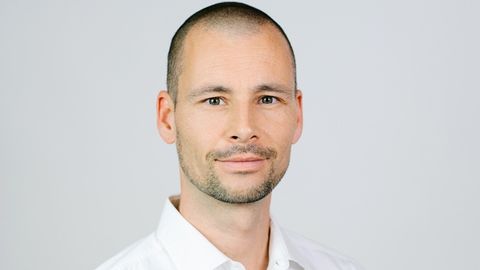
Georg Kroiss, Business Development Industrial at TTTech Computertechnik, answers the question.
When did your company decide that you would rely on TSN plus OPC UA? Will you keep a door open to this technological solution in parallel?
Georg Kroiss: TTTech was one of the first companies to make a massive commitment to OPC UA over TSN - not only in product development but also publicly. At SPS IPC Drives 2016, for example, TTTech and a whole group of well-known manufacturers held a press conference to draw attention to the opportunities offered by standardization via OPC UA TSN. Incidentally, NXP launched the first - still pre-standard - TSN chip with TTTech IP back in 2015.
As a technology supplier, we support every customer who wants to benefit from TSN, regardless of which application layers they rely on. However, the potential of combining TSN with OPC UA PubSub is clear, which is why we are continuing to invest in the integration of these two technologies in particular.
What are you already presenting on this topic at SPS IPC Drives 2018?
Georg Kroiss: We will be presenting our TSN solution, which is suitable for both FPGA and ASIC integration. Because the practical use of TSN requires more than just chip IP, we are offering a complete solution consisting of IP core, embedded software, development hardware and the world's first manufacturer-independent TSN configuration tool. Our solution can be seen in practical use at Intel in Hall 5, Stand 350, or at B&R in Hall 7, Stand 206, but we will of course also be demonstrating an application ourselves.
What is your roadmap in this regard for the next few years?
Georg Kroiss : Well-known chip manufacturers are already relying on our TSN solution, and more will follow in 2019. Our customers from the automation and component manufacturing sector can already use a prototype OPC UA over TSN implementation. We will release this as a product in 2019 and continuously optimize and expand our existing TSN solution, including configuration tools. We are also integrating OPC UA over TSN deeply into our edge/fog computing platform, as a deterministic infrastructure is essential for demanding tasks there in particular.


You might also be interested in
Safety in sensor technology
What do sensor manufacturers currently offer in terms of safety? At SPS IPC Drives, there were a number of clever concepts on show - including from Sick, Pepperl+Fuchs and Leuze electronic.
 read more...
Video flashback of the three days of the fair
New hall, new topics and a new name in 2019 - the SPS IPC Drives 2018 in seven minutes.
read more...The review in the movie
New hall, new topics and a new name - that was SPS IPC Drives 2018 in seven minutes.
read more...OPC UA and TSN - a major trade fair topic
The OPC UA and TSN communication standards are major topics of discussion in the industry. This could not be overlooked at SPS IPC Drives 2018.
read more...Smart transport - three approaches in the video
How can material and product transport in machines and systems be reorganized in the age of Industry 4.0? Beckhoff, B&R and Bosch Rexroth presented interesting approaches in this regard at SPS IPC Drives 2018.
read more...'Software & IT' in focus
Last year, SPS IPC Drives bundled the topic of 'Software & IT in manufacturing' in Hall 6. In response to high demand, this concept was extended to Hall 5 in 2018.
read more...The 'Automation Hackathon'
At the 'Automation Hackathon' at SPS IPC Drives 2018, seven start-ups had the chance to develop new business models for selected companies in the automation industry in 48 hours. Winner: the start-up Othermo in collaboration with Wago.
read more...Entering the Machine Building Business
Known as a technology supplier to robot manufacturers, Synapticon now plans to offer targeted solutions for machine builders. The kick-off was given at the SPS IPC Drives with the ‚Actilink‘ drive systems and a quick-start package for the production...
read more...The winding does it!
With the market launch of the new brushless DC motor family BXT, Faulhaber is setting new standards in the field of external rotor high-performance drives. The winding plays a central role in this.
read more...