

VisionTools
Virtual commissioning based on AI
AI-based systems for automated quality control cannot avoid the time-consuming collection of image data. At BMW in Dingolfing, an inspection cell has been in operation since July 2023, which starts camera-based visual inspection from the very first car body.

Optical systems for automated quality control have long been standard in numerous industries. These include simple color sensors and code readers as well as complex 3D multi-camera measuring systems. Conventional image analysis methods are used in many applications. However, when using AI algorithms, optical quality inspection systems in industrial assembly and production facilities require a large number of images for training. However, testable components or products are generally not available before the start of series production - and therefore no images are available. Effective training can therefore only begin with the start of production. Depending on the task and complexity, the final 'go' for the inspection process is sometimes delayed. If the number of units to be tested is small, the effort and costs per test part are comparatively high. This was also the case at the BMW plant in Dingolfing until July 2023: a test cell could only be put into operation once sufficient reference images of real vehicles were available - sometimes a Herculean task that took a considerable amount of time, depending on the scope of testing and features. This is why BMW, together with the image processing experts from VisionTools, pushed for a solution that would provide reliable image data even before the start of series production.
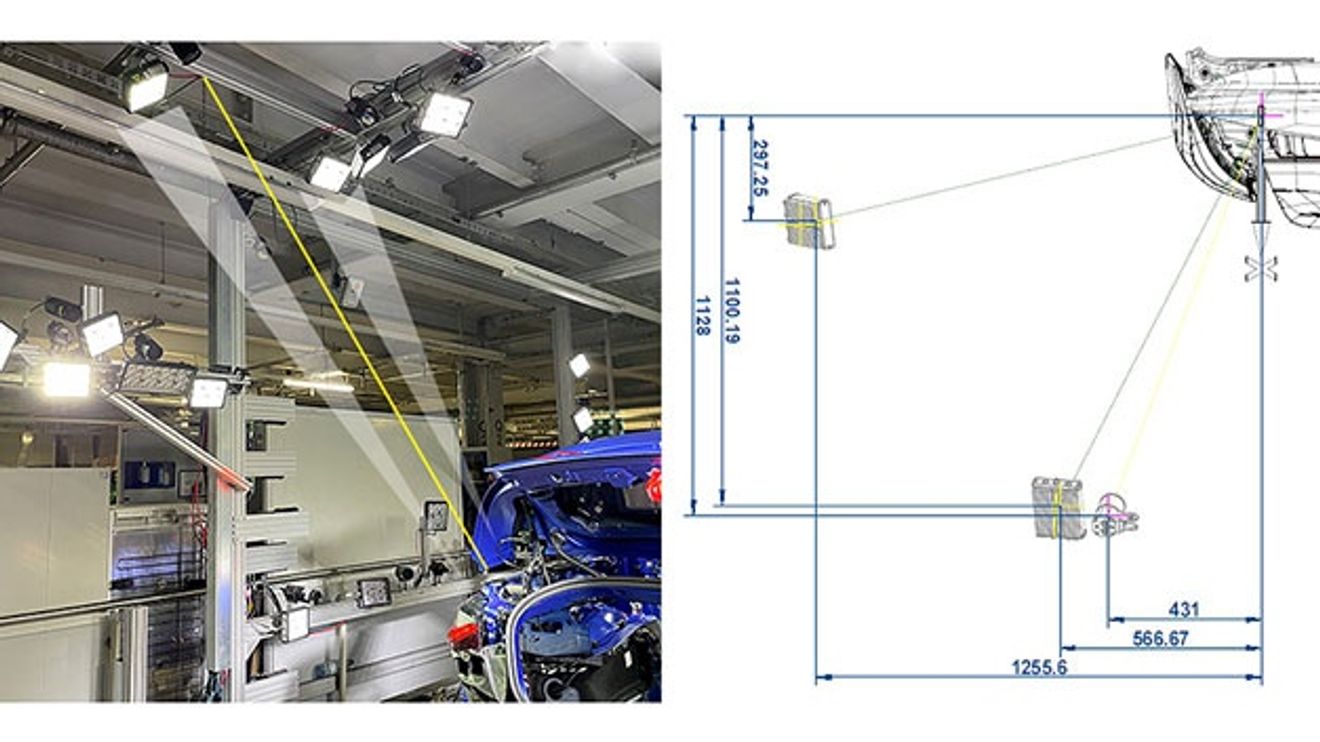
The test cell
Every minute, models of the new 4-series convertible, among others, enter the test cell via an assembly line. With the help of two cameras, the station analyzes fully automatically whether three rubber plugs are present or correctly inserted in the area of the two rear lights. The camera system immediately registers errors and irregularities of any kind. An employee receives a repair order via the display.

From CAD model to virtual training image in just a few steps: Synthetically generated camera images from CAD data for AI training for testing from component 1 in the real image processing process.
© Vision ToolsOnly at first glance does the inspection cell implemented by VisionTools for checking plugs on the rear light well look like a normal station. But behind this is a fundamentally new approach that is tantamount to a paradigm shift in testing and inspection processes: based on the CAD data provided, the image processing solution generates any number of virtual, realistic mapping variants of the test field at the touch of a button before the start of series production. All characteristics that occur in the real test run and can influence the image result are included in the simulation. For example, position and location tolerances of the workpiece and the relevant image processing components such as the camera and lighting are taken into account. Surface properties such as material, color and reflectance can be randomized in the simulation to a much greater extent than would be the case in reality.
would be the case in reality. Properties such as optical distortion and the depth of field of the camera and lens are also taken into account. As the dimensions of the test station are generally known, cameras and lighting can also be positioned in the virtual space to optimize the results.
Synthetic image generation

Color, position or other material properties are generated at random: synthetically generated camera images with simulated component variants for robust AI training.
© Vision ToolsThe upfront effort pays off: without a single real workpiece being available beforehand, the synthetic image generation provides sufficient realistic good and bad examples. The quality of the image data is so high that it is ideally suited for training the AI algorithms. A large number of randomization parameters are available in the simulation for each assembly (CAD element, lighting, camera): for example, position and material tolerances, colour and lighting differences, ambient light influences, image blurring and image distortion. These are continuously changed by a random generator within the set limits, thus generating the desired number of individual virtual images.

Assembly control through AI-supported error evaluation of the test characteristics on the real component from the very first vehicle.
© Vision ToolsThe generated image data also contains the label data (annotations) so that it can be used immediately and without further processing to train an AI algorithm. The inspection system goes into operation with the first workpiece produced. The real images captured during operation can be added to the virtual training data set to further optimize the system. As a digital twin, the setup and data set can be transferred directly to a station with comparable requirements. If the scope of testing is to be expanded, the digital image data basis can be adapted comparatively easily and with manageable effort.
Trusting project partnership

Wolfgang Zosel is a freelance journalist and owner of the pr'kom Kommunikation agency in Kusterdingen.
© pr'kom CommunicationAround 70 of the inspection cells equipped by VisionTools are in use at the Dingolfing assembly plant alone. The example of BMW shows that the use of a cost-effective, flexible and scalable AI-based image processing system instead of real image data is possible from the very first vehicle. With the 'VisionCockpit' training environment and the decentralized edge device 'VoE-AIBox', VisionTools will further expand its AI-based image processing solutions and align them more intuitively to customer requirements.


You might also be interested in
Long-term solution finding in incident response
Automated processes based on AI algorithms support incident management teams in identifying and responding to incidents more quickly. By integrating AIOps, operational processes can be optimized and the efficiency of ITOM teams increased.
 read more...
AI - hype or savior for the industry?
Just because AI is currently in vogue doesn't mean that investments in machine learning and the like should be made headlong and rashly. Instead, it is important to plan precisely and proceed step by step.
read more...Easy offline programming of robots
Before robots become a real support, each of their movements must first be programmed in detail and precisely. This raises the question of whether this is better done online or offline. A plea.
read more...VDMA at the Hannover Messe 2026
Relocation concerns in mechanical engineering
The German mechanical and plant engineering industry is under increasing pressure from regulation, high costs and geopolitical risks. According to the VDMA, many companies are considering investing abroad. At the same time, the industry remains...
read more...RobCo at the Hannover Messe 2026
Robotic system for dynamic environments
RobCo is presenting a new industrial robotics system for dynamic tasks in industry at the Hannover Messe. With 'Autonomous Alfie', the company is opening up a new category of robotic solutions. This allows tasks in which processes, objects and...
read more...Fraunhofer at the Hannover Messe 2026
Data, AI and material innovations for the industry of tomorrow
Under the motto "Innovations for our Future", nine Fraunhofer Institutes and Groups and the Research Fab Microelectronics Germany (FMD) will be presenting concrete solutions for a resilient, digitally networked industry at Hannover Messe 2026.
read more...Funding project on embedded AI
The "Edge AI Platform" project is entering its third round of funding: three Fraunhofer Institutes are further developing the platform to version 3.0 in order to provide companies with even more efficient access to embedded artificial intelligence...
read more...automatica to be held in China for the first time in 2027
automatica is expanding its global brand strategy and will take place in China for the first time in 2027. automatica Shanghai 2027, organized by Messe München Shanghai and the VDMA Representative Office in Shanghai, will celebrate its premiere from...
read more...Generative AI delivers more than 300 picks per hour
Sereact presents the latest generation of the Vision-Language-Action (VLA) model 'Cortex' and the associated visual intelligence 'Lens'.
read more...