
Visual Components
Easy offline programming of robots
Before robots become a real support, each of their movements must first be programmed in detail and precisely. This raises the question of whether this is better done online or offline. A plea.
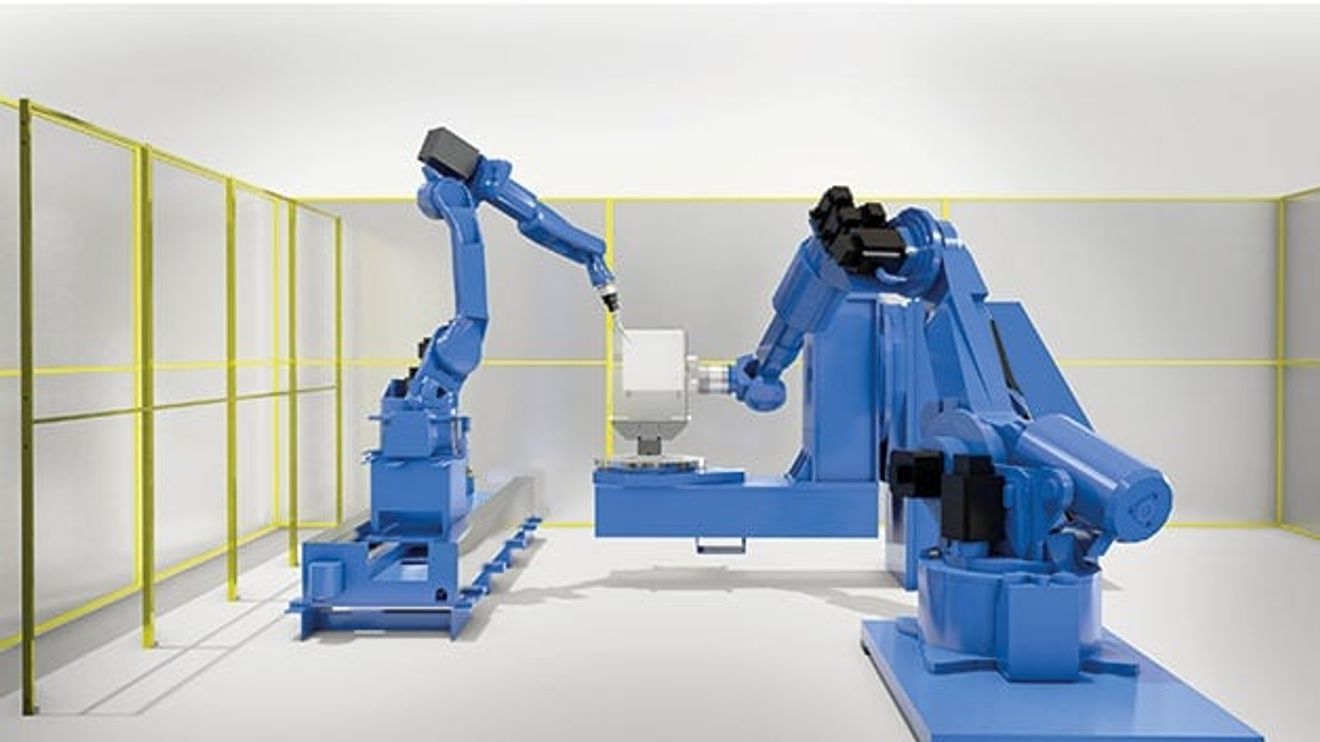
Although offline robot programming (OLP) offers numerous advantages, particularly in complex production environments, many companies are reluctant to use this method. The reasons for this are mostly misunderstandings and errors - such as the assumption that offline programming is only suitable for large productions.
Online or offline programming
When it comes to programming robots, a basic distinction is made between online and offline programming. In offline programming, the robot is programmed virtually in a simulation of production. If it is to paint a workpiece, for example, the programmers first import a CAD file of the robot cell into the OLP software and plan the movement of the robot arm using a digital robot model. The software then generates the corresponding robot program and checks it for possible collisions and errors. Only when the program runs smoothly is it loaded into the robot controller so that the cell can start work.
The alternative to this and current standard method is online programming directly on the robot: in the so-called teach-in method, a teach pendant is used to manually move a robot end effector to different positions and directions and save the relevant points so that the robot then moves along the saved positions.

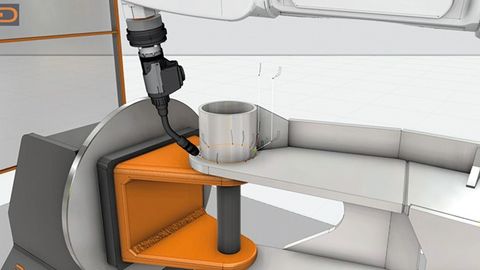
Welding program in the OLP software (left) and physical welding in the workshop (right)
© Visual ComponentsIn direct comparison, there are several advantages to offline programming:
- Since online programming involves working directly on the robot, the corresponding cell is not available for production during this time. In addition, the time required for this is often underestimated, as the downtime can sometimes last several days. In contrast, the downtime for offline programming is usually much shorter, as the programming is carried out on the virtual model; this means that the robot cell can be used in production during this time.
- With the online method, the robot is not 'taught' until the robot cell and all tools and devices have been designed, built and installed. Conveyor belts and other material handling equipment are also already set up and ready for use. If it turns out that the robot cannot reach a certain point as planned or does not meet the target cycle time, the cell must be redesigned. By programming on a virtual model and simulating the processes, problems can be identified at an early stage and project delays reduced.
- In contrast to online programming, with the OLP method the introduction of a new product into production and robot programming take place simultaneously and not one after the other. This minimizes the time required to integrate a new product.
- Unlike online programming, with OLP the programmer does not have to enter the robot cell to teach the points. This results in a lower risk of accidents and injuries, as the people involved are not exposed to the risk of unexpected movement of the robot or one of the other mechanisms in the cell while working on virtual robot models.
In addition, companies using OLP benefit from higher and more repeatable product quality, as robot programs can be more easily and better optimized offline. Modern OLP software can also be used across brands and processes, as it covers all applications independently.
Common errors
Despite the advantages, not many companies use the option of offline programming. One reason for this is sometimes misconceptions about the process. Three main assumptions are widespread:
- OLP is only suitable for large production facilities: the assumption that only companies with high production volumes benefit from OLP is not true. In fact, OLP is suitable where production runs are short and are frequently retooled or converted. This is particularly the case for small and medium-sized manufacturers that produce small batches.
- OLP is complex and not user-friendly: "Dealing with new software always requires a certain amount of training. However, there are OLP solutions on the market that are intuitive to use, so that even beginners can quickly get to grips with them. In comparison, manual programming using a teach pendant is often even more complex, as the commands vary depending on the robot brand and model.
- OLP is cost-intensive: Although the implementation of an OLP solution is initially associated with additional costs, these only have to be incurred once. The solution can then be used for programming all robot brands used. OLP users report an improved return on investment for their robot cells, as downtimes are reduced and robot utilization is increased.
Where OLP pays off
The more complex the robot paths, the more worthwhile it is to use OLP. Some examples of particularly suitable applications are therefore welding, cutting and assembly. In welding, for example, a large number of points often need to be taught. In addition, access and orientation pose a particular challenge for welding robots. Cutting often requires complex geometries with precise cutting patterns, which can be programmed and tested more quickly and easily in the virtual environment using OLP. Finally, in assembly applications, gripping and insertion movements require particularly precise control, which can be achieved to a greater extent with offline programming.
Modern OLP solutions

One software manufacturer that wants to bring OLP even further into the manufacturing industry is Visual Components, which has long been active in the field of 3D manufacturing simulation. By acquiring Delfoi, a pioneering company in software solutions for offline robot programming, the Finnish company added extensive OLP functions to its existing simulation tools in 2022. The software is intuitive and quick to learn, stores core process knowledge and makes it accessible to everyone involved in product, cell and fixture development. Intelligent and automatic tools for solving robot program problems complement the solution.


You might also be interested in
25 years of Computer&Automation - The e-paper
For 25 years, Computer&Automation has accompanied the growing influence of IT in automation technology. Ultimately, IT and automation can no longer be clearly separated. In this anniversary issue, you can read about the importance that...
 read more...
Products of the year - The e-paper special
"Products of the Year 2023" goes interactive: the new e-paper including video news is here! The winners of the readers' poll have been chosen and in our interactive special edition you will find all the winning products at a glance and exclusive...
read more...Takeover of the Delfoi robotics division
Visual Components has announced the acquisition of the robotics division of Delfoi. The Finnish company intends to accelerate its growth strategy with this move.
read more...Keysight accelerates quantum research with new system simulation
With Quantum System Analysis, Keysight introduces a system-level simulation solution designed to revolutionize the development of superconducting quantum systems. The software reduces dependence on expensive cryogenic testing and enables faster and...
read more...Digital twins and AI in industrial use
Schaeffler and Nvidia launch technology partnership
Schaeffler is cooperating with Nvidia to optimize production processes in the global plant network with the help of digital twins and AI-based simulations. The Omniverse platform plays a central role in this.
read more...With real-time data against disasters
A digital twin is more than just a two- or three-dimensional digital copy. It combines precise data with intelligent analysis and solves complex challenges. With locations in Paderborn and other cities, Eviden relies on the combination of artificial...
read more...More precise digital twins in production
SAS, provider of solutions for data and AI, is launching a new generation of digital twins on the market. The combination of SAS Analytics and 3D visualization in real time ensures photorealistic simulations in production.
read more...Solid start to the year
Dassault Systèmes has announced its unaudited IFRS financial results for the first quarter ended March 31, 2025.
read more...Transformation projects are very popular
IFS announces the results of a recent study, according to which the manufacturing industry is at a critical turning point. Although manufacturing companies are aware of the need for digital transformation, a lack of strategies and an oversupply of...
read more...