

Robotics
Probably the fastest goalkeeper in the world
Messi, Neymar and many other soccer greats have tried, but none of them have been able to beat this goalkeeper on the penalty kick. There is no human between the posts, but a robot - the 'RoboKeeper' - and probably the fastest goalkeeper in the world.
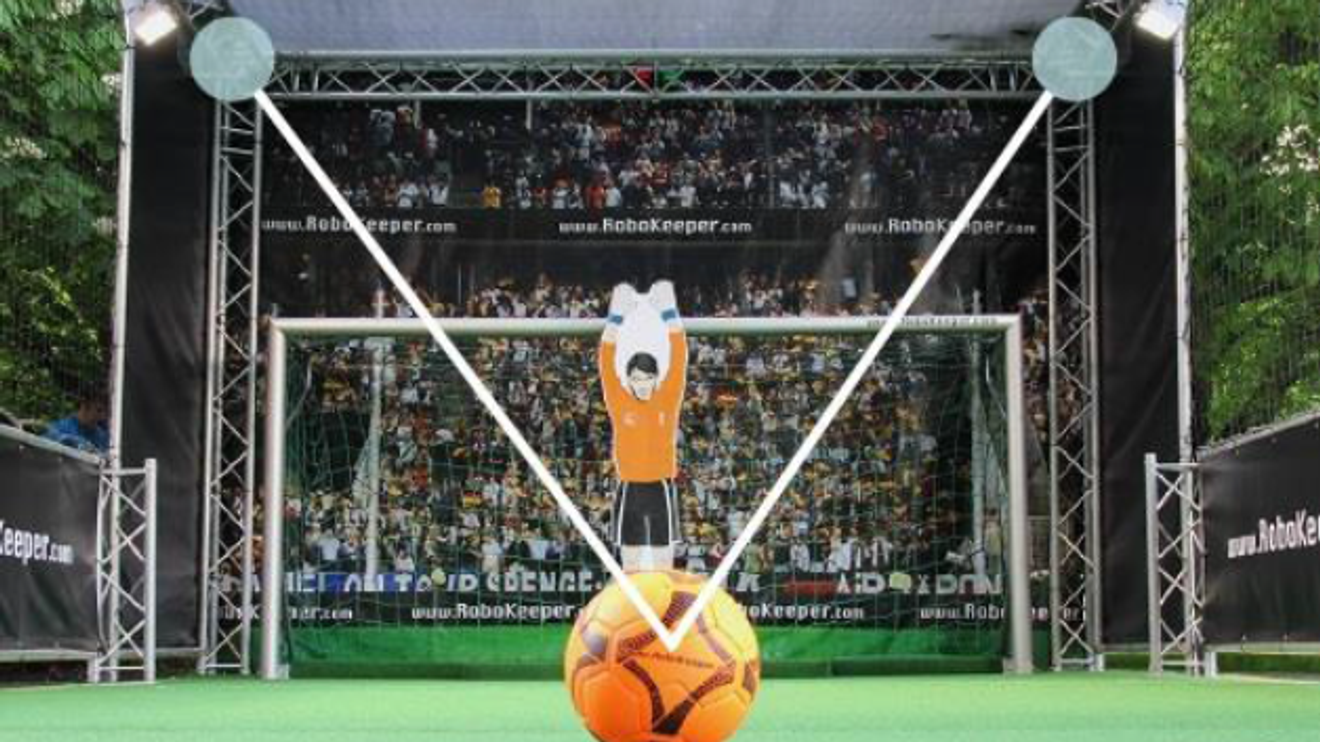
Two GigE cameras, equipped with automatic iris control and lenses with a video signal-controlled motorized iris, are mounted on the side above the goal and track the trajectory of the ball.
© 4attentionAs we all know, the round has to go into the square. But not with 'RoboKeeper', a development by the Fraunhofer Institute for Material Flow and Logistics (IML) in Dortmund. In most cases, the artificial goalkeeper emerges victorious from the pitch - and this applies to footballers of all abilities.
The boundary conditions of the project, which was launched in 2005, differ from those of a real soccer match: the goalkeeper kicks from a distance of around 9 m and the goal measures 2 x 4 m². Thomas Albrecht, research associate at Fraunhofer IML and project manager of the 'RoboKeeper' development, explains: "The aim of the development was to keep the balls safe even when they are shot flat into the bottom right or left corner of the goal at a speed of 100 km/h." This corresponds to the maximum distance for the goalkeeper, who stands upright in the middle of the goal when shooting. At this speed, the pure flight time of the ball is around 360 ms, according to Albrecht.
"In this time, the expected trajectory and the point of arrival of the ball in the goal plane must be extrapolated and the complete movement of the goalkeeper, including all acceleration and deceleration processes of the motor, must be completed in order to prevent a hit," says Albrecht. The accuracy requirements are in the range of a few centimetres, as it is not crucial that the goalkeeper figure holds the ball in the middle: "The 'RoboKeeper' only has to hit the ball in such a way that it is deflected and does not land in the goal."
Fast image processing
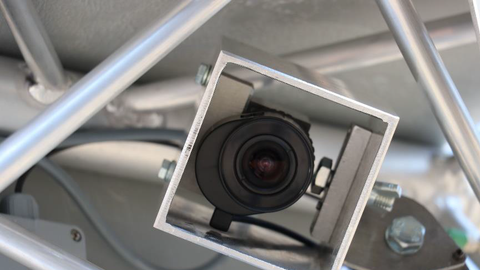
A fast image processing system serves as the robot goalkeeper's "eyes". Two 'Prosilica' color area scan cameras from Allied Vision Technologies with Gigabit Ethernet interfaces and a resolution of 659 x 493 pixels are mounted on the side above the goal. They focus on the ball and track its trajectory. The ball must stand out from its surroundings in terms of color.
The cameras each deliver up to 90 images per second, which are then evaluated by image processing software developed by Fraunhofer IML on a dual-core processor system from Kontron. If a movement in the direction of the goal is detected during the evaluation of three consecutive images, the first data is transmitted to the motor controller, which is responsible for the movement of the 'RoboKeeper' and positions the Robo goalkeeper.
Based on the calculations and with the help of a high-performance motor, the 'RoboKeeper' only needs around 300 ms to reach the calculated defensive position. It accelerates around 20 times faster than a Formula 1 racing car. The system has seven different difficulty levels and thus adapts to the performance level of the players.
If the system is set up outdoors, the sunlight and therefore the illuminance of the scene varies considerably over the course of the day. For this reason, camera systems equipped with automatic iris control and a video signal-controlled motorized iris were used. The 'CVO GAT23516AC' lenses from Goyo Optical used have a focal length of 3.5 mm and are wide enough to ensure correct ball detection from kick-off to goal.
The image processing setup consisting of the two cameras, the associated motorized lenses and the cables was supplied by Stemmer Imaging.
Fancy a duel?
During the 2018 FIFA World Cup, fans can try their luck on Red Square in Moscow. In addition to the system described above, other versions are also available: a scaled-down version with a shorter shooting distance and reduced goal size, as well as variants for field hockey, ice hockey and handball.


You might also be interested in
Thermal images guide autonomous robot 'Anymal'
When autonomous robots such as 'Anymal' help to search for casualties in rough terrain, thermography is almost indispensable.
 read more...
Exoskeleton / Augmented Reality
Support in everyday work
The "3rd arm" for tradesmen makes two things possible at once: effective support for the tradesman and computer-generated additional information directly on site.
read more...MTCON and Sensor-Technik Wiedemann combine expertise
MTConnectivity power2pcb (MTCON) has a new shareholder: Sensor-Technik Wiedemann (STW) has held a stake in the power element manufacturer since the end of 2019.
read more...Electromobility / green electricity
Intelligent charging saves fossil fuels
Charging electric cars can overload the electricity grid and lead to fossil fuel power plants having to step in. This is unnecessary and leads to high costs for grid operators. BMW and Tennet want to change this.
read more...Service robotics at Conrad Electronic
Sales robots in use around the clock
To provide its customers with a 24/7 shopping experience in Berlin Schöneberg, Conrad Electronic has now deployed a sales robot. The robot 'Alex' is designed to provide a high-tech shopping experience. It comes from the manufacturer pi4_robotics.
read more...Ridesharing field test in Paris
Renault tests Zoe as a robo-taxi
Renault launches a ridesharing field trial in Paris with two autonomous Zoe robo-taxis. The two prototypes have been specially modified. In addition to the technology for automated driving, they have a modified interior with multimedia and on-board...
read more...Robots for the hospital of the future
ABB has opened its first global Health Care Hub dedicated specifically to healthcare research on the campus of the Texas Medical Center (TMC) in Houston, Texas. A number of technology concepts were presented at the opening, including a mobile YuMi...
read more...Weidmüller, Enercity and Wallbe form alliance
Weidmüller Mobility Concepts, a wholly owned subsidiary of the Weidmüller Group, has acquired a 25.1% stake in Paderborn-based Wallbe GmbH from Hanover-based Enercity AG. Wallbe is a full-service provider of e-mobility charging solutions.
read more...New 'Digital Products and Services' division
With the new product division 'Digital Products and Services', Ecom is introducing a ready-to-use service for all mobile devices. What exactly is behind this announcement?
read more...