
Perception Park
Camera provides 'chemical fingerprint'
Hyperspectral-based image processing makes it possible to detect organic or inorganic contaminants on objects - not only on their surface, but in some cases also inside them. An overview.

While conventional 2D and 3D vision systems check the quality of objects by detecting certain defect features on the surface, hyperspectral imaging (HSI) goes one step further: it can be used to perform a spectroscopic analysis of objects in order to detect organic or inorganic contaminants - not only on the surface, but in some cases also inside the inspected materials.
Hyperspectral image processing systems usually use 100 or more different wavelengths and use a spectrograph that breaks down the light reflected by the object into its spectrum and images it onto the sensor of the camera used. An HSI system assembles the resulting images into a three-dimensional hyperspectral data cube, which can contain very large amounts of data. The result is a 'chemical fingerprint' of the object in question, which enables the material properties to be determined precisely. Using special evaluation software, each detected chemical component can then be marked with its own color in the captured images, allowing the user to easily visualize the substances present. The technology used for this is called Chemical Color Imaging (CCI).
The application possibilities
Hyperspectral image processing can be used in a wide range of industrial applications and in certain cases offers solutions for tasks where conventional image processing systems fail.
One example of an application is the classification of materials that have no visual differences but are not chemically identical. For example, plastics of different compositions can look very similar and can therefore hardly be distinguished using conventional image processing. HSI systems, on the other hand, analyze the chemical properties and reliably identify the materials.
The concentration and distribution of ingredients can also be recorded to a large extent and in real time using this technology.
A special feature of hyperspectral systems makes them particularly attractive for certain applications: some materials are not transparent to visible light, but can be penetrated by infrared light. This makes it possible to check the chemical composition of packaged contents even through appropriately designed packaging. Applications in which this property comes into play can be found in the pharmaceutical and food industries, for example.

Error detection in the pharmaceutical industry
As in many other sectors, production speeds in the pharmaceutical industry are increasing rapidly worldwide. In order to reduce the risk of product recalls and protect consumers from contaminated medicines, particularly strict safety regulations apply in this industry. Image processing systems have therefore been state of the art in the manufacture of pharmaceutical products for some time now in order to evaluate products in real time according to criteria such as shape, size or weight. By using hyperspectral imaging and CCI systems, the monitoring of pharmaceutical production processes can be further optimized, as they make it possible to examine pharmaceuticals for their molecular properties.
A typical application of HSI systems in the pharmaceutical industry is the inspection of retard tablets for correct coating. This form of medication releases the active ingredient after administration over a longer period of time or to a specific target in the body. The retard coating of the tablet is crucial for this controlled release of the active ingredient: if it is damaged or missing completely, the drug enters the body faster than desired and fails to achieve its long-term effect.
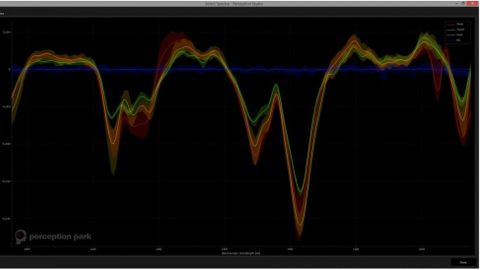
With a combination of HSI and CCI technology, the quality of sustained-release drugs can be reliably controlled. "Using a hyperspectral camera operating in the NIR range and applying chemical color imaging technology with our 'Perception Studio' software suite, we were able to clearly demonstrate that previously artificially created coating defects can be detected with 100% certainty and in real time, even in high-speed production," explains Markus Burgstaller, Managing Director of Graz-based Perception Park, which specializes in this technology. Quality inspection is even possible through blister packs, as long as the blister material is not made of aluminum, which would reflect the NIR radiation.
The inspection of retard coatings is just one of the many possible applications of HSI technology in the pharmaceutical industry. It can also be used to check whether tablets are packed in blisters in the correct number, undamaged and without foreign bodies, whether the correct ingredients are contained in drug capsules or whether they are completely sealed.
Safe food production
Similar requirements apply to the production of food as in the pharmaceutical industry: in order to prevent health risks to consumers, undesirable foreign bodies must not remain undetected in the products. In addition, the food must contain exactly the ingredients intended by the manufacturer and defined in the product descriptions for the buyer.
HSI and CCI also offer numerous application possibilities for this sector. For example, these technologies simplify the detection of impurities in food and identify foreign bodies such as stones or soil when sorting potatoes, carrots or other vegetables, as well as parts of shells or other substances when processing nuts, even in high-speed production lines. If food is stored for too long, maggots can also settle in or fresh fruit can start to rot.

An image processing solution based on hyperspectral imaging detects impurities such as maggots and pieces of wood between rice. The right partial image shows a segmentation image with detected maggots.
© Perception ParkIndustrially produced foods such as sausage and cheese are usually offered for sale to consumers in shrink-wrapped form. Similar to the pharmaceutical industry, HSI systems also allow quality inspection through the packaging in many cases. A special task here is the inspection of sealing seams, which are intended to guarantee absolutely leak-proof packaging of the food. Even the slightest contamination or damage to these seal seams can lead to leaky packaging and spoilage of the goods before the calculated best-before date. Unsaleable products or expensive product recalls would then be possible consequences for manufacturers in this area, which can be avoided in many cases using hyperspectral image processing for quality assurance.
HSI in wood processing

Wood processing technologies have made great progress in recent decades. In this field of application, too, there are many options for testing the quality of products such as sawn timber, wood-based materials, wood chips and paper and paper products using HSI systems. Even features and possible defects that are invisible to humans can be reliably detected.
A common task in this industry is the detection of defects such as resin pockets or knotholes. This task can be solved using a hyperspectral system in combination with a near-infrared hyperspectral camera. Resin in the wood can still be reliably identified even if it is covered by a thin layer of wood. Adhesives, which are often used in the production process to fill small holes with fillers, can also be easily identified using Chemical Color Imaging - conventional image processing cameras often fail here, as the adhesive is usually transparent.
Another important characteristic of wood is its moisture content. HSI analyses can clearly detect damp spots on the wood and display them as a CCI image. It is even possible to calibrate a perception system to measure the water content. By adapting a hyperspectral camera to such a calibrated perception system, Chemical Color Imaging transforms the camera system into an easy-to-understand 'moisture camera' for wood and can be implemented in any image processing system.
Sorting plastics
Last but not least, plastics recycling is emerging as a rewarding area of application for HSI systems. Even at the end of their service life, plastics are still too valuable to simply be thrown away. If the potential of currently landfilled plastic waste were to be used in an environmentally friendly way using the best recycling and energy recovery methods and technologies, many millions of additional tons of plastics could be recycled. This would also make it possible to generate large amounts of additional heat and electricity.
Such improvements require appropriate measures to stop the landfilling of plastics and to set up recovery-oriented collection systems. These must be harmonized with modern sorting infrastructure and improved recycling and recovery processes. 'Perception Studio' could help here, as hyperspectral image processing makes it easy to differentiate between polypropylene and polyethylene or other materials that appear very similar at first glance.


You might also be interested in
Four new USB camera models
Allied Vision has added a total of four Alvium cameras with a USB3 Vision interface to the '1800' series. All models feature a 2nd generation Sony CMOS sensor, either with Pregius global shutter technology or with rolling shutter.
 read more...
Waterproof and compact
For use in harsh environments, Matrix Vision offers a waterproof version of the 'mvBlueCougar-X' industrial camera with the IP67C option.
read more...The third dimension of light
Image processing based on polarized light can be used to detect hidden product properties such as stresses in plastics or glass. Jan Sandvoss from Stemmer Imaging explains the possibilities of the technology.
read more...Machine Vision streamlined
In order to generate the required amount of light for high-quality images, image processing systems usually work with external flash controllers. A current approach integrates these control units into the camera, thus reducing effort and costs for...
read more...Multispectral imaging
JAI has introduced a new generation of prism cameras for its 'Fusion' series of multispectral imaging solutions.
read more...On the advance
Falling prices and rising performance - the perfect basis for embedded vision technology. Six experts discussed this and more during Embedded World 2020 at the panel discussion 'Embedded Vision everywhere? ' organized by the VDMA Machine Vision...
read more...The new e-paper is now available
Our latest issue 4 is now available as an e-paper. Read now what's happening in the automation industry in April.
read more...Automated empties inspection
In contrast to conventional image processing systems, modern laser scanners not only check the completeness of the empties - they also determine whether the correct type of bottle is in the crate.
read more...Change in the Stemmer Imaging Management Board
There have been changes to the Management Board of image processing technology provider Stemmer Imaging: one new member has been appointed and one is leaving the board.
read more...