
IBM
Almost at the touch of a button
Technological progress is also bringing about a turning point in the field of quality inspection by visual inspection. Among other things, a lot has happened in the use of edge computing for inspection on the production line.
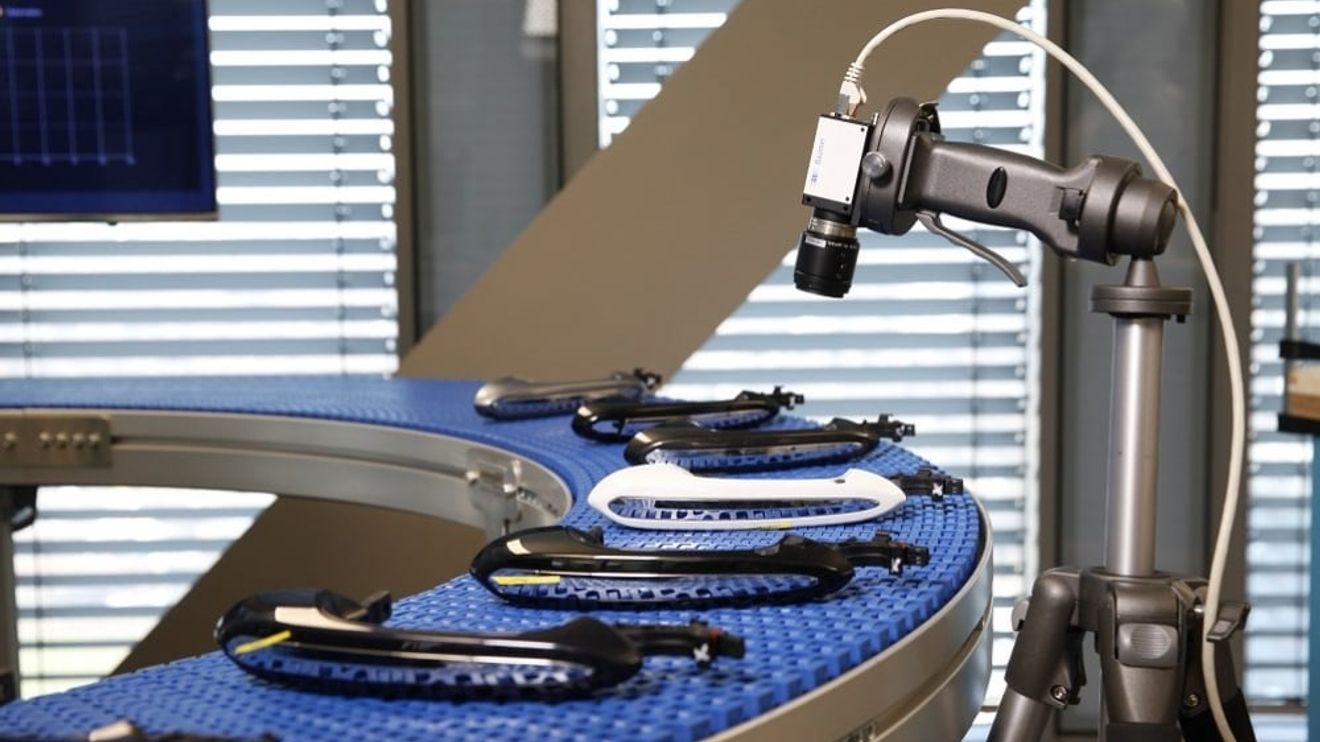
Just two years ago, cognitive visual inspection was a very academic topic. Data scientists were required on the company side in order to set up and train the highly complex neural networks of an image inspection model in-house. In addition, the respective customer-specific solution had to be integrated into the production lines at great expense. These were all factors that made the topic rather unattractive in practice - despite the constantly increasing quality requirements in production. After all, companies need to be able to rely on being able to produce their products with a zero-defect tolerance. Even when more flexibility is required and production quantities are moving towards batch size 1.
In recent years in particular, however, a lot has happened in the field of edge computing for visual inspection, meaning that specialized solutions can now be easily implemented almost at the touch of a button.
The challenge of image processing
In the age of Industry 4.0, it makes sense to automate visual inspection. An algorithm for pattern recognition is tested and trained to not only support the human eye directly on the production line, but also to recognize visual details such as color shading or the finest cracks, which can quickly escape the eye, especially during prolonged use. So far, so good. The challenge in practice has so far been to implement the superimposed model at the place of use.
Just a few years ago, this meant that the system environment had to be extensively rebuilt and statically adapted so that standardized and easier to evaluate images could be created. In addition, traditional approaches were still developed manually, which meant that they were application-dependent and often could not be extended to new applications. Such traditional approaches therefore generally suffered from a lack of flexibility and very limited scaling options; they also often required costly and time-consuming manual application development by experts in specific fields. Given these prospects, many companies were reluctant to take the step of implementing automation in image processing.
Implementation simplified

Thanks to automated visual inspection, product quality is increasing, while it is becoming easier and easier to bring the technology to the production line. Quality inspectors can now independently retrain and adapt the algorithm without the need for a data scientist.
© IBMToday, implementation has been significantly simplified and additional products, interfaces and integration options have been added. Above all, visual inspection can now be integrated into continuous customer processes, with artificial intelligence (AI) also playing a crucial role. A model can now be set up centrally, pre-trained and made available in a standardized way. And a quality inspector on site also has the option of adding new samples and images to the model. But what exactly is different?
Essentially, the cognitive visual inspection cycle can still be broken down into three phases.
- Step 1 is the central training of the model in the cloud: the quality standards are defined in this phase. The training process still requires a large amount of data and corresponding resources. However, thanks to the use of AI, this phase has been significantly simplified in comparison: the AI model for cognitive visual inspection only needs a fraction of the training images actually required in the first step in order to achieve solid results. In particular, the recognition of nuances, shading, the smallest micro-cracks or the finest irregularities that the human eye can no longer perceive can make a considerable difference to product quality.
- Once the initial model has been pre-trained for the visual detection of defects, the second step is to implement it in production. The model is brought to the machines via standardized software containers, i.e. decentralized image processing is used 'on the edge' and rolled out widely if required. Suitable edge devices that come into play at the network periphery are now extremely powerful and highly specialized. For example, small graphics processors are used as system-on-dule products such as the 'Jetson Nano' from Nvidia, which can be used to interconnect several neural networks for AI applications. The Jetson Nano can provide half a trillion operations per second (TOPS) in processing for tasks such as image recognition in just a few watts, without the need to run computing power via the cloud.
- Re-training the model is the third step and makes AI-supported visual inspection much more flexible. The model can be readjusted and retrained centrally and by trained quality inspectors on site at any time in order to achieve an increase in quality through greater accuracy. Nowadays, the pre-trained models are already so sophisticated that the rough parameters do not need to be adjusted any further. This means that a data scientist is no longer a prerequisite. Simply by providing additional image material, the quality manager is able to further train the model independently.
In addition, production facilities no longer have to be converted in a time-consuming and cost-intensive manner in order to benefit from the advantages of cognitive visual inspection. Implementing the AI application in the existing production structure is quicker and easier thanks to the new system-on-module devices.
Software centrally controllable

However, greater efficiency in the three stages is not everything; the real highlight is that once the pre-trained model has been set up, it can not only be applied specifically to one plant, but can also be rolled out to all company-wide plants as required - regardless of where they are located in the world.
are located worldwide.
The software can be controlled centrally thanks to the autonomous management solution, the 'Edge Application Manager' from IBM. This is used to deploy and remotely manage AI, analytics and IoT workloads, providing real-time analytics and insights. The solution enables the simultaneous management of a maximum of 10,000 edge nodes by a single administrator and is based on the open source project 'Open Horizon'. IBM 's management framework 'Open Horizon Framework' aims to be able to distribute secure, dedicated workloads to specific edge devices on a large scale in a centralized and controllable manner. This enables a single person to manage an extensive network of edge devices in a secure, centralized and simplified way.
Cognitive visual inspection using AI and edge computing can be used to automate not only production, but also, for example, the preparation of expert reports, such as for a wide variety of paint damage at vehicle inspection centers.
What are the benefits of 5G?
In order to fully utilize intelligent image processing solutions, it takes more than cameras and sensors. The software and the corresponding system infrastructure are at least as important - if not the key to the smooth functioning of the algorithms.
It is possible to run sensitive quality processes via cloud computing, but this makes production in particular heavily dependent on an internet connection. In practice, disconnected edge architectures are not yet widespread in many cases, although they offer great potential for using AI in visual inspection in an uncomplicated, flexible and cost-effective way.
According to a Gartner study from 2018, 10% of data is currently processed 'on the edge' - a figure that is expected to rise to 75% by 2025. In the future, the role of edge components in a wireless standard such as 5G will have its very own significance.
The specification of the standard stipulates that computing nodes with different computing capacities are available at the respective physical stations in the network, via which certain loads can already be processed locally. 5G should be seen as complementary to IBM 's 'Open Horizon Framework': While 5G specifies the decentralized computing capacity, the framework specifies which workloads the respective components should perform.
Central management solutions such as the 'Edge Application Manager' or the 'Open Horizon Framework' together with 'small boxes' such as the 'Jetson Nano' and mature wireless standards such as 5G will make edge computing in production a reality in the future, as they significantly increase the attractiveness of applications such as cognitive visual inspection. And who knows - what is AI-supported visual inspection today could be the entire production process à la 'Smart Factory on the Edge' tomorrow.


You might also be interested in
ABB and IBM combine their expertise
ABB and IBM are working together on cybersecurity. In future, ABB process control systems will be able to connect to the IBM security platform. This will make it easier to detect digital threats.
 read more...
Highly sensitive wafers moved safely
Until now, the transport of wafers from one workstation to the next with the help of robots has been hampered by the lack of precision with which mobile robots move and grip. A solution from Kuka and Cognex aims to change this.
read more...Sick and Microsoft cooperate on 3DToF
Together with Microsoft, Sick wants to drive forward the development of commercial industrial 3D cameras and related solutions. These are compatible with a Microsoft ecosystem based on the Microsoft Depth, Intelligent Cloud and Intelligent Edge...
read more...Mobile or for use in confined spaces
The robustly built high-speed camera Phantom VEO 1310 from High Speed Vision is suitable for research, development and production automation.
read more...SWIR hyperspectral camera for industrial high-speed inspection
Teledyne Dalsa launches 'Kaleido', a hyperspectral camera for use in the shortwave infrared (SWIR) range, designed to overcome the existing integration and performance limitations of industrial sorting processes.
read more...IDS and Prophesee intensify partnership
IDS and Prophesee are intensifying their partnership for the next generation of event-based industrial cameras. Together they want to explore new sensor architectures that combine classic imaging with Prophesee's event-based 'Metavision' technology.
read more...Dual leadership in Shanghai
Stefan Becker has been appointed Managing Director of Eckelmann Automation Technology in Shanghai and will manage the subsidiary together with Zhongwei Huang.
read more...IDS Imaging Development Systems
Camera series for streaming, monitoring and event recording
IDS Imaging Development Systems launches the 'uEye Live' camera series with the 'uEye SCP' and 'uEye SLE' product ranges. They specialize in monitoring tasks, deliver various live streams and also enable event recording.
read more...AI and streaming meet robustness
IDS Imaging Development Systems is expanding its range of AI cameras with the 'IDS NXT oslo'. The model combines artificial intelligence with video streaming and recording functions in a compact, industrial-grade housing.
read more...