

Interview with Martin Cotter, ADI
Success through collaboration
With the ADI Catalyst, Analog Devices is taking a new approach to product and system development. In this interview, Martin Cotter, President Analog Devices EMEA, talks about cross-company development, deep trust and what Europe has to do with it.
Why did Analog Devices create the Catalyst?
Martin Cotter: The Analog Devices Catalyst actually came about because we realized that semiconductor technology is capable of serving more customers. Many companies were developing small analog circuits themselves, and now they are demanding more - including from us. Our customers want to take advantage of the digital world of data and our technologies can help. For us, this means that we have to understand the system in order to influence it with our technologies. For example, in order to benefit from one of our innovations in the next product generation, such as a new robot, several adaptation cycles are required at several of the robot manufacturer's suppliers. In the past, we visited these suppliers for a week every three months or so to work with them on the components. So it took a very long time for the effects of our technology to reach the end user, the user of the robot. In the ADI Catalyst, all parties come together to work on the system. Through the collaborative development approach, we shorten the time for the introduction of a new technology by perhaps two years per supplier, and the market launch of new end products ultimately by three to four years.

Martin Cotter, President of Analog Devices (EMEA), is responsible for the Industrial and Multi Markets division as Senior Vice President.
© ADIWhat advantages does ADI technology and the new development approach offer robot users?
Cotter: A robot automates production, but also provides information. Our customers, in this example the robot manufacturer, see the need to create added value through the digital world: Production processes can be monitored using sensor technology and the collected data can help to optimize the process. Data is usually processed directly on the robot application. So it's all about smarter technology at the edge - and that comes from ADI. In this way, we become part of its differentiation, as our technology enables robot users to optimize processes, make them more flexible and increase product diversity in production.
When exactly do your customers come to you? During product development or during prototyping?
Cotter : As a rule, customers come during prototyping, they want to manufacture the first generation of a product. The aim is to speed up the introduction of new technologies.
In the beginning, we thought we would have to convince our partners of ADI Catalyst. But ultimately it starts with them: they have a problem and come to us to improve their system. What we've found is that it's usually a problem of a bigger scale. If it's a good problem, a valuable problem, they invest and we invest. So it's a collaboration where each side benefits: We can't solve the problem alone because we don't know enough about it; our partners can't solve it because they don't know our products and their properties. Together, we come closer to solving the problem in a different way that we hadn't thought of before.

For this to work, all partners have to be very open about their expertise. So how can you convince them of this?
Cotter : There is a very high level of trust. It has to be clear from the outset what we and they are offering and what we can expect from each other. As a rule, this is very clearly defined.
Europe is a very interesting place for this approach because the European Union, with its 30 years of experience in EU projects, is also based on cooperation. Almost all European projects require more than one partner country and more than one country as well as clear role definitions, and we follow this model. This means that the protection of each partner's intellectual property and the rights to future intellectual property from the cooperation project are clearly defined. To put it simply: what belongs to us belongs to us, what belongs to them belongs to them, what we develop together, we use together. However, cooperation does not begin with a comprehensive contract, but with the establishment of mutual trust.
Does the European approach also work for partners from Asia and
America?
Cotter: International companies are used to operating in Europe. They are no strangers to using this European model. In my opinion, the same approach with the same intellectual property framework can be implemented in other countries such as the United States and Asia.
Success through collaboration - continued
Are the developments and solutions in Catalyst hardware- or software-driven?
Cotter: In Catalyst, we work in a solution-oriented way and a solution consists of hardware and software. Let's take a drive solution as an example: the goal is an energy-efficient drive system with very precise motor control. A stepper motor has around a tenth of the power consumption of an induction motor, so it offers an advantage. It becomes a full drive system thanks to the motor control consisting of semiconductor architectures and a unique algorithm. The value of the overall solution therefore results from the combination of hardware and software: the hardware has a specific architecture, but the software makes it possible to utilize the flexibility in the architecture.
Keyword energy efficiency: Digitalization is seen as a key technology on the way to greater energy efficiency. However, digital solutions also require servers for data processing, which are known to require a lot of energy for operation. Isn't that contradictory?
Cotter: This is a very complex question that not only includes the overall energy requirement, but also the question of the added value or benefit of a technology. I think it's everyone's responsibility to use a technology for its best purpose - in this case, digitalization. And data centers are part of this new world. Our aim is to counteract inefficiencies and the potential for energy savings is huge, especially in the industrial sector. Let's stay with the example of data centers: we offer a power supply solution that allows a 48 V power supply right down to the individual cores of a server system. This means that the solution can bypass a conversion in the power circuit and thus increase the system efficiency by three to four percent. This means we can improve inefficiency by a third. Motors in an industrial environment are another example of a high potential for energy savings. More than half of the electric motors in industrial applications are over ten years old and have no variable frequency control. Replacing every one of these older motors in every factory in the world with a modern drive system would have the fastest and most massive impact on energy demand worldwide. Replacement is slow because companies are reluctant to invest in a functioning factory. A way must therefore be found to make investment in energy-efficient technologies attractive. Europe is leading the way here and has passed a law that regulates the use of energy-efficient motors in industrial plants.
Nevertheless, energy costs still account for a high double-digit percentage of total operating costs. The payback period for energy-efficient motors is therefore short. In my opinion, this will develop into a dynamic and we are very much looking forward to this moment. Energy efficiency - sustainability in general - is very important to us and we are trying to help reduce carbon emissions with our developments and solutions.
Back to the ADI Catalyst and product development with partners - is this the new way for companies to be and stay competitive?
Cotter: Yes, absolutely! But you have to trust that the outcome of working together is better than what each could do on their own. It's a new kind of competition and I think the smarter companies will open up to it. Basically, it's like a village: only as a community can you achieve the big goals. As I mentioned at the beginning, we thought we would have to convince our partners of the concept. And now look around you: It works all by itself!
| ADI Catalyst |
|---|
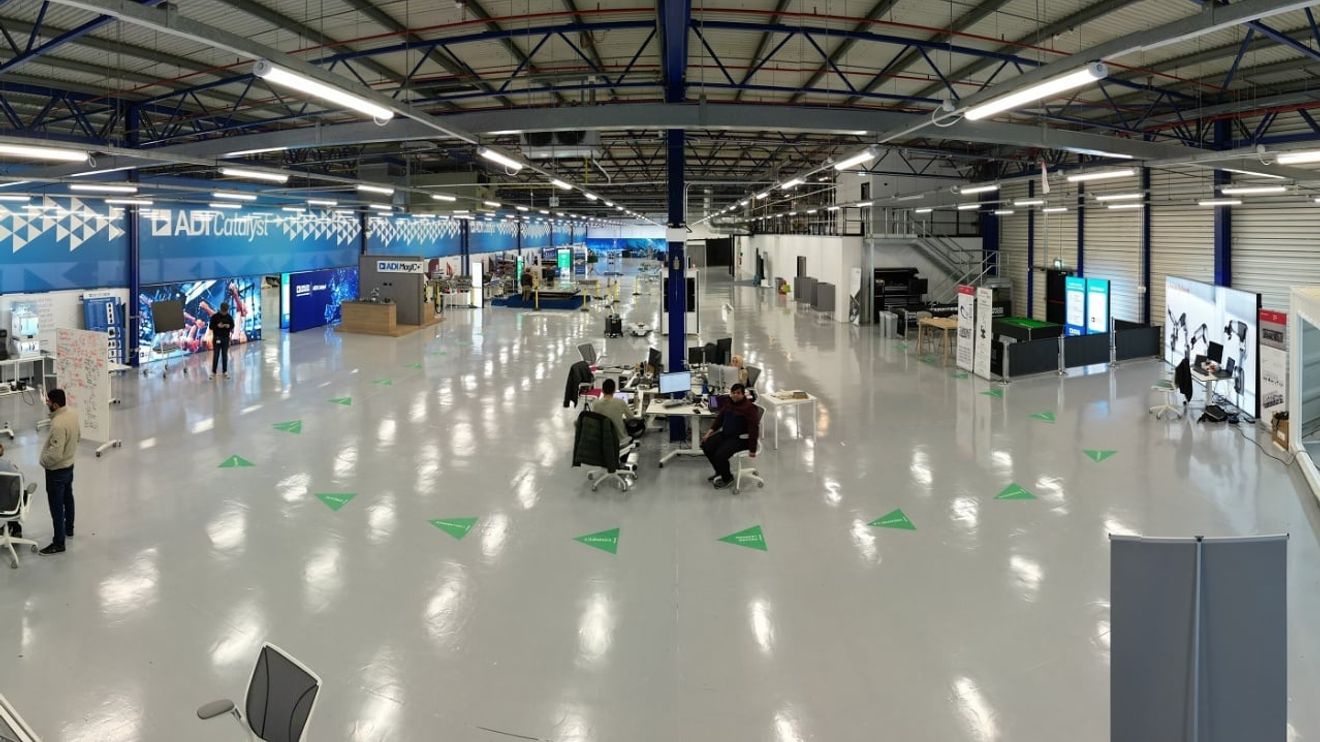
| With the ADI Catalyst, Analog Devices has created a facility for collaborative development. The hub is connected to the European research and development center in the Raheen Business Park in Limerick, Ireland. Covering an area of almost 10,000 m², the aim is to accelerate collaboration between customers, business partners, suppliers and ADI. The aim is to develop solutions as quickly as possible. The center is currently under construction. By 2025, the company plans to invest €100 million and create up to 250 new jobs, focusing primarily on the development of software-based solutions and innovations in the field of artificial intelligence (AI) for application areas such as Industry 4.0, sustainable energy, vehicle electrification and next-generation connectivity. |


You might also be interested in
International Federation of Robotics
U.S. Robotics Industry Sees Double-Digit Growth
In the U.S., sales of industrial robots rose by 11% compared to the previous year: 38,000 units were newly installed in 2025. This significant recovery is driven by robust growth in the food industry and other non-manufacturing sectors. However, the...
 read more...
International Federation of Robotics
The 2026 IERA Award was presented
The 2026 “Award for Innovation and Entrepreneurship in Robotics & Automation” (IERA) goes to the Swiss deep-tech company Verity for its fully autonomous indoor drone system. The flying robots support the logistics and retail sectors by...
read more...Quantum-resistant hardware security for Nvidia robotics platform
Infineon Technologies integrates the hardware security module 'Optiga TPM SLB 9672' into Nvidia's 'Jetson Thor' computing platforms for robotics and autonomous systems. The module secures cryptographic keys directly at chip level and thus protects...
read more...6 Criteria for the objective comparison of humanoid robots in industry
A new benchmark from Fraunhofer IPA is intended to enable the first standardized and neutral analysis of humanoid robots for industrial use based on six key criteria.
read more...Regulation and safety slow down robotics projects in Germany
QNX has published the study "Inside the Robot: Architecture Benchmark Report". The results of the global survey of 1000 robotics developers show that software and safety requirements are increasingly becoming the central bottleneck for innovations...
read more...'Physical AI' as a turning point for robot use?
Physical AI - AI that can act more freely in the physical world beyond predefined processes - is regarded as the next evolutionary stage of artificial intelligence. Companies see great potential in this, especially for robotics, in the coming years....
read more...International Federation of Robotics
China puts AI robotics at the center of its national strategy
With its 15th five-year plan, China has placed robotics at the center of its new industrial strategy. The aim is to focus AI research on physical applications and use robotics as the main driver of economic growth.
read more...Autonomous pallet handling for confined storage and production environments
Filics presents the latest generation of the 'Filics Unit', which consists of two synchronized, physically separate robots and is designed for ground-based Euro pallet transport.
read more...World's largest robotics training center planned
The Munich Institute of Robotics and Machine Intelligence (TUM MIRMI) at the Technical University of Munich (TUM) and Neura Robotics are joining forces to create the world's largest research and training center for robotics in the scientific field....
read more...