
Weidmüller
Automated machine learning
Use analytics to optimize operations, improve product quality and create new business models without prior knowledge of data science? Develop and operate machine learning models without being a data expert? Software makes it possible.

To date, only a fraction of the data available through digitalization in production facilities has been specifically evaluated. The use of artificial intelligence to evaluate data can, for example, help to improve the quality of products, optimize processes or continuously monitor the condition of a machine. But what does this mean for machine manufacturers and plant operators? How deeply and in what form do they need to engage with artificial intelligence (AI)?
As a rule, the creation of machine learning (ML) models is time-consuming and the implementation is cost-intensive: in the classic approach to developing an ML model, a complex manual process has to be run through, which processes a data set via various process steps and only then leads to the ML model. The data set used for this consists of historical data from the machine or the processes under consideration. These complex processes are usually carried out by data scientists.

Using the Weidmüller Industrial AutoML software to evaluate data helps, for example, to improve the quality of products, optimize process sequences or continuously monitor the condition of a machine.
© WeidmüllerWeidmüller takes a different approach here: the 'Industrial AutoML' software relies on the knowledge of the domain experts. This means that the data analysis - which would otherwise have to be carried out by a data scientist from an external partner or from within the company - is provided by the tool, which is 'merely' fed with the expert's application know-how. In other words, the knowledge about the machine and its application flows directly into the modeling. This symbiosis of technical expertise on the machine and data science know-how from the tool delivers results quickly and easily - without the need for extensive training or the purchase of additional know-how.
The software tool automatically runs through the steps required to create ML models for a wide range of ML algorithms. It then automatically determines which ML models most robustly recognize relevant machine states or process criteria.
Navigation
The software tool guides the user through the model development process for the simple development of ML models. ML automation primarily concerns the following steps: Data import, data enrichment, automated model creation and model deployment. To this end, the software consists of the 'ModelBuilder', which is used to create the models, and the 'ModelRuntime' for deployment and use of the models. The software not only helps users to prepare the training data, but also translates and archives their complex application knowledge into a reliable ML application. The expert focuses on their knowledge of machine and process behavior and links this with the machine learning steps running in the background. In this way, the user also benefits from the latest developments in the machine learning environment, which are continuously incorporated into the tool. To further simplify the use of the tools for users, the navigation of the ModelBuilder in particular has been improved.

The software tool guides the user through the process of model development and optimization.
© WeidmüllerDiscrete processes taken into account
Up to now, data analysis has often ignored the fact that a machine runs through different cycles. Instead, these are seen together as one database and analyzed together. However, a clear separation of the individual cycles is important in order to be able to make precise statements about product quality during operation, for example.
Weidmüller has therefore further developed the software so that discrete processes are also taken into account. In the time series view, a value or an individual variable is recorded over a certain period of time. This allows the individual cycles to be analyzed separately. The behavior of the machine within a cycle is considered so that, for example, differences in the sensor curves from cycle to cycle can be better identified. This is a significant improvement on the previous approach: In the application of the models - the ModelRuntime - statements can now be made about the quality of an individual workpiece, for example.
Execute ML models
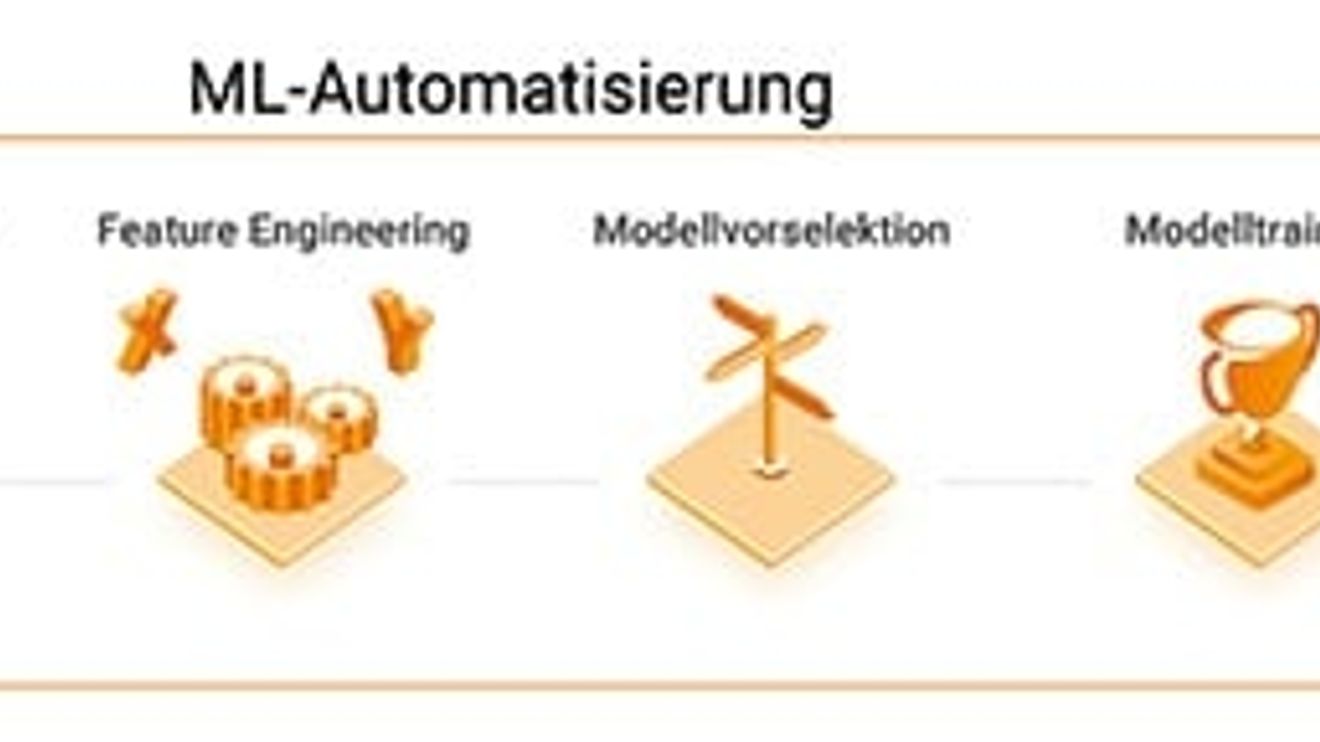
The Industrial AutoML tool automates the steps required to create machine learning models for a wide range of ML algorithms.
© WeidmüllerThe models can be executed directly on the machine 'on-prem' or in the cloud. In the AutoML ModelRuntime, i.e. the runtime environment, users configure, operate and evaluate their own ML models. The ModelRuntime is based on Docker containers, in which the essential elements for executing the ML models are linked together: Definition of the machines, connection of the data sources, models to be executed and configuration of the model execution. The ML models created are imported and assigned to the respective machine. In this way, the model results can be incorporated into the further operational process, for example to trigger messages about the respective machine status.
Various sources of information
The amount of data to be analyzed is constantly increasing, but it is not always available in the same consistency. As the data usually comes from different information sources - be it sensor data such as temperature or pressure, motor speeds or current curves - it can differ significantly in terms of the time intervals at which it is generated. Temperature data, for example, is recorded slowly, perhaps only once an hour - in contrast to pressure measurement, which is continuous and therefore generates much more data in a short space of time. As a result, there is a different amount of data per information source and the machine learning tool has to distinguish between these different data sources.
The Industrial AutoML tool takes into account the fact that the data is read at different intervals and compensates for these differences without the need for an external tool. The software consolidates the data, regardless of whether it is available at long intervals - as in the case of temperature measurement - or continuously - as in the case of pressure measurement. The models take into account data with different sampling rates (update rates) and use this knowledge to create individual models. Different sampling rates for the input data are not a problem for model training or for the subsequent execution of the models; the values are considered in correlation with the cycle time.
Optimized data requirements

When evaluating data in the cloud, for example, it is relevant how much data is transferred to the cloud, as each transfer costs money. With the Industrial AutoML tool and the integrated cycle analysis, the volume can be optimized. Users can control their cloud costs themselves by sending data to the cloud at different update rates. At the same time, they can determine how often the models generate results in order to save on data transmission and storage. For example, in the case of temperature observation, a model based on low update rates should be selected, as it is known that the temperature values only change slowly. This reduces the cloud costs.


You might also be interested in
Added value through data
Weidmüller focuses on supporting users in transforming their data into added value - from data acquisition, pre-processing and communication to data analysis and business logic.
 read more...
Democratization of machine learning
The 'Industrial AutoML' software enables companies to implement machine learning models independently - without a data scientist. The application engineer contributes their domain knowledge and the software automatically creates the ML model.
read more...No digital (industrial) future without artificial intelligence
High energy costs, uncertainties in the energy supply chain and the strong focus on China as an export country are calling into question the future viability of Germany's (export) business model. The transition to a smarter, more intelligent...
read more...Sensor platform for AI testing in SMEs
KNIME is free software for analyzing large amounts of data. The KNIME2Edge platform is designed to enable companies to get started with AI technology without having to invest a large amount of resources and specialist staff at the outset.
read more...Research building opened in Bremen
One of the most important research institutions in Germany in the field of artificial intelligence has opened a new building in Bremen. The DFKI intends to use the extension to advance research into future topics, according to a press release.
read more...EU Commission wants to protect victims of artificial intelligence
According to the EU Commission, anyone who suffers damage due to artificial intelligence should be able to claim compensation more easily in future. According to the Commission, this should also increase confidence in new technologies.
read more...IDS Imaging Development Systems
AI-based pick and place
Traditional pick-and-place tasks in industry are still largely carried out by humans. However, artificial intelligence can lead to a decisive change - robotics processes in the machine vision environment can also be automated using AI.
read more...Winner of the Achema Founder Award 2022 selected
The Achema Start-up Award took place again this year. This year's winners of the Start-up Award are Semodia, Pipe Predict and Lumax Biotech.
read more...Reducing the CO2 footprint with machine learning
The ecological transformation can be accelerated with the digital transformation. Various examples show how artificial intelligence can be used to reduce the carbon footprint in production. But how sustainable is AI?
read more...