

AI Agents in the Industry | Part 3
Bridging the Gap
Companies are increasingly using AI agents as digital employees in industrial environments. This raises a crucial question: how can we effectively connect these agents to the data sources they need to do their work? Two approaches to connecting AI agents with enterprise data sources.

As organizations increasingly deploy AI agents as "digital employees" in industrial environments, a critical question emerges: how do we effectively connect these agents to the data sources they need to function? This article explores two primary strategies for bridging this gap and examines when each approach delivers optimal value.
The challenge is not merely technical, but strategic. Organizations must choose between standardized, interoperable solutions and proprietary, tightly integrated frameworks. Each approach offers distinct advantages and limitations that directly impact return on investment, security posture, and operational effectiveness.
In this article, we will examine two main strategies:
- Using Model Context Protocol (MCP) as a standardized approach for connecting Large Language Models to data sources
- Custom frameworks, such as AWS Bedrock Agents, for proprietary integration
Continuing the conversation Our previous articles established two fundamental principles. First, we explored how Generative AI functions as a skilled digital worker, requiring clear procedures and comprehensive instructions to perform specific actions effectively. These AI agents operate much like human employees, needing context, guidance, and access to relevant information.
Second, we demonstrated that data serves as the foundation of trust between digital workers and human operators. When AI agents provide recommendations, such as suggesting infrastructure replacements or configuration changes, human operators need confidence in the underlying data analysis. This trust comes from comprehensive, longitudinal data that allows AI agents to provide transparent, explainable recommendations backed by historical patterns and quantifiable evidence.
The Industrial Scenario: Network Troubleshooting
To illustrate both approaches, we return to our network troubleshooting scenario from the first article. The problem begins with a simple question: "Why can't the PLC connect to New Sensor 2?"
When a human network engineer approaches this problem, they follow a systematic methodology. First, they gather fundamental information: network topology, device inventory, and access credentials. Next, they validate basic connectivity to check whether devices are powered correctly, if cables are connected and network interfaces are operational. Finally, they examine configuration details, comparing VLAN settings, IP assignments, and routing tables across devices.
This process requires access to multiple information sources: network documentation, device manuals, configuration management databases, and direct device interfaces through web consoles or command-line interfaces. The engineer must correlate information across these sources to identify the root cause and implement a solution.
The MCP Approach: Standardized Integration
The Model Context Protocol offers a standardized method for connecting AI agents to data sources. In our network scenario, this approach requires network equipment vendors to provide MCP servers -either hosted directly on network devices or as customer-deployed applications with device credentials.

The MCP Server implementation includes three key components:
Tools: Tools are a powerful primitive in the Model Context Protocol (MCP) that enable servers to expose executable functionality to clients. Through tools, LLMs can interact with external systems, perform computations, and take actions in the real world, such as CLI connections for retrieving network topology and port status information
Resources: Resources are a core primitive in the Model Context Protocol (MCP) that allow servers to expose data and content that can be read by clients and used as context for LLM interactions, including Web UI manuals that enable the AI agent to generate valid steps for specific network devices.
Prompts: Prompts enable servers to define reusable prompt templates and workflows that clients can easily surface to users and LLMs. They provide a powerful way to standardize and share common LLM interactions, such as standardized VLAN information queries and port configuration checks.
Users configure multiple MCP clients (such as Anthropic Claude Desktop) to connect with multiple MCP servers, creating a distributed network of AI-accessible resources (Figure 1).
Real-World Implementation: Belden's HiOS Documentation Experience via MCP Server
Belden's journey with MCP began with a specific challenge: making our extensive HiOS (Hirschmann Operating System) documentation accessible to AI agents for network troubleshooting. HiOS powers our industrial networking equipment, and its documentation represents years of engineering expertise covering complex networking protocols, device configurations, and troubleshooting procedures.
Our implementation leveraged AWS Knowledge Bases to create an Agentic RAG (Retrieval Augmented Generation) system with advanced preprocessing techniques. We used the open-source Bedrock Knowledge Base Retrieval MCP Server from AWS Labs, which provided a standardized interface between MCP clients and our corporate AWS infrastructure. This approach allowed us to maintain our existing AWS SSO security framework while exposing documentation capabilities to AI agents.
The AWS Knowledge Bases foundation proved crucial for this implementation. Rather than relying solely on general foundation model knowledge, our system could retrieve specific, proprietary information from HiOS documentation to improve response relevancy and accuracy. When network engineers asked questions about device configurations or troubleshooting procedures, the AI agent could search our comprehensive documentation repository, find relevant information, and provide responses backed by authoritative sources with proper citations.

Our setup process followed AWS Knowledge Bases best practices. We connected the knowledge base to our unstructured HiOS documentation stored in S3, configured Amazon OpenSearch Serverless as our vector store for indexing embeddings, and implemented regular synchronization to keep the knowledge base current with documentation updates. The system could answer user queries by returning relevant information from our documentation, augment AI responses with retrieved technical details, and provide citations to original documentation sources for verification (Figure 2).
The Technical Reality: Challenges and Complexity
However, our implementation revealed significant practical challenges that organizations must consider when adopting MCP. The technology proved highly technical, requiring sophisticated host applications like Claude Desktop to function effectively. This presented immediate friction in our Microsoft Office-centric environment, where most users rely on familiar tools like Amazon Q Pro and Q Pro CLI for their daily workflows.
Installation complexity emerged as a major barrier. Each workstation required installing Python or Node.js client programs, a straightforward task for developers but a significant challenge for network engineers and operators without programming backgrounds.
Credential management added another layer of complexity. While our corporate AWS SSO setup provided elegant authentication for users already familiar with AWS workflows, extending access to field engineers and operators will require additional configuration and training. Each user needed to understand not just how to use the MCP server, but how to maintain their AWS credentials and troubleshoot authentication issues.
The JSON configuration requirements will created significant user experience friction. Engineers accustomed to graphical interfaces might find the manual configuration editing process error-prone and intimidating. Fortunately, Claude Desktop's recent introduction of Desktop Extensions (DXT files) on June 26, 2025, has dramatically simplified this process, allowing one-click installation and configuration.
MCP Characteristics and Strategic Trade-Offs
The MCP approach offers compelling advantages that make it attractive for organizations with specific requirements and capabilities. Transparency stands out as a benefit -all tools, prompts, and resources remain visible to users, providing ground for inspection and customization of AI agent capabilities. This visibility provided is crucial for compliance requirements and debugging complex interactions, particularly in industrial environments where understanding system behavior is essential to secure safety and reliability.
The promise of vendor independence represents another strategic advantage, though with important practical limitations. Organizations can theoretically use any compatible LLM, reducing dependence on specific AI providers and providing negotiating leverage in vendor relationships. However, our experience revealed that prompts require significant optimization for different models, limiting practical portability. What works effectively with Claude may require substantial modification for GPT-4 or other language models.
Modular development are perhaps the most immediately practical benefit for organizations with internal development capabilities. Teams can develop specialized MCP servers independently -one for network analysis, another for documentation retrieval, and a third for security procedures. This separation allows expertise to be focused where most effective within different teams, while still maintaining a consistent interface for AI agents.
However, MCP also presents significant challenges that organizations must carefully evaluate. Infrastructure complexity increases substantially compared to traditional integrations. Organizations must deploy and maintain MCP server infrastructure, handle updates, monitor performance, and uphold high availability across multiple servers. Consequently, amount of resources required may preferably be invested elsewhere.
Authentication considerations multiply in distributed MCP environments. Each server requires its own authentication and authorization mechanisms, creating additional security considerations and potential points of failure. While recent MCP updates have addressed many early vulnerabilities, the distributed nature of the architecture inherently creates a larger attack surface compared to centralized solutions.
The reality of LLM interoperability falls short of theoretical promises. Despite vendor independence claims , maintaining multiple versions of prompts and procedures for different AI providers adds operational overhead and complexity that organizations must handle. This might be considered limitation of the practical benefits that standardized approach brings when using multiple AI systems.
Optimal Use Cases for MCP
MCP excels in specific scenarios that align with its architectural strengths and capabilities. The approach works best for organizations with publicly available documentation, standardized procedures, and minimal intellectual property protection concerns. Network device documentation, CLI command references, and standard troubleshooting procedures represent ideal MCP applications where transparency and standardization provide clear benefits.
Businesses with strong internal development capabilities and preferences for open standards will find MCP particularly appealing. Our experience with HiOS documentation demonstrated this -we could integrate our proprietary documentation with standard networking resources through a unified interface.
MCP also works well for those requiring maximum transparency and auditability in their AI implementations. The visibility of all tools, prompts, and resources allows for detailed inspection and validation of AI agent behavior, crucial aspect for regulatory compliance and operational safety in industrial environments.
The Custom Framework Approach: AWS Bedrock Agents
Although MCP serves as an excellent building block for AI integration, it represents a foundation rather than a complete solution. When customers need a system that functions as a skilled digital worker capable of complex reasoning they must consider whether to assemble multiple MCP servers or bet on a custom framework designed for end-to-end AI applications.
The decision often comes down to practical realities. Consider our network troubleshooting scenario: a single web UI manual that we referenced in our MCP implementation contains over 1,000 pages of technical documentation. Across our product line, we maintain hundreds of such manuals, each covering different aspects of network management, troubleshooting, and optimization. If we wanted to offer customers deep expertise across all these domains through MCP, we would need to provide potentially thousands of individual tools through multiple servers.
Subsequently, several critical challenges surface. When an LLM encounters hundreds or thousands of available tools, it can become overwhelmed and will struggle to select the most appropriate actions for specific situations. In enterprise networks with hundreds of devices, each potentially hosting its own MCP server, we would need host systems capable of managing complex credential schemes across multiple devices while ensuring secure access patterns. Perhaps most importantly, we cannot allow LLMs to issue configuration commands directly via CLI when we only need to retrieve data from devices -the security implications would be unacceptable.
These challenges require network management systems and AI agents to work together in ways that transcend simple tool integration.
Implementation Architecture
Custom frameworks like AWS Bedrock Agents take a fundamentally different approach, moving the complexity of managing security, hosting, data processing, and AI coordination into a managed platform. Rather than asking customers to configure and maintain distributed systems, this approach transforms what was previously a risky and painful.
When complexity involves configuring and aligning numerous moving parts, a custom framework can consolidate all these elements into a secure and reliable solution. Data, processing, and AI agents become tightly integrated to offer secure, timely, and cost-effective solutions precisely when and where customers need them.
MRP Troubleshooting Agent
Belden developed an internal MRP (Media Redundancy Protocol) troubleshooting agent that clearly demonstrates the practical advantages of the custom framework.
It addresses one of the most complex challenges in industrial networking: analyzing redundancy configurations across multiple devices and network topologies. MRP provides critical redundancy for manufacturing processes, and misconfigurations can result in production downtime, safety concerns, and significant financial losses.
Our technical architecture integrates multiple specialized components to deliver comprehensive troubleshooting capabilities.. We established secure edge-to-cloud connections that share only required data with our solution to minimize the attack surface while securing comprehensive analysis capabilities. Advanced preprocessing techniques helped the LLM identify exact root causes by structuring and contextualizing raw network data before analysis. Integration with our comprehensive documentation enabled the system to offer the best possible solutions backed by authoritative sources and proven procedures.
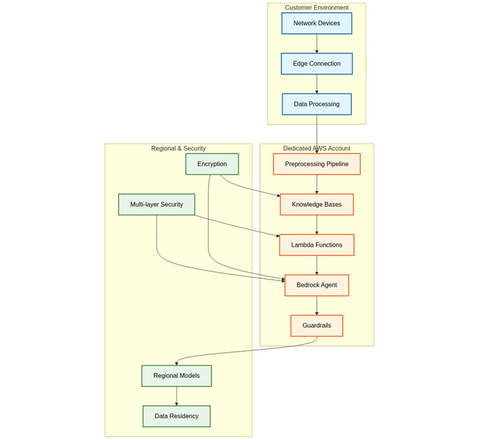
With this solution, AWS IAM, AWS KMS and AWS Bedrock Guardrails provide multiple layers of safety controls to prevent harmful outputs. The architecture runs in dedicated AWS accounts per customer. It follows a single-tenant approach that provides the highest level of security and data isolation. We deploy models in the customer's preferred region to improve user experience and comply with data residency requirements. Beginning this fall, we can also offer deployment via the EU AWS Sovereignty Cloud for customers with the most stringent sovereignty requirements (Figure 3).
The Benefits of Integrated Frameworks
User-friendly procedures eliminate the need for complex configurations, LLM hosting decisions, or managing prompt interoperability issues across different AI providers. Customers can focus on their core networking challenges rather than becoming AI infrastructure experts. Our engineering teams refine preprocessing algorithms, update documentation integration, and improve troubleshooting procedures without requiring customer updates.
Protection of companies intellectual property becomes straightforward within a managed framework. The custom framework approach allows companies to monetize their expertise while keeping proprietary algorithms and procedures secure from competitors.
AWS provides strong security through encryption for stored and transmitted data, full audit logging, and advanced threat detection – it is all built into the platform. It would be costly and complicated for most organizations to put it in place themselves, especially smaller businesses or those without specialized IT security departments.
With managed services, it is much easier to manage costs. Organizations benefit from efficient resource use and clear, predictable pricing. There’s no need to invest, yet users still gain access to the latest technologies.
Optimal Use Cases for Custom Frameworks
The framework particularly suits organizations building customer-facing products and services where reliability, performance, and user experience directly impact business outcomes. When technical expertise represents competitive advantage, custom frameworks boost monetization while at the same time protect proprietary knowledge and procedures.
For organizations that need strict security and compliance, a custom frameworks are often the better fit. Managed services, on the other hand, let teams use advanced AI tools without having to build or run the infrastructure on their end. Consequently, they can allocate more resources on what they do best and deliver more value to their customers.
Future Convergence and Industry Evolution
Both approaches will likely coexist as the industry matures. Public documentation and standard procedures may increasingly adopt MCP standards, while proprietary solutions and competitive advantages remain protected within custom frameworks.
The industry may eventually achieve greater standardization in tool and resource connectivity, though LLM prompt interoperability appears unlikely in the near term. This suggests that MCP servers may need to maintain multiple prompt variations optimized for different language models, adding operational overhead.
Cloud providers continue to excel in managing complex security infrastructure, compliance requirements, and operational overhead. This advantage may persist as organizations seek to focus on core competencies rather than managing AI infrastructure.
AI agents - more than just a technical decision
Our real-world experience implementing both MCP and AWS Bedrock Agents reveals that the integration of AI agents with enterprise data sources represents more than a technical choice, it reflects fundamental decisions about strategic priorities and preferences.
Belden's implementation of MCP for HiOS documentation integration demonstrated both the promise and complexity of standardized approaches. While we successfully connected AI agents to our comprehensive technical documentation through AWS Knowledge Bases, the journey revealed significant practical hurdles. The requirement for technical host applications, complex installation procedures, and sophisticated credential management created barriers that limited adoption among our broader user base. However, the recent introduction of Desktop Extensions (DXT) by Claude Desktop addresses many of these usability concerns, suggesting that the MCP ecosystem is rapidly maturing.
Our AWS Bedrock implementation for MRP troubleshooting illustrated the power of integrated frameworks when organizations need complete solutions rather than building blocks. By moving the complexity of security hosting, data processing, and AI coordination into a managed platform, we transformed what was previously a risky and time-intensive troubleshooting process into an accessible and reliable one. The single-tenant architecture, regional compliance capabilities, and integrated guardrails provided enterprise-grade security while enabling rapid innovation cycles.
Perhaps most importantly, our experience demonstrates that both approaches can deliver significant value when properly aligned with organizational capabilities and use case requirements. The MCP approach revealed the importance of comprehensive documentation integration and the challenges of managing distributed AI systems. The AWS Bedrock implementation showcased how integrated platforms can address complex technical challenges while maintaining security and compliance requirements.
Success in either approach requires honest assessment of organizational capabilities, clear understanding of use case complexity, and alignment between technical architecture decisions and business objectives. As the industry continues evolving, the most successful implementations will be those that recognize these trade-offs and choose the approach that best serves their specific combination of technical requirements, operational constraints, and strategic goals.


You might also be interested in
"AKIMI" Research Project develops AI for Flexible Robotics
The AKIMI research project is launching at the WZL at RWTH Aachen University. The goal is to develop agent-based AI that simplifies the programming and reconfiguration of robotic systems for small and medium-sized enterprises.
 read more...
Trumpf collaborates with the IPAI AI Network
Trumpf is a new partner of the IPAI AI network in Heilbronn. Together, the two parties plan to develop and test artificial intelligence applications for industry.
read more...Siemens makes 'Sinumerik One' AI-capable
Siemens has unveiled a new generation of hardware for Sinumerik One. The CNC controller offers greater computing power, a 64-bit architecture, AI support, and meets the requirements of the EU Cyber Resilience Act.
read more...Valtech Identifies Shortcomings in Agentic AI
The Valtech study “The Agentic Age” shows that skilled workers are open to agentic AI, while many companies have not yet established integrated AI-supported work processes.
read more...Federation Architecture | Part 3
Toward an Industrial-Grade AI for OT
Operational Technology (OT) controls physical processes and therefore operates under preventive and deterministic constraints. Modern AI, by contrast, is probabilistic and improves through iterative learning. Reconciling these paradigms remains a...
read more...Federation Architecture | Part 2
No Architecture Is Perfect
Having introduced the principles of Federation Architecture in Part 1, this article examines their practical implications. It describes operational effects, limitations and areas of application, and situates FA within existing industrial...
read more...Extended three-member Management Board for Deutsche Messe
Deutsche Messe AG is reorganizing its personnel and consistently focusing its Management Board on the further development of the company and the exhibition grounds in particular. With an expanded three-member Management Board, the company is...
read more...Federation Architecture | Part 1
Rethink IT-OT Convergence in an AI-Driven World
AI is shifting threat models for industrial infrastructures. Federation Architecture proposes a disciplined middle ground between isolation and full integration - with edge autonomy, one-way data flow, and human approval.
read more...AI-enabled rugged mobile workstation
With 'Z14I-HG' Durabook presents an AI-ready Fully Rugged Mobile Workstation with Nvidia RTX 5000/3500 Ada graphics.
read more...