
Belden | Part 1 "AI Agents"
AI Agents as "Digital Employees"
AI agents are revolutionizing industrial processes: As digital employees, they combine AI with autonomous functions, act independently and enable new efficiency potential. This article shows how companies can use them successfully - from network analysis to AWS-supported implementation.
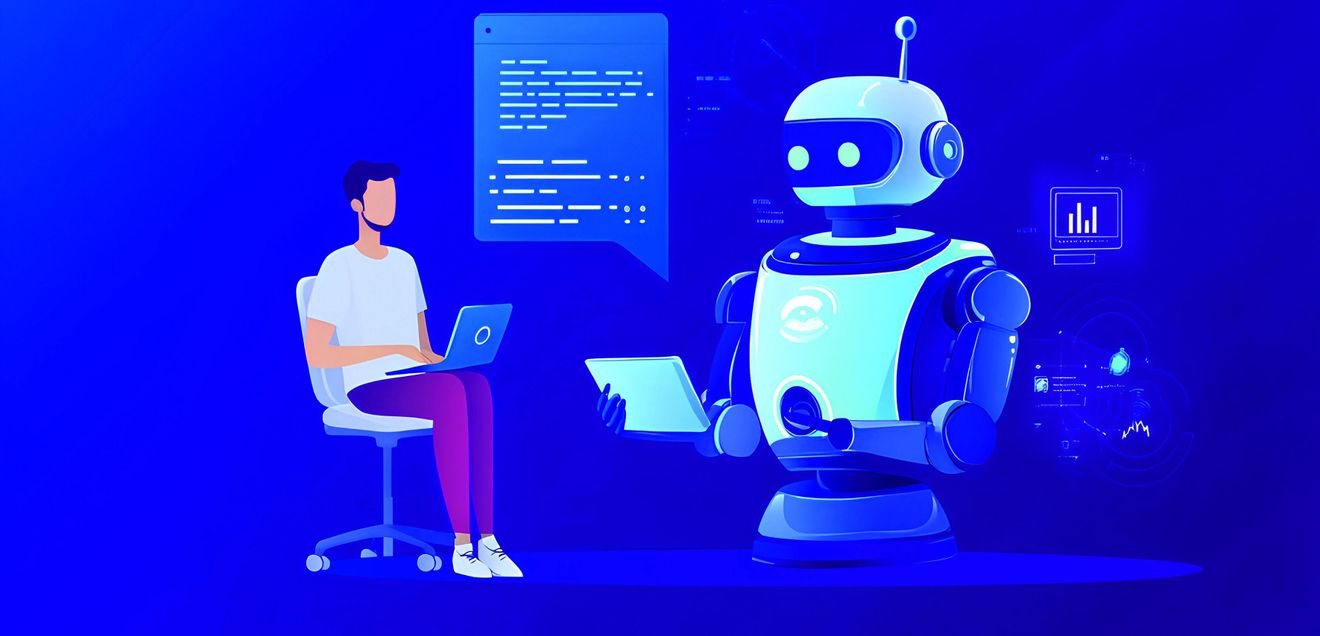
The integration of AI Agents into industrial environments represents a fundamental shift in operational technology (OT) management. Unlike traditional automation tools, AI Agents function as "digital employees" capable of working 24/7 without fatigue or distraction. This parallel to human workforce is not just metaphorical but functional - these systems require clear objectives, access to quality data, proper guidance, and secure working environments.
In OT contexts, where mission-critical systems demand consistent performance, AI Agents should initially be deployed in non-critical operations.
AI Agents represent an emerging class of software systems that combine artificial intelligence capabilities with autonomous operational functions.
- As defined by Google, they are "software systems using AI to pursue goals, complete tasks, with reasoning, planning, memory, and autonomy." [1]
- AWS describes them as "software programs interacting with the environment, collecting data, and performing self-determined tasks to meet goals; rational agents."[2]
- IBM further characterizes them as "systems or programs autonomously performing tasks, designing workflows, and using tools, encompassing decision-making and problem-solving. [3]
In industrial contexts, these definitions converge to describe AI Agents as digital systems capable of independent operation, environment interaction, and goal-directed behavior, functioning much like skilled employees within carefully defined parameters.
According to McKinsey , telecom companies could unlock up to $250 billion in value by 2040 by implementing advanced responsible AI practices, turning exceptional customer service into a strategic business advantage. The key advantage is their ability to combine broad IT knowledge (how to process and analyze data) with domain-specific OT expertise (what data matters and how to interpret it). This combination enables continuous monitoring and analysis that would be impractical for human teams alone[4].
Requirements for Effective AI Deployment
For AI Agents to function effectively as digital employees, organizations must provide detailed instructions and comprehensive data access. Unlike traditional systems that follow rigid programming, AI Agents require context-rich guidance to perform effectively. As with human interns, failing to provide sufficient context results in underperformance.
The input context must include:
- Specific operational parameters and their acceptable ranges
- Historical patterns and known anomalies
- Clear explanation of which metrics require immediate attention
- Detailed protocols for different scenarios
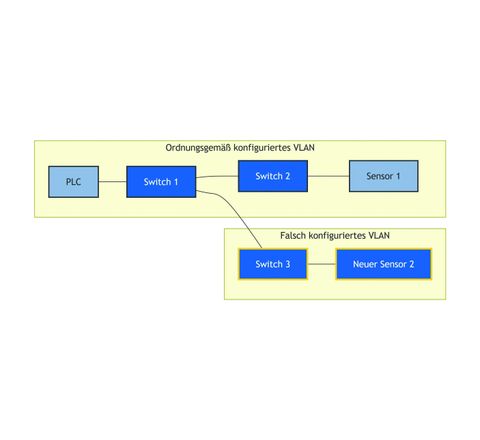
Let's use a simple example of a misconfigured network described on network topology created with Provize Suite (Figure 1). Here we have three end devices: PLC, Sensor 1 and New Sensor 2. The Belden network was initially configured according to best practices by an external consultant, which means that PLC and Sensor 1 were put in a common VLAN network. However, New Sensor 2 and Switch 3 are not using valid VLAN configuration, preventing the PLC from connecting to New Sensor 2.
In the existing setting, an Operator needs a Network Admin's help (external or internal) to configure Switch 3 and New Sensor 2 to fix the connectivity issue, which may take days or weeks.
With a generative AI approach and proper data, this troubleshooting can be offloaded to an AI Agent.
An example dialogue between Operator and AI Agent might look like:
|
Operator: Why can't PLC connect to New Sensor 2? AI Agent: The connection issue is due to VLAN misconfigurations. Analysis of the network topology shows that while PLC and Sensor 1 share a properly configured VLAN, Switch 3 and New Sensor 2 have invalid VLAN settings that prevent communication with the PLC. Operator: Please fix it. AI Agent: I'll correct the VLAN configuration to enable communication between PLC and New Sensor 2 by: 1) Updating Switch 3's VLAN settings to match the network standard, 2) Configuring New Sensor 2 with the appropriate VLAN ID... Changes have been applied. Please confirm connectivity. Operator: Confirmed. |
When properly configured, these digital employees can monitor critical infrastructure continuously, delivering concise and valuable insights with explanatory chains that reference actual data values. This allows human operators to quickly validate AI recommendations, building trust in the system over time.
The explanatory component is crucial - effective AI Agents don't just flag anomalies but provide reasoning that references specific data points, timestamps, and operational context. This approach mirrors how experienced human operators would communicate findings, making the insights more accessible and actionable for technical teams.
Implementation framework: AWS Bedrock
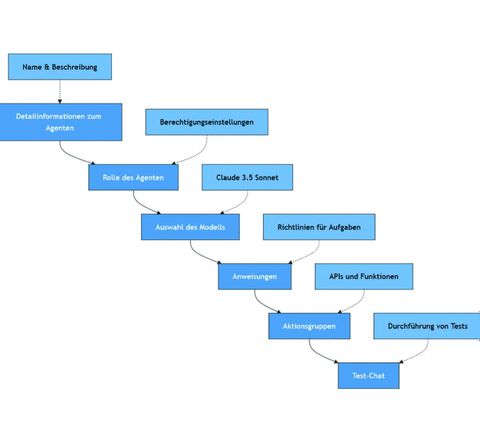
The troubleshooting example of VLAN misconfiguration isn't theoretical - it represents a real implementation by Belden using AWS Bedrock AI Agents framework. AWS Bedrock provides a production-ready framework that implements AI Agent orchestration and tooling capabilities.The AWS Bedrock implementation process, illustrated in Figure 2, follows these key steps:
- Agent Creation: Define the agent's name and description, providing context for developers managing the implementation.
- Permission Configuration: Establish the agent's role with appropriate permissions for accessing services and data.
- Model Selection: Choose an optimized LLM to orchestrate the agent's actions - in this case, Claude 3.5 Sonnet.
- Instruction Configuration: Provide detailed plain English instructions for specific tasks, such as VLAN troubleshooting steps and the exact APIs to call.
- Tool Integration: Define the functions and APIs available to the AI Agent, including parameter requirements and capabilities.
- Testing & Deployment: Validate the agent's behavior immediately after configuration.
This implementation pathway is streamlined through AWS services, leveraging AWS Bedrock, Lambda, and other components for rapid deployment and integration.
Building the Foundation for AI Success

To get to the the full potential of AI Agents, the industry needs to go through several essential steps accompanying any new technological introduction. We are currently at a stage where there is no standardization, the industry discourse has not yet aligned in a commonly accepted view on industrial AI, and businesses move forward with careful scepticism around the new technology. To utilize AI agents effectively, organizations must inevitably invest in mature and cost-effective data infrastructure. Both digital and human employees need to operate from the same foundation of raw facts to work effectively.
This infrastructure requires:
- Reliable data collection systems with appropriate redundancy
- Standardized data formats and storage solutions
- Clear data governance policies
- Robust cybersecurity measures
- Comprehensive API strategy for seamless system integration
When implemented correctly, this foundation leads to new operational capabilities, most prominently shifting from reactive to proactive management approaches. With AI Agents continuously monitoring complex systems and surfacing only the most relevant information for human review, a multiplier effect emerges, enabling businesses to maintain increasingly complex networks despite challenging industry-wide talent shortages.
Literature
[1] What are AI agents? Google Cloud.
[2] What are AI agents? Amazon Web Services.
[3] What are AI Agents? IBM.
[4] Responsible AI: A business imperative for telecom companies. McKinsey, October 18, 2024.
| Article series "AI Agents in Industry" |
|
AI agents are revolutionizing industrial processes: As digital employees, they combine AI with autonomous functions, act independently and enable new efficiency potential. This series of articles provides answers to questions relating to implementation, suitable architectures and the necessary database, among other things. In our next article, "Building the Data Foundation for Industrial AI," we'll explore practical approaches to developing a mature, cost-effective data infrastructure that supports both human operators using AI Agents. We'll examine key architectural considerations, implementation strategies, and best practices for organizations at various stages of digital maturity. |


You might also be interested in
Extended three-member Management Board for Deutsche Messe
Deutsche Messe AG is reorganizing its personnel and consistently focusing its Management Board on the further development of the company and the exhibition grounds in particular. With an expanded three-member Management Board, the company is...
 read more...
Federation Architecture | Part 1
Rethink IT-OT Convergence in an AI-Driven World
AI is shifting threat models for industrial infrastructures. Federation Architecture proposes a disciplined middle ground between isolation and full integration - with edge autonomy, one-way data flow, and human approval.
read more...AI-enabled rugged mobile workstation
With 'Z14I-HG' Durabook presents an AI-ready Fully Rugged Mobile Workstation with Nvidia RTX 5000/3500 Ada graphics.
read more...Siemens and Nvidia are accelerating Chip Testing
Siemens and Nvidia have significantly accelerated the verification of AI chips. With the help of FPGA-based prototypes, tens of trillions of design cycles could be tested within a few days before production. This should improve the development and...
read more...Study on AI and the World of Work
Human-Machine Teamwork becomes central
A C-level survey by valantic and the Handelsblatt Research Institute examines how AI will transform the world of work by 2030. Managers expect creativity, empathy and ethical judgment to remain crucial skills in the future.
read more...IFS relies on Asset-based Pricing Models
IFS is introducing a new pricing model designed to simplify access to 'Industrial AI'. Instead of paying per user, companies will in future pay per asset operated, enabling company-wide use without cost increases.
read more...Robust AI Performance at Temperatures from -40 °C to +85 °C
Congatec is expanding its portfolio of Computer-on-Modules (COMs) to include variants with Intel Core Ultra Series 3 processors for the industrial temperature range from -40 °C to +85 °C.
read more...Q.ANT hires Michael Krüger for Sales
Photonics specialist Q.ANT is expanding its management team. Michael Krüger is taking on the newly created position of Vice President Commercials and will be responsible for driving forward the marketing of the processor technology.
read more...AI-supported infrared Analysis Camera
Flir has developed a thermal imaging camera for perimeter surveillance that expands the manufacturer's range of mid-range infrared security products.
read more...