

Switching and protection
Stumbling blocks with direct current
The question "direct current or alternating current?" is becoming increasingly important - not least due to the increasing use of renewable energy sources that generate direct current. When switching and protecting with direct current, however, there are a few subtleties to consider.

At the beginning of the last century, the 'electricity war' broke out between Thomas Edison and George Westinghouse - the latter had acquired the patents for the three-phase motor from Nikola Tesla. While Edison fought vehemently for 'his' direct current, Westinghouse was convinced that alternating current was the measure of all things; in the end, alternating current prevailed. After all, it was easy to transform into high voltages so that electrical energy could be transmitted over long distances from generation to consumer with low losses. Nevertheless, local direct current networks continued to be operated for a very long time; the last direct current supply - in Frankfurt am Main - was only finally discontinued in 1959.
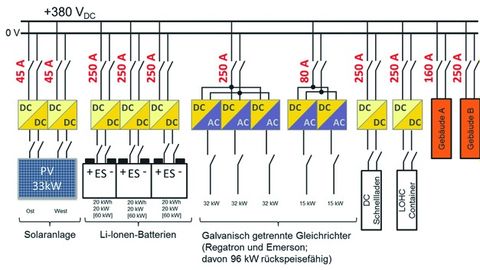
A 380 V DC microgrid was installed at the Fraunhofer IISB (Erlangen): Various DC sources feed into a two-pole 380 V DC bus. Loads include LED lighting and a 24 V (DC) sub-grid for supplying office equipment.
© B. Wunder, Fraunhofer IISBToday, it is possible to generate DC voltages of over 1 MV. In China, for example, HVDC lines (high-voltage direct current transmission) with transmission voltages of up to ±800 kV have now been put into operation. DC voltage is now also an exciting topic for small energy distribution systems (so-called microgrids). This is because DC systems make it possible to reduce conversion losses by up to 5% compared to AC when supplying renewable energy sources such as PV systems. This is a strong argument in times of rising energy prices.
As part of the EU research project DCC+G, a test grid was created at the Fraunhofer Institute IISB in Erlangen, which supplies part of the office building with a DC voltage of 380 V. A new building at the same institute, which is scheduled for completion in fall 2018, will be supplied entirely with DC. Various DC sources feed into a two-pole 380 V DC bus. Loads include LED lighting and a 25 V (DC) sub-network to supply office equipment such as laptops and printers. This eliminates the need for many individual power supply units and there is also no dangerous touch voltage.
Switching operations with DC voltage

If the advantages and disadvantages of DC voltage and AC voltage are compared, AC voltage actually appears to have more advantages at first. However, due to the increasing use of renewable energy sources that generate DC voltage, the lower overall losses in the low-voltage grid are becoming disproportionately important. As a result, switch-on and switch-off processes with DC are increasingly coming into focus.
Arcing as a problem area
When a mechanical contact system is opened, a so-called switching arc occurs - depending on the voltage and current. Therefore, in the case of mechanical switches with higher DC voltages, complex measures are required to extinguish the switching arc in order to protect the switching chambers from thermal damage.

Oscillogram of a switch-off process for a DC voltage of 375 V and an arcing chamber. The contacts open approx. 4 ms after the short circuit occurs, the arc voltage immediately jumps to the minimum arc voltage of approx. 14 V.
© E-T-AThe switching arc consists of space charge zones - the cathode and anode drop zones - and the arc column. The arc column is a quasi-neutral 'thermal plasma' of finite conductivity, which has temperatures of 1000 to 30,000 K. The current in the arc is carried almost entirely (approx. 99 %) by electrons. The current in the arc is carried almost entirely (approx. 99 %) by electrons. A voltage drop occurs across the switching arc. This is made up of several components: the voltage drop across the two space charge areas at the electrodes and the voltage drop across the arc column. For short arcs, the determining component is the sum of the voltage drops across the space charge zones; for long arcs, the voltage of the arc column predominates.
In order to burn stably, an arc requires a minimum voltage of approximately 14 V. The minimum current depends on the electrode material and is around 0.4 A for copper and silver. If the current falls below these values, the arc extinguishes automatically. Therefore, arcs in automotive electrical systems with system voltages of 12 V cannot burn stably.
As a general rule, the arc voltage must be higher than the driving source voltage to extinguish a DC arc. Depending on the current flowing and other parameters, the minimum burning voltage of an arc in low-voltage switching devices is set at 15 to 20 V. This is exploited by forcing the arc into an extinguishing chamber and dividing it into many individual arcs using metal plates insulated from each other. The resulting increase in arc voltage, together with cooling effects caused by outgassing products and squeezing of the arc, is sufficient to extinguish it. At least twelve extinguishing plates are required to extinguish source voltages of up to around 400 V. It is irrelevant whether the voltage is AC or DC.
If the arc is not extinguished in the first half-wave with AC voltage, it can ignite again after the zero crossing if the switching path is not sufficiently deionized after the current zero crossing. With DC voltage, the current must be forced to zero as quickly as possible. This is achieved by magnetic fields - energized by means of blowout coils or additional permanent magnets. The resulting magnetic force on the arc drives the switching arc into the extinguishing chamber.
Electronic switching with semiconductors
Today, MOSFETs (Metal-Oxide-Semiconductor Field-Effect Transistors) or IGBTs (Insulated Gate Bipolar Transistors) are used for electronic switching. Both types of power semiconductors enable currents to be switched on and off even outside the zero crossing. This is a significant difference to current-controlled thyristors, which only switch from the conducting to the non-conducting state when the current becomes zero.
However, neither MOSFETs nor IGBTs are the first choice for DC switching. MOSFETs offer low losses in the on-state, but have relatively low reverse voltages. IGBTs, on the other hand, offer high reverse voltages but have a higher on-resistance. If the chip area is doubled, the on-state losses of the IGBT are reduced by 10 to 20 %, while 50 % can be achieved with the MOSFET.
IGBTs are now available for reverse voltages of several 1000 V. Commercially available MOSFETs with relatively low losses, on the other hand, have reverse voltages below 1000 V. To protect against system-related transient overvoltages, the minimum blocking voltage of the semiconductors used for switching should be 600 V in 380 V DC systems. For this reason, IGBTs are often used here.
In inverters, power semiconductors are switched on and off very quickly, with switching frequencies of up to 200 kHz. Therefore, losses during switching are crucial there.
If semiconductors are used like a mechanical switch, on the other hand, they must switch 'off' or 'on', carry the rated current continuously and isolate in the off state under operating conditions. For this reason, the losses in the on-state are decisive here.
The hybrid switch

Hybrid power relay (prototype) with a rated voltage of more than 600 V(DC) and a rated current of 300 A. The ...
© E-T-AThe idea of a hybrid switch to eliminate the disadvantages of mechanical contact paths and electronic switches is not new. Studies on hybrid contactors for AC voltage with thyristors were already carried out in the 1980s - and with the power semiconductors available today, the use of hybrid switch technology also makes technical sense in the case of direct current.

... Switching arc activates the electronics as soon as the main contact opens. The semiconductor only operates during the switching process. The mechanical contact carries the current when switched on.
© E-T-AIn hybrid switching devices, electronics limit and switch off residual currents. Due to the very short times in the on-state, the semiconductors do not require cooling and their current-carrying capacity increases to values that are significantly higher than the nominal data. The switching speed and the limited switch-off overvoltage significantly determine the losses in the semiconductor. Therefore, the switching process in the semiconductors should be very fast in order to minimize the switching losses. The overvoltage protection absorbs a large part of the energy stored in the circuit inductance and thus forces the current to zero.

The combination of the advantages of modern power electronics and sophisticated mechanical contact systems creates a technology that is ideal for switching at higher DC voltages (see Table 2).
Author:
Peter Meckler is Head of InnoLab (Innovation & Technology and Test Laboratory) at E-T-A in Altdorf near Nuremberg.


You might also be interested in
The future of CANopen
Similar to the automotive industry, industrial automation also requires more and more bus bandwidth. In addition, the cloud is becoming increasingly important in terms of communication. How does the CAN protocol, which has long been established in...
 read more...
Unauthorized access fended off
Plant modernizations often require new safety precautions. This was also the case for a manufacturer of cleaning agents and disinfectants, who had to safeguard the material flow in the area of a roller shutter door, among other things.
read more...WLAN in the factory - the selection criteria
WLAN is suitable for various applications in the factory. However, due to the many influencing factors, it is not always obvious how a network based on the IEEE 802.11 standard can be optimized to meet the requirements of industrial use. - Here is...
read more...Compact controls and drives a must
Smart factories promise operators a high degree of flexibility - for example through the use of driverless transport systems or mobile robot solutions. The automation of these subsystems in turn requires extremely compact control and drive concepts.
read more...Simply integrate safety
Machine and system manufacturers are increasingly turning to mapping safety functions via the communication bus. How can integration on the component side be achieved with reasonable effort?
read more...Flexible buffering via software
The complete automation of manual or semi-automatic processes is a major challenge with very short cycle times. When it comes to workpiece carrier transport, the machine manufacturer Goldfuß relies on a system that allows the creation of flexible...
read more...Individual IoT systems
How big? How much power? How robust? Which housing? The requirements for IoT systems are extremely varied. By designing individual embedded applications, devices can be created that are perfectly tailored to the application.
read more...A digital image
The digital twin accompanies machines and systems throughout their life - from the initial idea to ongoing operation and a look into the future. The aim is to avoid errors, optimize systems and prevent failures.
read more...Traceability optimized
Directly marked 2D data matrix codes ensure the traceability of engine and transmission parts at KIA Motors. Read rates of 99 % are the target.
read more...