

Photovoltaics
Start-up develops low-cost circuit against shading
A spin-off from Karlsruhe University of Applied Sciences has developed an electronic circuit that reduces shading on solar modules and thus improves the efficiency of the system. The electronics will be available to buy in spring at a price of 35 euros.
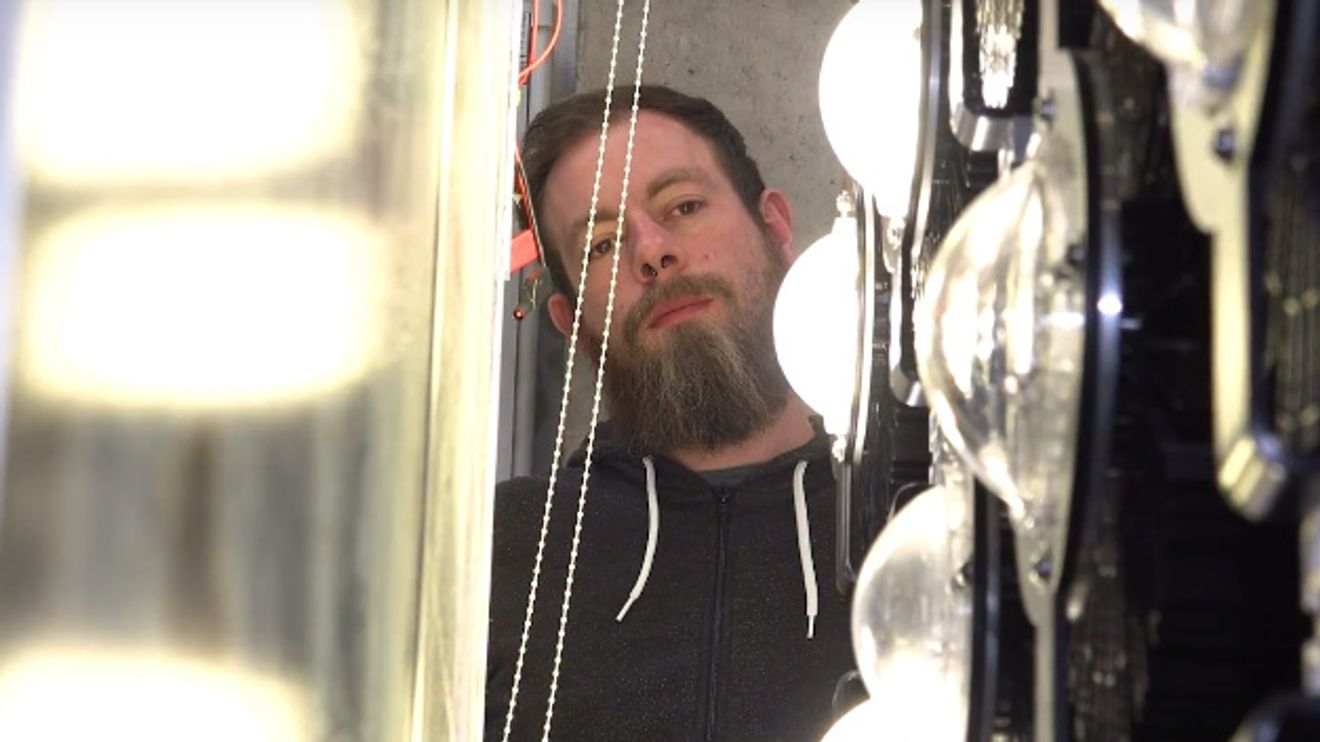
Co-founder of BRC Solar GmbH: Richard Brace
© BRC Ltd.The problem is well known: If only one twentieth of the surface of a solar panel is in the shade, this leads to the same result as completely covering the module - with serious consequences for the overall system: "The modules of such systems are usually connected in series," explains founder Richard Brace, "so if the current drops in one module, it drops in the entire system, so shading one module leads to a drop in the output of the entire system."

A spin-off from Karlsruhe University of Applied Sciences has developed an electronic circuit that reduces shading on solar modules, thereby improving the efficiency of the system.
© BRC Ltd.And this is precisely where the development from BRC Solar (video) comes in with a small, patented circuit: it is only attached to shaded modules and only becomes active when they are shaded, which increases the efficiency of the overall system and reduces the necessary investment outlay.
Although there are technical solutions against shading on the market, "these are either very expensive," says colleague and Managing Director Timm Czarnecki - who, like Brace, studied electrical engineering and information technology - "or they are not particularly efficient."
At the moment, the three founders - the third member of the team is Pascal Ruisinger, a graduate of the Bachelor's degree course in Industrial Engineering and Management, who is responsible for the financial planning and controlling of the young company - are preparing for series production and the market launch of their add-on module, which they hope to bring to market in the first quarter of 2019 for around 35 euros.
They were able to develop the electronics at the university and test them extensively in the laboratories: the performance of solar modules with shading problems can be significantly increased. However, it was not only the close technical and scientific connection to the university that was important for the founders, "we also received a lot of organizational support, for example from the university's start-up laboratory," emphasizes Pascal Ruisinger, "we were able to present our idea to experts and received important information on which funding measures were suitable for us. This is currently helping us a lot in setting up the infrastructure for our small company. For example, the EXIST program is providing us with premises."
Mentor Prof. Dr. Rainer Merz is still at their side today: "Of course, we are very interested in how the company is developing and our students are also following this closely. On the other hand, we are already thinking about further developments - the three founders will therefore remain connected to us and perhaps we can even set up joint research projects in the future, with which we can then inspire subsequent generations of students for such exciting questions in energy generation and also present the path to professional independence using a real example."


You might also be interested in
Wind power / Predictive maintenance
Bonfiglioli cooperates with Schaeffler
A compact solution package for the predictive maintenance of azimuth drives for wind turbines is the result of a long-term development partnership between Bonfiglioli and Schaeffler.
 read more...
ABB sells solar inverter division
The ABB Group has sold its solar inverter business to the Italian company Fimer. With this transaction, ABB is continuing to systematically focus its business portfolio on other growth markets.
read more...Renewable energies cover 44 % of electricity demand
According to the ZSW and BDEW, renewable energies accounted for 44% of electricity demand in Germany for the first time. Compared to the previous year, the share of green electricity thus increased by 5%.
read more...10 MW wind turbine and rotor diameter of 193 m
Siemens Gamesa plans to launch a 10 MW turbine with direct drive on the market in 2022. Compared to the previous model, the offshore turbine is expected to increase annual energy production by 30 %. Each rotor blade is approximately the length of a...
read more...Smart Grid - the next step
The VHPready standard is intended to make the smart grid a reality. The further development to version 5.0 is intended to make the standard fit for digitalization - with artificial intelligence and protocol-independent information models.
read more...LTI Motion pushes the wind energy sector
With a new wind energy competence center in Unna (North Rhine-Westphalia) and production sites in Lahnau (Hesse) and Shanghai, LTI Motion intends to expand its wind business into a strategic growth pillar.
read more...Renewable energies / Intersolar
Stäubli cooperates with Power-Blox
Stäubli Electrical Connectors (formerly Multi-Contact) has entered into a strategic partnership with the Swiss start-up Power-Blox. Together, they want to offer new solutions in the field of energy storage and off-grid systems in the future.
read more...First solar road inaugurated
The world's first solar road has been launched in France. The 1 km long and 2 m wide road with an area of 2,800 square meters is equipped with particularly stable photovoltaic modules, which were developed using a completely new method.
read more...Into the stratosphere with the solar airplane
The SolarStratos mission aims to fly a solar airplane into the stratosphere. Weighing 450 kilograms, it will be the first solar-powered aircraft capable of reaching this altitude. The solar systems required for this were developed by the CSEM...
read more...