
Cables
The requirements for moving applications
Cables that have to follow the movements of robots or machines are exposed to high loads. This makes choosing the right cable all the more important.
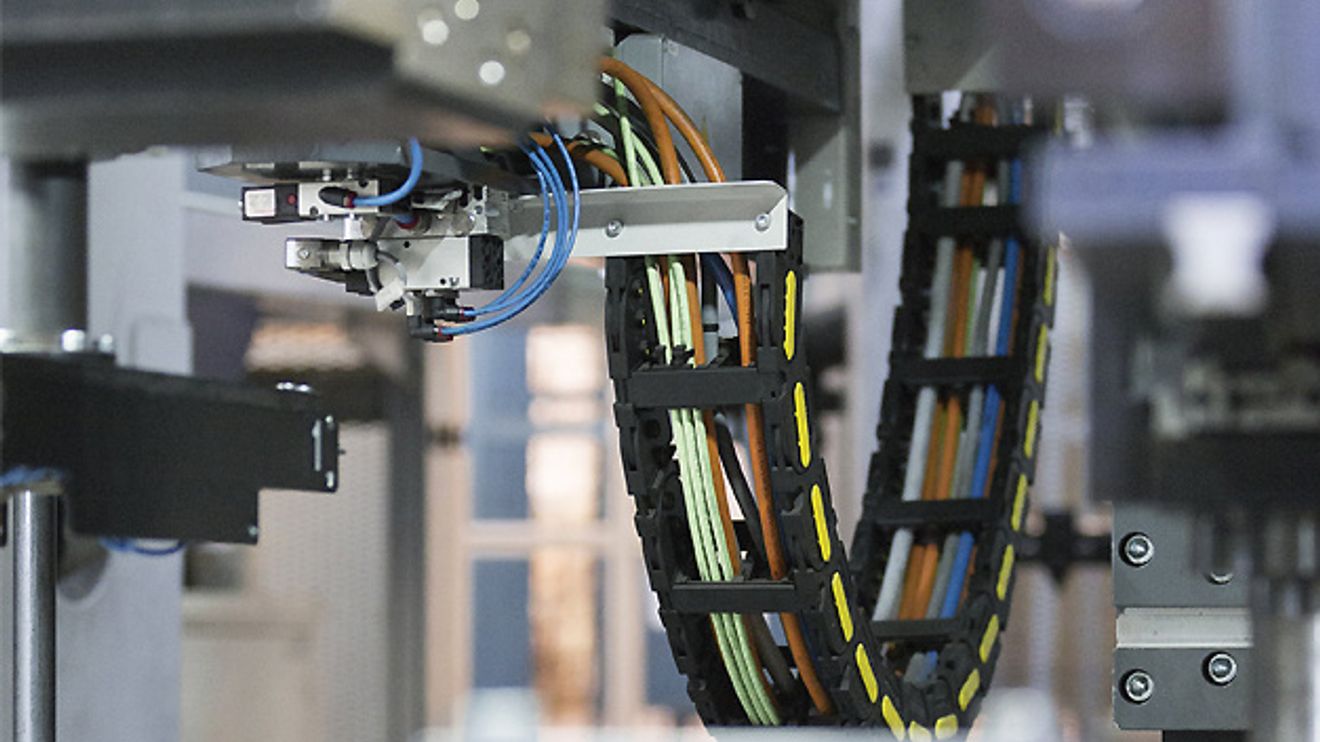
Accelerating and decelerating at several times the acceleration due to gravity and millions of times over - it's hard to imagine what cables that follow the movements of a robot arm or move back and forth 'crammed' into energy supply chains in the work cycle of a machine have to withstand. And with ever higher cycle rates and speeds as well as ever tighter bending radii as a result of the miniaturization of machines, the demands on the mobility of cables have also increased significantly in recent years. Accordingly, polyurethane (PUR) or special thermoplastic elastomers (TPE) are now mainly used as jacket materials for highly dynamic cables instead of PVC. Furthermore, the internal structures of the cables have been adapted accordingly, for example by stranding the individual cores in the cable, constructing shielding braids and optimizing the core insulation materials. And last but not least, the demands on assembly have increased - in other words, complete systems in which all components are optimally matched to one another.
Bending, drilling, drumming
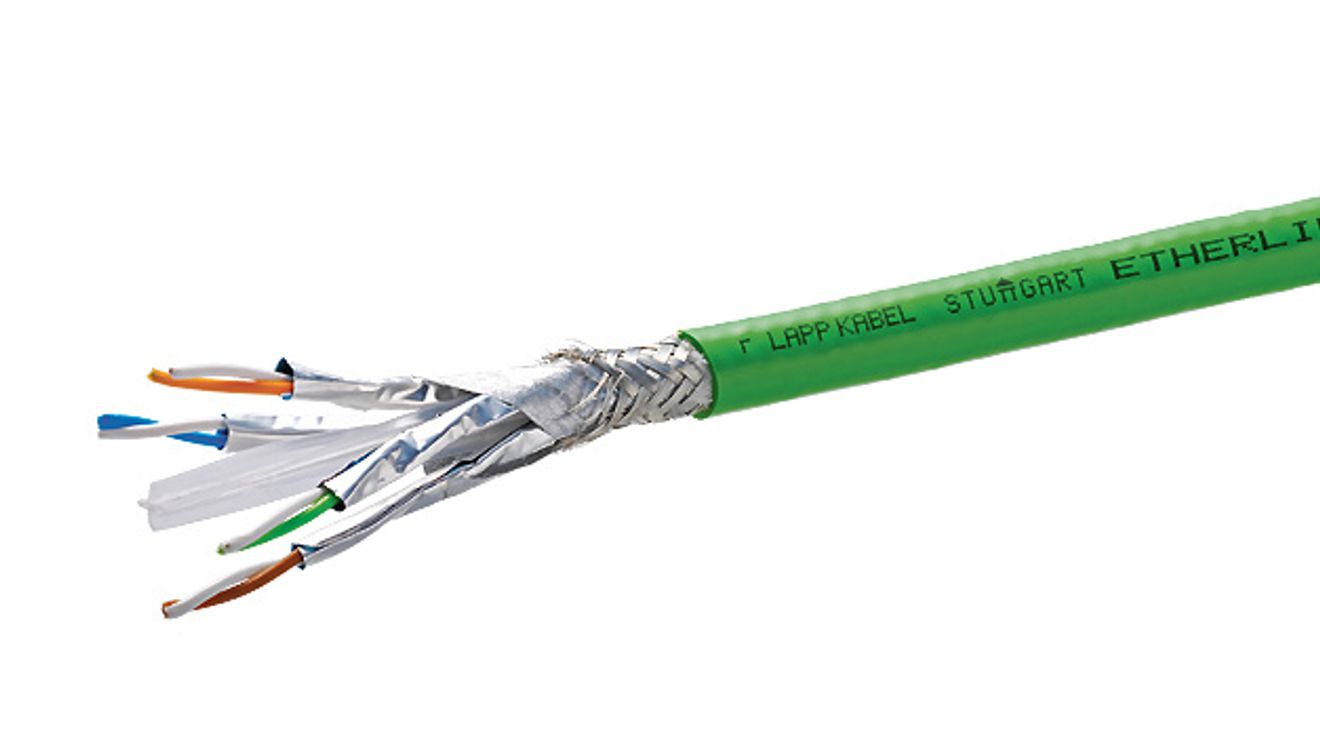
Data transmission rates of up to 10 Gbit/s are possible with the so-called 'Etherline Torsion Cat. 6A' for use in cable drag chains.
© U.I. LappDepending on the application, cables have to withstand very different loads. A distinction is made between three types of movement:
Bending:
This is probably the most common type of movement. In a drag chain, the cable is always bent in the same direction - sometimes millions of times. Where cables are not guided in a chain, for example on robots, the bending direction can also vary during movement, possibly combined with torsion.
Torsion:
The cable is twisted around the longitudinal axis of the cable. However, pure torsional movements are rare in industrial applications. They do occasionally occur in special applications, such as in wind turbines for cables that run from the rotating nacelle down into the tower.
Reeling up and down:
This relates to cables in event technology, for example, which are unwound from drums and then rewound and stored after the event. Here, the bending direction varies completely randomly, i.e. it is combined with twisting.
How well a cable can withstand such movements over the years depends primarily on the sheath material. Material experts are faced with the challenge of having to reconcile other properties such as fire behavior or resistance to oil, chemicals and cleaning agents in addition to flexibility. Although PVC still dominates the overall market for cable sheathing materials, other materials such as TPE or PUR, which is the first choice for highly dynamic applications, have also become established, especially for moving applications.
Polypropylene in particular has proven its worth as a core insulator in moving applications. These materials have a higher strength than PVC/PUR. Polypropylene and TPE are also much more resistant to tearing and stretching as well as more dimensionally stable than PVC, which in turn allows for smaller wall thicknesses and smaller diameters and therefore tighter bending radii. This also helps to reduce the weight and space required for laying chains and cables. The higher strength is also advantageous because the cable is better able to compensate for the high shear and tensile forces in the chain and the dreaded 'corkscrews' do not form. Polypropylene also has very low capacitance (the dielectric constant is only around half that of PVC), which ensures lower power losses - which in turn allows longer cable lengths. TPEs have comparable mechanical and electrical properties to PUR, but have advantages in terms of chemical compatibility, among other things - this is an advantage in the food industry, for example, with its frequent cleaning processes.
However, it is not just the cable materials that determine how well a cable can withstand movement - the connectors or the drag chains used to protect the cables also have to keep pace. Users are therefore increasingly asking for pre-assembled cables, i.e. cables with fitted connectors, often already installed in the cable drag chain. This brings quality benefits, especially in moving applications, as all components are perfectly matched to each other.

Lapp has recently bundled its system solutions under the name 'Ölflex Connect'. All components are matched to each other, which provides added safety and functionality even in moving applications - as here at machine manufacturer Toshulin.
© U.I. LappWhen developing fully assembled energy chains, it is always important to set the right priorities: The mechanical design of the energy chain is often designed first and then the cables are adapted - which can result in the chain working very well but the cables failing prematurely. For the user, however, it is not the chains themselves that are important, but the cables or hoses with which they are fitted. Lapp is therefore taking a different approach with its 'Ölflex Connect' assembly initiative and is focusing everything on the optimum and long-term performance of the cables. And if, for example, optimum performance cannot be achieved with a standard cable, a special cable can be developed according to the requirements - it is not uncommon for new standard products to be created from such custom-made products.
In general, electromagnetic compatibility is becoming more important in factories, and this also applies to moving cables. As a rule, these are shielded against electromagnetic influences with a copper braid. The degree of coverage of the braid must usually be over 80 % so that no electromagnetic interference can get through. There must also be no gaps in the braid when it is bent. The braiding angle is crucial here: for highly dynamic applications, the copper wire is laid around the cores at a particularly steep angle - measured to the cable axis - so that it makes a full 360° turn around the cores over a shorter distance.
One example of an Ethernet cable that is ideal for use in energy supply chains is the so-called 'Etherline FD Cat. 6A' from Lapp. Among other things, it is suitable for robot monitoring or for checking production products using camera systems. The 'Torsion' version of the cable can be used for applications where twisting of the cable is to be expected. High mobility is a challenge, especially for data cables with particularly high bandwidths, as these bandwidths require extremely effective shielding - which must remain intact even after millions of movement cycles. Category Cat. 6A Ethernet cables with data transmission rates of up to 10 Gbit/s were therefore previously only available for fixed or slightly moving installations.
Glass is also flexible
If even higher data rates are required, the time has come for fiber optic cables. Today, users can choose between three fiber types: Plastic optical fibers (POF) for shorter distances of up to 70 meters, PCF fibers (plastic-coated glass fibers) for distances of up to 100 meters and glass fibers for even greater distances and for applications that require the highest data rates. In principle, all fiber types are suitable for moving applications, provided that the recommended bending radii are observed. For maximum transmission performance, however, the bending radius of fiber optic cables should not be less than 15 times the diameter. It does not break below this, but the attenuation increases. In other words: Light is lost in the tight bend and the signal quality deteriorates.
How well a fiber optic cable can withstand movement depends largely on the materials that encase the fiber. These are often aramids, i.e. textile fibers that give bulletproof vests or fiber-reinforced plastics their special properties. The textile sheath absorbs any tensile forces that may occur and prevents the fiber optic cable from being stretched.
Before it is recommended for an application, each cable type undergoes a rigorous test program at Lapp. The engineers test the torsion of fiber optic cables for wind turbines in an old elevator shaft, in which they twist cables over a length of twelve meters. This is unique in the industry. It is customary to test shorter cable sections that are twisted at smaller angles in order to extrapolate the result to longer cable lengths.
As far as further development trends in moving cables are concerned, it is not necessarily a question of even greater accelerations and higher travel speeds - the current standard accelerations of 5 to 8 g will be sufficient for the time being. In other words, cables are not the weakest link in the chain at the moment. Rather, other properties are increasingly required that are not directly related to mobility - such as compatibility with harsh environmental conditions, chemical media or low temperatures, all of which cause plastics to become brittle.
Author:
Bernd Müller is a freelance author from Bonn.


You might also be interested in
Authorized distributors made visible online
Lapp is expanding its digital service portfolio and is the first B2B industrial company to provide its authorized distributors with a verifiable online seal from authorized.by. The company aims to create more transparency and security for buyers and...
 read more...
Axel Barnekow Widmark becomes CEO
Habia, a global supplier of customized high-performance cables, announces changes in the company's management: On April 1, Axel Barnekow Widmark took over the position of Chief Executive Officer. He succeeds Carl Modigh, who will remain with the...
read more...Avoid wear and tear
Tsubaki Kabelschlepp has added a new function to its condition monitoring system so that wear can also be monitored outside the chain without the need for additional cables in the cable carrier. The system also monitors the push/pull forces during...
read more...Cables in a modular system
The 'Heluchain' system from Helukabel is a modular system that is available in three expansion stages and combines cable drag chains, highly flexible cables, individual assemblies and matching accessories.
read more...Cables for stage technology
Igus wants to tap into the stage technology market and has developed a plainly colored series of highly flexible 'Chainflex' cables.
read more...Strengthening fiber optic cable production in Germany and Europe
The production of fiber optic cables in Germany has fallen by over 43% in the last ten years. In order to avoid long-term strategic dependencies, the ZVEI is calling for the maintenance and expansion of industrial capacities for network components...
read more...Energy chain series switched to recycled material
Igus is converting the entire catalog range of its standard energy chain series 'E2.1' to the new recycling material 'igumid CG LW'.
read more...Billion in sales maintained
Despite the challenging geopolitical and economic situation in 2024, Igus was able to increase the number of active customers by 5%. With sales of € 1.105 billion, the company recorded a comparatively moderate decline in sales of 2.5%.
read more...Igus takes over assembly provider
Igus has taken over the company Elko Verbindungstechnik. With this step, the company is expanding its assembly capacities in the field of drive technology.
read more...