
Enclosure cooling
The problem of heat
Electronic components are becoming increasingly smaller and the size of components, systems and installations is decreasing. For modern control cabinets, this often means a rethink in planning, particularly with regard to cooling.

Two aspects are at the forefront of modern control cabinets: the smallest possible space requirement and a high packing density. At the same time, a wide range of physical conditions must be taken into account, which have a significant impact on both energy efficiency and the service life of the installed components.
Today, industrial electronics are generally designed to be robust and can easily withstand vibrations or vibration and shock tests, for example. In addition, components and systems can be designed in such a way that neither moisture nor humidity can penetrate.
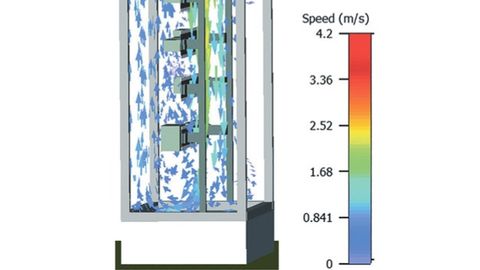
The situation is different with heat: it is still the great enemy of all electronics! Efficiencies of over 90 % in some cases are often standard for electronic or electrical devices and machines. It is therefore no problem to use compact and condensed designs; the space required per watt installed is reduced. However, even if the energy efficiency is very high thanks to high efficiency, the heat is concentrated in a very limited area and can quickly reach very high, critical values there. In addition, the compact design results in less surface area, which reduces heat dissipation to the environment. This increases the risk of heat nests or hotspots, which is exacerbated with increasing packing density.
One way of counteracting this risk is to use ductless wiring systems, such as those offered by Lütze. The elimination of cable ducts results in a space saving of 30 %; in addition, natural convection is supported by a reduction in flow-calmed zones. Another thermodynamically important feature of ductless wiring systems is the division into a mounting side and a wiring or cable routing side.
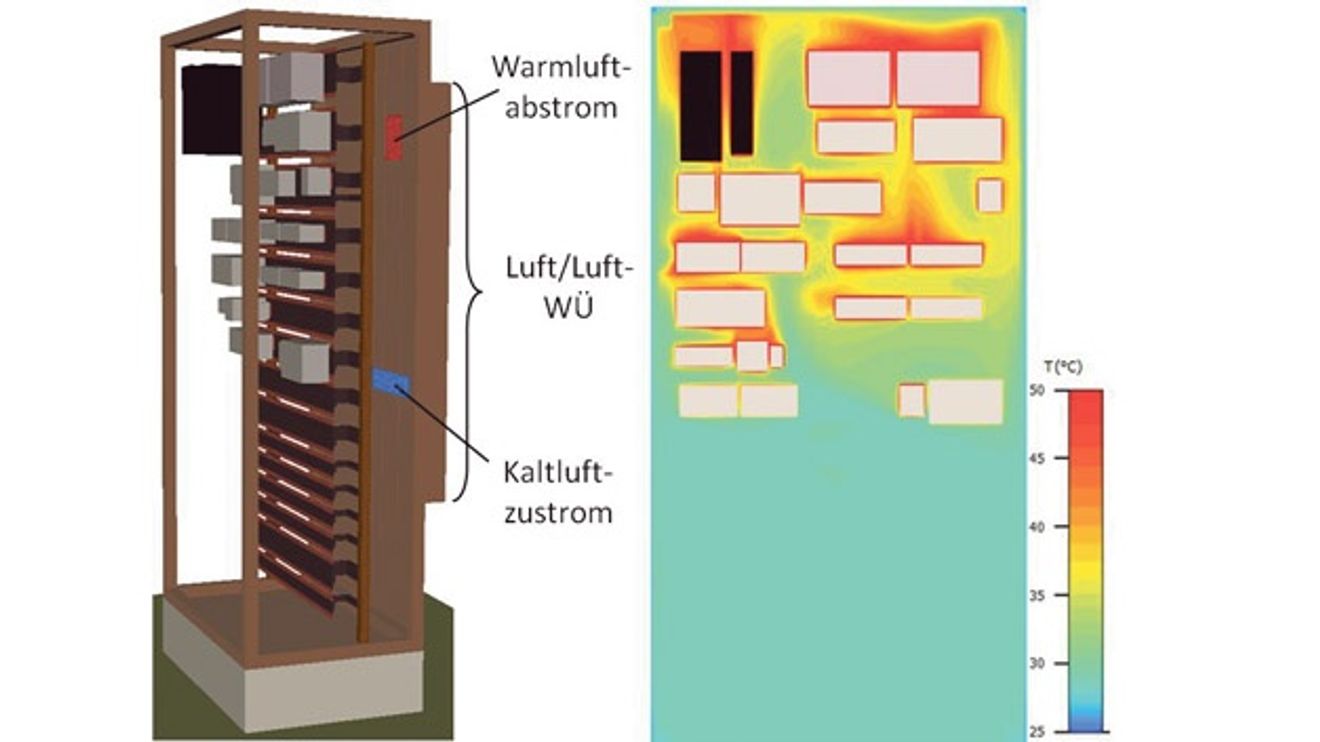
In close cooperation with the Institute for Thermodynamics and Thermal Engineering at the University of Stuttgart and the Fraunhofer Institute, Lütze has brought together the results of various research projects on the subject of 'Thermal behaviour in the enclosure' in the form of analyses, field tests and simulations, thus implementing new ideas for an optimized and balanced enclosure climate. One of these ideas combines the clear division into a front mounting level and a rear level for wiring and cable routing on the one hand and the elimination of horizontally mounted cable ducts in particular on the other. This enables an actual circulation flow and stimulates and supports natural convection. This positive effect also works without active cooling and is measurable. The use of an air conditioning unit also measurably increases cooling efficiency.
Gaining space, what now?
The high packing density in a smaller housing requires a higher cooling capacity, which drives up costs and has a negative impact on energy efficiency. Targeted positioning of large heat loads close to the cooling air inlet can alleviate the thermodynamic problems somewhat, but not eliminate them. The same applies if the placement of components is consistently optimized according to power losses.

The hardware planner can also take the opposite approach: At least some of the space gained can be used for a so-called 'loosened packing density' by spreading the components out and arranging them more generously. This avoids or reduces flow-calming zones in the upper part of the enclosure. This supports natural air convection or at least hinders it less, and the cooling capacity can be reduced.
This effect can be further enhanced. The current 2nd generation of the 'Airstream' ductless wiring system from Lütze offers a curved core structure for the profiles, which increases torsional strength.
The advantage of curved profiles
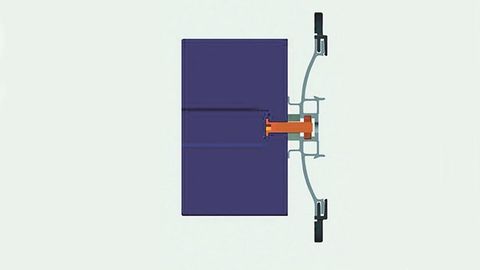
Heavier and larger components can be mounted securely and stably on the DIN rail without additional effort. The thin profiles slim down the enclosure and are installed in such a way that they are exposed to the cooling air flow and optimally ventilated.
However, components with high power loss and correspondingly high heat dissipation, such as frequency converters or power supply units, deserve special attention. The enclosure designer should specifically cool such heat-critical components in order to increase the service life (MTBF) or efficiency (no de-rating). Airblade' can be used to precisely direct the air flows in the enclosure: Part of the airflow is redirected directly to the components with high power loss and the air circulation inside the enclosure is optimized.
Is an air conditioning unit necessary?

Cooling and power loss in relation: The influence of air conditioning components on the maximum temperature in the free air volume is clearly recognizable.
© SagittariusThe aforementioned studies and simulations have shown that an active cooling unit is essential from an installed power loss of >600 W, regardless of whether the enclosure is positioned free-standing or as a wall-mounted unit. If the enclosure is air-conditioned using ambient air as a heat sink, as in the case of free cooling, the air temperature inside the enclosure is always higher than the ambient temperature.
This raises the question of which type of air conditioning unit and which output is to be used and where this unit is to be installed, whether laterally, frontally or as a roof-mounted unit. The question of whether an active cooling unit can be dispensed with by loosening the packing density and avoiding dead flow areas also requires more detailed investigation.
In many situations, it may be sufficient to simply support convection with a circulating air fan - for example with the 'Airblower'. This low-power blower is hooked into the upper part of the enclosure from the front without tools and locked in place. The heated air is sucked in and blown downwards at the rear, generating a continuous circulation flow. In addition, heat is constantly dissipated via the side walls. The fans can be switched on and clocked individually. With an air volume of 510 m³/h, the temperature layers are homogenized in just a few minutes and the temperature level can be reduced by up to 10 K. Three sensors placed in the control cabinet record the temperature, a parameterizable control unit takes over the signal processing and supplies the fan with power (24 V DC).
The company's own series of measurements have shown that using the Airblower is sufficient for cooling the enclosure in many cases. As only the air inside is moved in a controlled manner and no external air is drawn in, such enclosures can also be built completely sealed in accordance with protection class IP67 and can therefore also be used in hygienically critical applications - such as in the food or medical sectors.
Authors:
Peter Burger is Branch Manager at Lütze in Switzerland;
Michael Bautz is Product Manager Cabinet at Friedrich Lütze in Weinstadt.


You might also be interested in
The lubricant problem in food production
Lubricants for components used in food production machinery must be safe for human consumption. However, as these are very expensive, alternatives are in demand - for example in drive chains.
 read more...
IO-Link for the vacuum
To make electric vacuum generators, grippers or compact ejectors visible for the smart factory, they must supply digital energy and process data in real time. This works using interfaces such as IO-Link, Ethernet or NFC in the vacuum components.
read more...Integrated microchips
Whether medical devices, product tracking, vehicle systems or 5G communication - the demands on safety, performance, documentation and user-friendliness are increasing. What is the significance of microchips integrated into connectors or cable...
read more...RJ45 - fit for the IIoT
Industrial-grade RJ45 connectors are a good solution for applications without increased protection against dust, dirt or splash water. What must the data interface look like so that the 'dinosaur of data transmission' can serve industrial...
read more...Engineering with a digital twin
There is simply not enough time for time-consuming activities such as drawing up parts lists based on circuit diagrams in control cabinet construction. How can the process - from planning to installation to operation - be optimized?
read more...The effects of the F-Gas Regulation
Can refrigeration units and chillers still be used when the F-Gas Regulation on climate protection comes into force on January 1, 2020? What do the bans on the use of refrigeration and air conditioning systems and new regulations for their...
read more...Choosing the right heat sink
In order to equip a data center with high-speed modules for optical interfaces, AFCI was looking for a suitable solution for cooling the high-performance servers. Pin heat sinks were the solution.
read more...(Ethernet) cables put to the test
The dynamic requirements for cables and the associated energy chains are high. How must (Ethernet) cables be designed so that they can be safely routed in energy chains even under the highest bending stress?
read more...Predictive maintenance of cables subject to wear
A sophisticated concept is needed to be able to maintain cables subject to wear and tear in a predictive manner. Lapp is currently developing one for Ethernet cables that uses machine learning approaches, among other things.
read more...