
Downsizing
The miniaturized cable
As industrial robots and machines become ever more compact, cables and connectors also have to 'slim down'. What options are there?

Due to the trend towards individualized production - keyword batch size 1 - machines and especially robots are becoming smaller rather than larger and also more flexible. Where humans and robots are even expected to work hand in hand, robots must become more compact. This has consequences for connection technology, as compact and lightweight robots require cables that save space and weight. Some or all of their cables are routed inside the arm. Here, however, they run even more tightly around the axes, which means a higher load. Nevertheless, they must be able to withstand many millions of movement cycles with bending and torsion.
Not too thin!
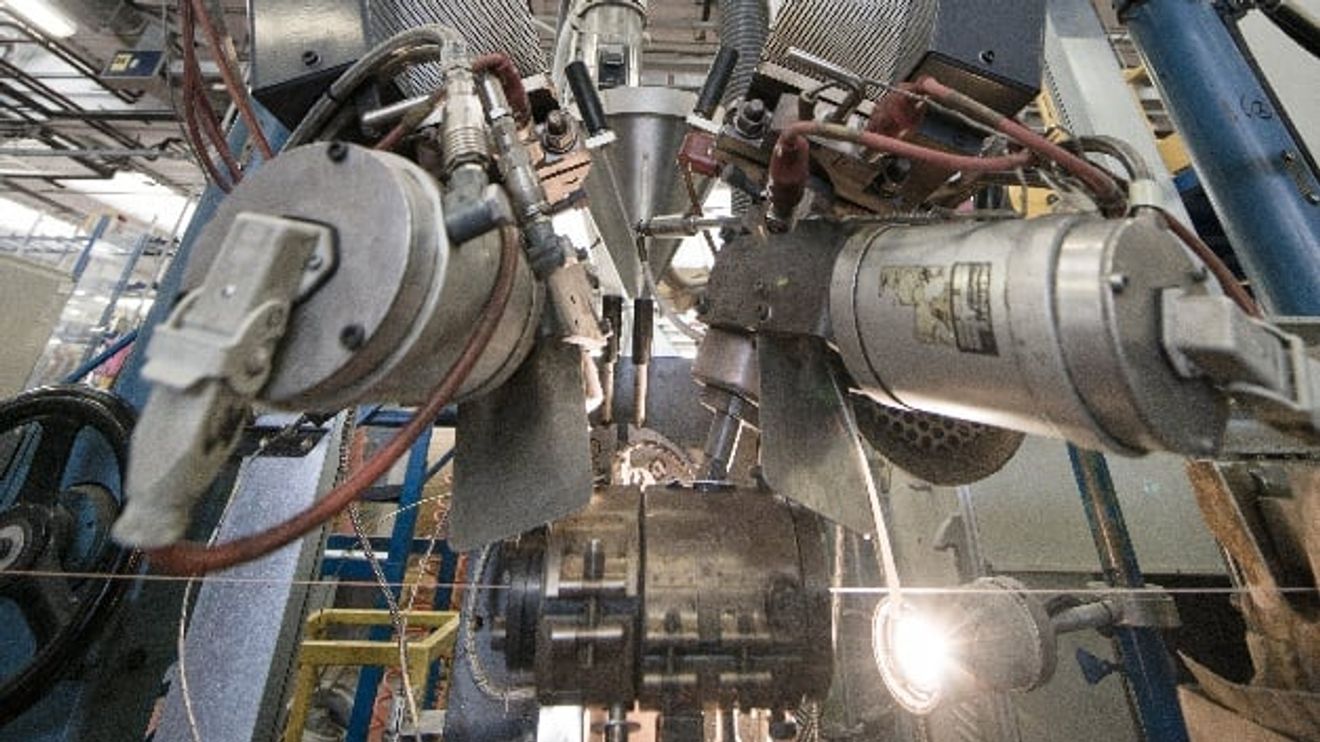
In the skin-foam-skin process, three extruders apply the wire insulation in a single work step. This means that the insulation can be particularly thin to enable cables with small cross-sections.
© LappSuppliers of connection systems have various levers to make cables more compact and at the same time more robust. However, there is hardly any leeway when it comes to the conductor, as the power requirement of the servomotors determines how thick the conductor has to be. However, motors are also becoming smaller and their output lower, so that they require less current and therefore smaller conductor cross-sections. In some cases, designers are wasting space because they are in the habit of using the same thick cables as in larger robots with more powerful drives.

In high-quality data cables, the PE is foamed during extrusion. Properties such as capacitance or impedance can be precisely adjusted by regulating the amount of gas. This allows a thinner cable to be manufactured.
© LappIf space is still tight despite the optimum choice of conductor, the cable manufacturers have to come up with something else:
- Insulation prevents short circuits between the cores. In the case of data cables for fieldbuses or Ethernet, it also influences the data transmission properties. Low capacitance is important. It is determined by the distance between the cores and the insulating material between them, the so-called dielectric. Polyethylene (PE) has proven itself as a material. This is foamed on high-quality data cables during extrusion. By regulating the amount of gas, properties such as capacitance or impedance can be precisely adjusted and thinner cables can be produced.
- During stranding, the fine metal wires of the conductor are twisted because this increases flexibility. However, this increases the diameter. Thickness and flexibility can be controlled by the lay length - the distance for one turn of the twist. If it is longer and therefore the twist is smaller, the cable is thinner. However, the cables are still flexible.
- Ethernet is increasingly being used for fast connections and higher data volumes. Cat. 5 cables with data rates of up to 100 Mbit/s have four cores, which are constructed as a star quad for compact robots. The two pairs of cores are stranded inside the sheath in such a way that they take up less space compared to normal pair stranding - the diameter can thus be 30% smaller - and still withstand years of movement such as bending and torsion.
- So-called single-pair cables even have only one pair of wires. They can transmit 1 GBit/s - which is fast enough for many applications. The cables take up little space, require little installation effort and are low cost. However, cables for single-pair Ethernet are not yet available for use in industry, as the necessary standards are still outstanding. Newly established working groups are working on this, so Lapp expects the first series products for single-pair Ethernet to be available in two to three years.
If the robot is equipped with many sensors or even a high-resolution camera, a star quad or even single pair cable is no longer sufficient. Instead, Ethernet cables according to Cat. 6A or Cat. 7 with up to 10 Gbit/s are used. They contain eight cores that are stranded as pairs. These four pairs are also twisted together to save space. Nevertheless, the space requirement is naturally greater than with the star quad. If the cable is moved a lot - which is unavoidable in robotics - the four pairs of wires must be kept apart so that they do not touch each other during bending. This is done by a plastic core with a cross-section that is also stranded. It ensures that the wire pairs do not change position during movement. At the same time, it reduces crosstalk between the wire pairs.
Connectors also more compact
In addition to thinner cables, smaller robots also require more compact connectors that can be used in a variety of ways. If, for example, a robot is retrofitted with a camera for quality inspection, it should also be easy to expand the connector. The solution is modular connectors. The 'Epic MH' connector system from Lapp, for example, can be modularly equipped for cables with a wide range of functions and can accommodate any number of connector modules for power, signals and data. If a function is added, another module is inserted or another is replaced.
Customized connectors are also possible. For example, Lapp designed a connector for a manufacturer of compact robots that needed to be quick to assemble. Other requirements included harmonious integration into the design of the robot, EMC properties and data transmission via Ethernet. At the same time, the connector had to take on housing functions such as strain relief for the cable. This task was solved with a modified M23 standard circular connector.
Power and data are often transmitted on or in the robot arm via cables with M23 circular connectors. For smaller robots, this standard has been shrunk to the smaller M17 and M12 formats. If it needs to be even smaller - for robots with purely internal cabling, for example - such connectors are no longer practical. Here, the cables are sometimes connected via plug-in connectors, as known from the connection of printed circuit boards.
Author:
Bernd Müller is a freelance journalist on behalf of Lapp, Stuttgart.


You might also be interested in
Rosenberger joins the EBO MSA initiative
Rosenberger has joined the newly formed Expanded Beam Optical Multi-Source Agreement (EBO MSA). This industry initiative is developing open and interoperable standards for optical connectivity in next-generation AI data centers.
 read more...
Sales growth and future investments in anniversary year
In the past 2025 financial year, the Wago Group achieved an eight percent increase in turnover compared to the previous year. The company is also expanding its product portfolio and entering the smart home market.
read more...Jens Hunecke becomes a member of the Wago Management Board
Jens Hunecke will join the Management Board of the Wago Group as Chief Business Officer (CBO) of the Interconnection division on May 1, 2026.
read more...Asia strong, Europe weak
The Lapp Group achieved sales of 1.93 billion euros in the past 2025 financial year (October 1, 2024 to September 30, 2025). Driven by growth in Asia and America, the Stuttgart-based family-owned company is thus compensating for its decline in sales...
read more...Ad van de Noort takes over management of EMEA sales
On January 1, 2026, Ad van de Noort officially took over the role of CSO EMEA at the Lapp Group. He had been in charge of sales in the EMEA region (Europe, Middle East, Africa) on an interim basis since June 2025.
read more...Lapp founds company in Taiwan
On January 1, 2026, the Lapp Group assumed operational responsibility for the cable business, which was previously managed by the DKSH Business Unit Technology, Taiwan. With this strategic agreement, Lapp establishes its own company in Taiwan.
read more...Lapp Group takes over JJ-Lapp joint venture in full
The Lapp Group, a provider of cable and connection technology, has fully acquired JJ-Lapp, a joint venture between Jebsen & Jessen and Lapp with a focus on the Southeast Asian market. At the end of 2025, the companies completed the transaction...
read more...Efficient cabling with hybrid connectors
According to Conec, the hybrid connector series offers the right connector for almost every performance class thanks to its various sizes (B12, B17, B23, B40).
read more...M23 motor connector for servomotors
A new addition to Lapp's portfolio is the circular connector 'Epic M23P A3 Quickflex', a solution for voltages up to 1000 V that can be used directly on the servo motor.
read more...