
Predictive maintenance
The intelligent energy chain
Predictive maintenance of energy chains and cables used to be a difficult task. Integrated sensors are now bringing digitalization on board here too.

The (industrial) Internet of Things is largely about digitalization. The aim is to make the networking of production systems, products and people, production or distribution more efficient. Machines communicate with each other and exchange information about status, workpieces and possible error messages - the 'smart factory' is being created. The '4th industrial revolution' is driving the development of smart factories thanks to large amounts of data (big data). Big data - collected in companies around the world - serves as 'learning material' for neural networks. Built into computers, they learn very quickly how to use and link the data according to requirements: the result is self-learning image processing systems, intelligent robots and autonomous vehicles that are changing the world of work, especially in the industrial environment.
So how do manufacturers of energy chains and cables fit into this scenario? This is shown by the example of Igus, a manufacturer of components made from high-performance plastics. As part of Industry 4.0, the company aims to make the maintenance and servicing of its components more efficient and economical. The 'isense' family was developed for this purpose - various sensors and monitoring systems that turn the supplier's plastic solutions into intelligent products. The components do not simply go into 'defective' status, but instead initially announce the defect as a need for maintenance. This establishes predictive maintenance in the field of energy chains and cables.
The early warning system
The better business processes are linked to production processes, the more efficiently production, spare parts ordering and maintenance interlock. Reliable and, above all, valuable maintenance forecasts are therefore important. However, even in the age of digitalization, such forecasts require more than just big data. Igus uses empirical values from a historically grown test database filled with millions of data records to derive correct conclusions and recommendations for action that can be planned over time from sensor data.

Thanks to options such as Profinet, Ethernet, Ethercat or CC-Link IE, the 'smart plastics integration' concept makes it possible to integrate intelligent plastics solutions into existing IT structures.
© IgusThe maintenance concept from Igus is called 'smart plastics': sensors of all kinds record the condition of components, energy chains, cables or even linear and rotary table bearings and report this to a data concentrator, the 'icom' module. This transmits the data to an intelligent system. Energy chains, for example, can be monitored for their tensile and thrust force during operation and serviced before a malfunction occurs. The worst-case scenario - plant downtime plus production stoppage - can thus be avoided. In addition, maintenance and service calls become easier to plan.
Trades that use a large number of chains not only benefit from this monitoring sensor, but also from special measuring technology that detects chain breakages. It reports immediately after the breakage so that prolonged overloading of the opposite side of the chain is avoided. As a result, the time required for servicing is manageable and there is no consequential damage to other chain links.
Another important component of the 'isense' sensor family is a sensor for line monitoring. Used in the right places, cable breaks can be avoided thanks to the permanent measurement of the electrical cable properties. Another sensor is used to measure acceleration or temperature on the energy chains. There are also sensors for wear and abrasion, as plain bearings and linear drives are subject to particularly high requirements due to their function.
Evaluate data in a targeted manner
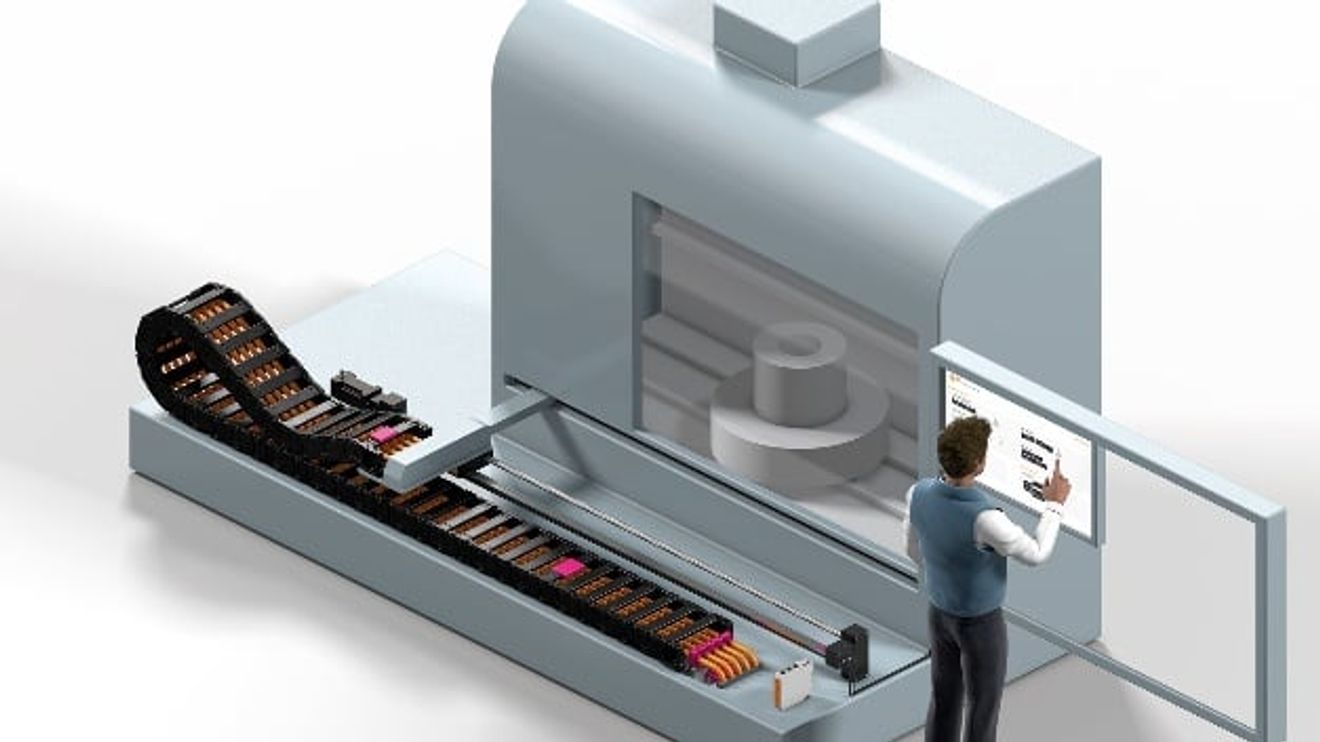
To keep production trouble-free, companies can use the 'isensestand-alone' system, in which sensors for breakage and cable monitoring record the measured values on energy chains and cables.
© IgusOnce the measured values from a sensor have been transmitted to the 'icom' module, they must be interpreted in order to generate an instruction for action. This is the task of four 'isense' systems which, depending on their design, process the sensor values further.
- If, for example, companies are only interested in keeping production running smoothly, the stand-alone system is a good choice. This application can be integrated by a machine programmer. The sensors for breakage and cable monitoring on energy chains and cables record the measured values. If the predefined reference values are exceeded, the NC contact is triggered and the machine stops. Alternatively, the sensor values are transferred to the customer's PLC. Depending on the PLC programming, exceeding the reference values triggers visual or acoustic warnings. Machine programmers can also program the system to stop via the PLC or simply display the sensor value on the PLC panel. At the same time, users can have the data transmitted individually via a serial interface (RS2322/UART) for their own evaluation. A stand-alone solution for abrasion is currently in the planning phase.

If service technicians need to monitor a large number of energy chains, cables and bearings, the 'isense-offline' system is the ideal solution. All messages are displayed on an industrial PC without an internet connection.
© Igus- If, for example, a large number of energy chains, cables and bearings have to be monitored by the service technician at a production or port facility, the 'isense-offline' system comes into consideration. This requires an additional industrial PC on which all messages are displayed. There is no connection to the Internet here. In this simple variant, the service life calculations are static and unchangeable. However, users for whom topics such as 'machine learning' and 'artificial intelligence' will become increasingly relevant in the future have little flexibility with this solution. The system does not compare the maintenance recommendations with an online database; this can only be done manually by a service technician. Nevertheless, the offline system offers advantages for the daily work of maintenance technicians, as a glance at the IPC is enough to keep them informed of any impending failures in the production environment.
- If the manufacturing processes are more complex and, for example, parts become assemblies or components within a production process, it is essential to look at the big picture. After all, if a chain breaks at an insignificant point or there is a risk of wear on a drive, the consequences can be devastating: Plant downtime, production stoppages and delivery delays cost time, money and reputation. If you always have to produce 'just in time' or are a supplier for other companies, you need to keep your processes efficient and stable. This is where the 'isense-integration' system comes in. Thanks to topologies and standards such as Profinet, Ethernet, Ethercat and CC-Link IE, OPC-UA or MQTT can be integrated into the existing software environment and the intranet. Connecting the system to the ERP system makes work easier for production managers: if, for example, a production visualization is available for the entire manufacturing process, a click in the application shows the operating status of the various components. If a sensor reports a failure or wear, this also becomes visible in the production visualization. Spare parts can be ordered directly by the shift supervisor via the ERP system. Machine programmers can also feed the data from the 'icom' module directly into the PLC. As usual, all commands that are to be executed in the event of a sensor message can be stored here. In addition to the immediate shutdown of the system, acoustic or visual warning messages or a notification on the panel are also possible.

The 'isense' product family includes energy chains, cables, linear guides and rotary table bearings equipped with sensors and monitoring units that permanently monitor their own condition.
© Igus- With the 'isense Online' concept, service assignments can be optimally planned, maintenance teams only cover the routes that are really necessary and, thanks to the integration into the ERP system, also with the right spare part in stock, which is provided after the sensor warning. This not only saves costs in the long term, but also supports shift managers, maintenance crews and the team in stock management. Maintenance assignments become predictable: Fitters are not only called out when the red signal lamp reports a shutdown, but receive an email in advance that drives are about to wear out, energy chains are at risk of total failure or need to be replaced due to age. Electricians benefit from continuous measurements that signal impending cable breaks and then report them by text message or email. This makes maintenance manageable and prioritizable. Service teams can be put together intelligently and staff shortages and thus total breakdowns can be reliably avoided.
Clocked according to priority
In order to implement intelligent warehousing and always have the right quantity of spare parts in stock, an automatic quotation is generated in the Igus CRM system at the same time as the pending maintenance notification - after approval by the customer - and sent to the previously defined contact person (e.g. the purchasing department) for ordering. In practice, this means more efficient production and maintenance, as missing or obsolete spare parts in the customer's inventory are a thing of the past.
Another benefit of the online system: the data from the Igus laboratory is processed on a server with the anonymized customer data and also with open data from other customer applications to create a data model. All of this is done using machine learning strategies that make use of complex algorithms and create 'weak' artificial intelligence.
The result is a kind of data-based 'electronic design manual' that queries the service life calculation from the protected customer area. All data recorded by built-in sensors on chains, cables and plain bearings is fed into the (anonymized) test database on request.
The target/reference values for the operating states of energy chains, cables and plain bearings are currently determined in advance from this data pool, which has grown over decades. The online system feeds the recorded measured values back into the database and uses them further. In this way, thousands of existing data in combination with new data form intelligent structures, so-called neural networks, which are able to learn. Newly acquired data can be fed back to the component, which ultimately becomes increasingly intelligent.
Author:
Richard Habering is Head of the igus smart plastics division at Igus in Cologne.


You might also be interested in
The lubricant problem in food production
Lubricants for components used in food production machinery must be safe for human consumption. However, as these are very expensive, alternatives are in demand - for example in drive chains.
 read more...
IO-Link for the vacuum
To make electric vacuum generators, grippers or compact ejectors visible for the smart factory, they must supply digital energy and process data in real time. This works using interfaces such as IO-Link, Ethernet or NFC in the vacuum components.
read more...Integrated microchips
Whether medical devices, product tracking, vehicle systems or 5G communication - the demands on safety, performance, documentation and user-friendliness are increasing. What is the significance of microchips integrated into connectors or cable...
read more...RJ45 - fit for the IIoT
Industrial-grade RJ45 connectors are a good solution for applications without increased protection against dust, dirt or splash water. What must the data interface look like so that the 'dinosaur of data transmission' can serve industrial...
read more...Engineering with a digital twin
There is simply not enough time for time-consuming activities such as drawing up parts lists based on circuit diagrams in control cabinet construction. How can the process - from planning to installation to operation - be optimized?
read more...The effects of the F-Gas Regulation
Can refrigeration units and chillers still be used when the F-Gas Regulation on climate protection comes into force on January 1, 2020? What do the bans on the use of refrigeration and air conditioning systems and new regulations for their...
read more...Choosing the right heat sink
In order to equip a data center with high-speed modules for optical interfaces, AFCI was looking for a suitable solution for cooling the high-performance servers. Pin heat sinks were the solution.
read more...(Ethernet) cables put to the test
The dynamic requirements for cables and the associated energy chains are high. How must (Ethernet) cables be designed so that they can be safely routed in energy chains even under the highest bending stress?
read more...Predictive maintenance of cables subject to wear
A sophisticated concept is needed to be able to maintain cables subject to wear and tear in a predictive manner. Lapp is currently developing one for Ethernet cables that uses machine learning approaches, among other things.
read more...