

Connection technology
The intelligent connector
The digitalization trend in industry does not stop at purely electromechanical components. The ISA project investigated what intelligent connectors could look like.
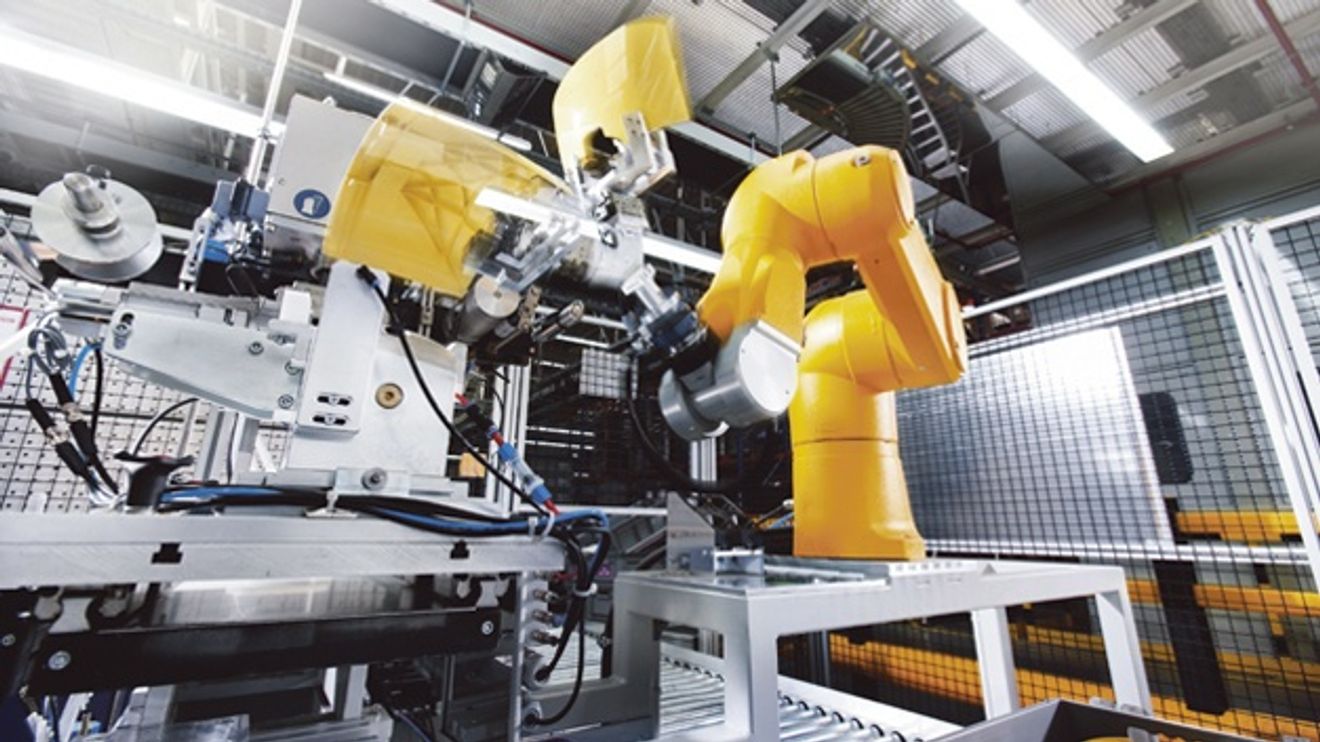
Without a consistent infrastructure, digitalization quickly reaches its limits; connectors and electrical connection technologies play a central role in the networking of tomorrow's production. As the main interface between machines, control systems and data processing systems, they form the basis for the functioning, ease of use and reliability of automation technology.
Three trends are influencing the development of industrial connectors: digitalization, decentralization and miniaturization.
In the course of decentralization, more and more functions are migrating to the device and field level. As a result, there is an increasing need for a continuous connection between devices along the horizontal and vertical axis of the automation pyramid. The addition of intelligent functions is also part of decentralization.
For this reason, the BMBF project "Intelligent electrical connectors and connection technology with electronic signal processing" (ISA for short) is researching new connection technologies and integration techniques in order to implement intelligent connectors for sensors and actuators.
The integration of sensor and diagnostic functions directly into the connector makes additional sensor technology superfluous. The example of an intelligent connector from Weidmüller shows what this can look like in practice. The smart connector was developed as part of the ISA project and was presented at the Hannover Messe 2019.
Electronic signal processing
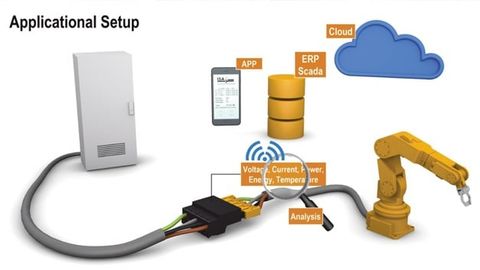
The smart connector is located inside the connecting cable, where it records various electrical values and transmits them to an app, a cloud, an ERP or SCADA system, for example.
© Weidmüller InterfaceThe intelligent connector can be located in the connecting cables of production systems, modules or islands. It is used for power supply as well as for signal and data connection to the SCADA or ERP level.
Current, voltage and power are recorded on the three phases in the smart infrastructure connector. The maximum current is 3 x 72 amperes. The voltage is measured directly at L1-L3, without galvanic isolation. Temperature detection is also integrated.
The plug connector operates in the temperature range between -40 and +125 °C, with a voltage of 3 x 230 V(AC) and a signal frequency of 50/60 Hz. The current is measured using Hall sensors, i.e. without interrupting the circuit.
The plug-in cycle counter
The number of mating cycles determines, among other things, the functionality and 'wear' of a connector. Weidmüller implements the counting function with an energy-autonomous piezo-based miniature system: The force applied during the mating cycle generates energy to supply the downstream electronic system with power. The energy converter is located in the force flow of the mating system - in or on the connector. The energy supply activates the electronic counter. Plausibility criteria are used to validate whether the plugging process has been carried out safely. If validation is successful, the counter is incremented by 1. The absolute value is saved in a non-volatile memory. When the specified maximum number of plugging cycles is reached, a visual mark is made on the measuring system. The meter reading can then be read out contactlessly via an RFID interface, whereby the system is supplied with power via the RFID interface during the reading process.
Author:
Horst Kalla is a trade press officer at Weidmüller Interface in Detmold.


You might also be interested in
The lubricant problem in food production
Lubricants for components used in food production machinery must be safe for human consumption. However, as these are very expensive, alternatives are in demand - for example in drive chains.
 read more...
IO-Link for the vacuum
To make electric vacuum generators, grippers or compact ejectors visible for the smart factory, they must supply digital energy and process data in real time. This works using interfaces such as IO-Link, Ethernet or NFC in the vacuum components.
read more...Integrated microchips
Whether medical devices, product tracking, vehicle systems or 5G communication - the demands on safety, performance, documentation and user-friendliness are increasing. What is the significance of microchips integrated into connectors or cable...
read more...RJ45 - fit for the IIoT
Industrial-grade RJ45 connectors are a good solution for applications without increased protection against dust, dirt or splash water. What must the data interface look like so that the 'dinosaur of data transmission' can serve industrial...
read more...Engineering with a digital twin
There is simply not enough time for time-consuming activities such as drawing up parts lists based on circuit diagrams in control cabinet construction. How can the process - from planning to installation to operation - be optimized?
read more...The effects of the F-Gas Regulation
Can refrigeration units and chillers still be used when the F-Gas Regulation on climate protection comes into force on January 1, 2020? What do the bans on the use of refrigeration and air conditioning systems and new regulations for their...
read more...Choosing the right heat sink
In order to equip a data center with high-speed modules for optical interfaces, AFCI was looking for a suitable solution for cooling the high-performance servers. Pin heat sinks were the solution.
read more...(Ethernet) cables put to the test
The dynamic requirements for cables and the associated energy chains are high. How must (Ethernet) cables be designed so that they can be safely routed in energy chains even under the highest bending stress?
read more...Predictive maintenance of cables subject to wear
A sophisticated concept is needed to be able to maintain cables subject to wear and tear in a predictive manner. Lapp is currently developing one for Ethernet cables that uses machine learning approaches, among other things.
read more...