
Cable glands
The hygiene challenge
The food industry relies on the hygienic design of its machines and systems. However, savings are often made on components such as cable glands or cable guides - and therefore at the wrong end!

Microbiological or bacterial contamination of food is relatively common, as a glance at the government's internet portal shows. This development should not be taken lightly, warns Markus Keller from Stuttgart's Fraunhofer IPA, a specialist in ultra-pure and micro-production: "We need to take a holistic view of this problem area, i.e. not just limit ourselves to cleaning machines. From my experience in microbiology, I know that just one wrong germ can destroy weeks of work."
In order to make the design of a device hygiene-friendly, designers and biologists must be involved in the development process together - for example, when it comes to optimizing valves, fastenings, surfaces or cable guides so that harmful adhesions are excluded from the outset. According to Markus Keller, more and more decision-makers in the industry are becoming aware of the importance of hygienic design; however, production systems are often built and ordered purely on the basis of cost, with the result that inexpensive plastic cable glands are found on high-quality machines for the food industry because the purchaser is not prepared to spend more money on hygienic components.
Manufacturing according to EHEDG specifications
If you do not use comprehensive hygienic design, you run the risk that your cleaning procedures will be very time-consuming and therefore expensive. On the other hand, contamination in the production process can lead to expensive and image-damaging recalls. If you consider the total costs including procurement, risk analysis, cleaning and the associated downtimes over the service life of a system, it is clear that a consistent hygienic design is more cost-effective in the long term.
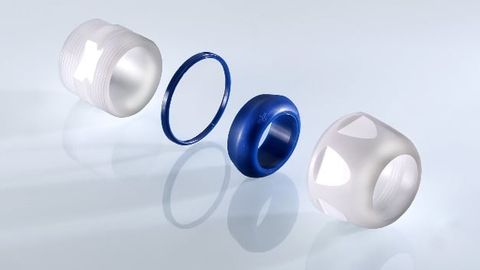
Pflitsch has developed the first hygienic cable gland made of plastic, enabling EHEDG-compliant implementation of hygienic design at a comparatively low cost.
© PlowThe design must be firmly anchored in the tenders and specifications in accordance with the EHEDG guidelines, demands Markus Keller. Current EHEDG, VDI and international ISO 14159 guidelines mean that an appropriate hygienic design is state of the art when using machines and systems in a hygienic environment. It is also necessary to involve hygiene officers in decisions from the outset.
Hygienic design has not only come into focus in the food industry. Related sectors such as the pharmaceutical and drug industries have also become highly sensitized and apply hygienic design principles without directly calling it 'hygienic design'. Markus Keller says: "In principle, it affects all technology sectors and their suppliers that have to deal with clean rooms and clean environments. The semiconductor industry, for example, has been dealing with these aspects for a long time, albeit with a focus on particles rather than microbiology, but with the same design principles."
The topic of hygienic design does not end with the choice of material for the housing, but affects the entire product - including the cable gland, such as those manufactured by Pflitsch.
In the automated production facilities of the food, pharmaceutical and chemical industries, as well as in the clean rooms of the electronics industry, dust and dirt particles must be prevented from adhering, as they can promote the formation of bacterial nests. In addition, the cleaning agents used must run off cleanly. This is a particular challenge for cable glands, as cavities, gaps and open threads, as with standard glands, are absolutely taboo in hygiene applications.
Stainless steel or plastic

The 'Blueglobe Clean Plus' simplifies adaptation to hoses. This allows cables to be mechanically protected or several cables to be routed safely in terms of hygiene.
© PlowOne of the first complete fittings to be certified in accordance with EHEDG is the 'Blueglobe Clean Plus' from Pflitsch. Stainless steel 1.4404/AISI 316L or a food-safe plastic is used for its fitting body, which is manufactured in such a way that it has a very smooth surface with a roughness <0.8 μm and rounded, edge-free transitions to the wrench flats. Instead of the required 3° large radii, Pflitsch generally provides 6° radii, which additionally increases hygiene safety.
Plastics in accordance with FDA 21 CFR 177.2600 are used for sealing inserts and sealing washers, which are suitable for contact with food in accordance with EU Regulation 10/2011. Other features include protection classes IP66, IP68 (15 bar) to IP69 K, a cable-friendly seal thanks to a large sealing insert and high strain relief, which prevents the cable from slipping out of the cable gland.
Variants for hygiene practice
The new plastic version of the hygienic cable gland is currently available in sizes M12 to M40 for cable diameters from 5 mm to 29 mm. The stainless steel version ranges from M8 to M40 for cables from 4 mm to 29 mm. There is also an EMC version that achieves the highest attenuation values up to the GHz range with its 360° contacting of the cable shield. This is ensured by an internal triangle spring that wraps securely around the shielding braid when the cable is inserted. This results in the desired EMC protection even when the pressure screw is loosened.

The 'Blueglobe Clean Plus' hygienic cable gland reliably inserts the power cable and control cable into a Kobold motor housing with a high level of strain relief. Screwed onto a block, the thread is completely covered so that no dirt particles can be deposited or bacteria nests can form.
© PlowFor applications in which cables require additional mechanical protection or where several cables need to be brought together in a hygienic manner, Pflitsch has worked with conduit manufacturers to create a solution for safely combining food-safe conduits and corrugated conduits with the cable gland.
A high-temperature version of the cable gland is also available for production processes in the pharmaceutical and food industries, which sometimes involve very high or low temperatures, with a sealing insert and sealing washers made of high-quality silicone. These high-temperature cable glands with stainless steel and plastic gland bodies can be used at temperatures from -40 °C to +150 °C.
To show the range of applications for the hygienic design and cable glands, here are three examples:
Drive according to EHEDG
The drive technology manufacturer Georgii Kobold has designed a series in a stainless steel housing consistently in accordance with EHEDG specifications. The housing shape, surfaces, materials, seals and cable entry had to be designed accordingly. The company therefore opted for the Pflitsch cable gland developed in accordance with EHEDG guidelines. With its few components, the cable gland is easy to install: The gland body is screwed into the housing wall of the drive (or inserted into through-holes and fixed with a locknut). The pressure screw is then screwed on, the cable is pushed through and the pressure screw is tightened to block with no gaps. A flush sealing washer made of an EHEDG-approved elastomer material securely seals the cable gland against the housing. The entire assembly of the two cable entries for power and control data is carried out from the outside without special tools.
Robust camera housing
The areas of application for image processing range from the classic industrial sector to clean rooms, the pharmaceutical and food industries, measuring equipment in climatic chambers and offshore operations or applications for solar systems in the desert. Autovimation manufactures protective housings for camera systems and accessories to protect sensitive camera technology from mechanical, chemical or thermal stresses. Thanks to the company's 'Heat-Guide/Quick-Lock' camera attachment, the camera housing also serves as a heat sink, which can reduce the temperature in the camera housing by up to 20° C. For extreme temperature ranges, water cooling systems, controlled heating plates and housings with Peltier air conditioning are also available.
To connect the camera technology to the peripherals via power and data cables, Autovimation relies on cable entries from Pflitsch, which ensure a high level of tightness even with very different cables. Thanks to the 'Blueglobe Clean Plus', camera housings can also be realized for the hygiene sector.
The electropolished V4A stainless steel housing 'Dolphin', for example, offers IP69K protection for compact cameras with a cross-section of 29 mm x 47 mm to 40 mm x 40 mm. It was specially developed for hygienically demanding tasks. Particular emphasis was placed on avoiding corners and edges where dirt or germs could settle. All potential gaps are sealed with FDA-approved seals.
Hygiene has priority
At Weber Maschinenbau, design is currently at the top of the specifications. One example is the 'Slicer 906' for cutting cheese, sausage and meat into slices from 0.1 mm to 50 mm at a cutting speed of up to 1500 rpm. The slices are deposited in all standard configurations according to customer requirements - for example stacked, shingled or folded. The system, made of stainless steel and acrylic glass, was designed to be as hygienic as possible, so the Pflitsch solution is also used here in order to be able to insert a large number of different cables and pneumatic lines into the stainless steel housing in a hygienic and durable manner.
Author:
Walter Lutz is a freelance technical journalist in Haiger.


You might also be interested in
The lubricant problem in food production
Lubricants for components used in food production machinery must be safe for human consumption. However, as these are very expensive, alternatives are in demand - for example in drive chains.
 read more...
IO-Link for the vacuum
To make electric vacuum generators, grippers or compact ejectors visible for the smart factory, they must supply digital energy and process data in real time. This works using interfaces such as IO-Link, Ethernet or NFC in the vacuum components.
read more...Integrated microchips
Whether medical devices, product tracking, vehicle systems or 5G communication - the demands on safety, performance, documentation and user-friendliness are increasing. What is the significance of microchips integrated into connectors or cable...
read more...RJ45 - fit for the IIoT
Industrial-grade RJ45 connectors are a good solution for applications without increased protection against dust, dirt or splash water. What must the data interface look like so that the 'dinosaur of data transmission' can serve industrial...
read more...Engineering with a digital twin
There is simply not enough time for time-consuming activities such as drawing up parts lists based on circuit diagrams in control cabinet construction. How can the process - from planning to installation to operation - be optimized?
read more...The effects of the F-Gas Regulation
Can refrigeration units and chillers still be used when the F-Gas Regulation on climate protection comes into force on January 1, 2020? What do the bans on the use of refrigeration and air conditioning systems and new regulations for their...
read more...Choosing the right heat sink
In order to equip a data center with high-speed modules for optical interfaces, AFCI was looking for a suitable solution for cooling the high-performance servers. Pin heat sinks were the solution.
read more...(Ethernet) cables put to the test
The dynamic requirements for cables and the associated energy chains are high. How must (Ethernet) cables be designed so that they can be safely routed in energy chains even under the highest bending stress?
read more...Predictive maintenance of cables subject to wear
A sophisticated concept is needed to be able to maintain cables subject to wear and tear in a predictive manner. Lapp is currently developing one for Ethernet cables that uses machine learning approaches, among other things.
read more...