
Lapp
Service as a product
Five evolutionary stages characterize a company's path from pure product supplier to problem solver. But how can the transformation from exclusive production to service be shaped in concrete terms?

Christoph Loos, CEO of Liechtenstein-based tool manufacturer Hilti, said in 2017: "Customers want to buy holes instead of rotary hammers." This statement, which has often been quoted since then, sums up what manufacturers are increasingly realizing - technology alone does not offer customers any value, no matter how sophisticated it may be. The technology must provide them with a concrete benefit - for example, by solving a problem or improving a situation. On top of this comes digitalization, which allows customers to use machines without having to buy them. The 'X-as-a-Service' business model is becoming increasingly popular - where 'X' can stand for mobility, lighting or machining.
As a result, developing and producing innovative, high-quality or inexpensive products is no longer enough for a company's success. Instead, companies need to consider how their products can solve problems, fulfill a wish or even function as a service - what is required is the development from pure product manufacturer to solution provider.
From product to service provider
The FIR research institute at RWTH Aachen University, which specializes in service and maintenance, describes the path from product to solution provider in five stages.
- At the first stage, a company begins as a pure product manufacturer. The product and its features are clearly the focus of the business model and marketing. If the company is already offering services at this stage, this is done unsystematically and not as part of planned business revenue. At Lapp, for example, this level initially includes the production and sale of connection components such as cables, connectors and switches. This is also the entrepreneurial origin of the Stuttgart-based provider in the field of cable and connection technology.
- At the second stage, a company then offers individual services in addition to the product that are useful for its use. One example from Lapp is the additional handling of logistics services and project management in the project business.
- The third stage includes services as a business model which, together with the product, are an integral part of the offering - for example, a service with which the company offers its customers customized solutions and their implementation. Lapp can already be involved in planning processes for machines, for example, whereupon individual adaptation and implementation of corresponding connection components is possible. Special cable configurators ensure greater flexibility in planning and ordering. In the 'Ölflex Connect' system, for example, the company offers tailor-made solutions from design and drawing to assembly and pre-assembled drag chains.
- At level four, the company has arrived at a complete solution. The product is no longer the core component of the business model. It is now about comprehensive services for development, production, operation and optimization. To this end, Lapp offers the 'Health Check Service' for machine and system areas.
- Finally, the fifth stage involves a company that offers a complete solution as a service in an operator model - an as-a-service model.
Win-win for everyone involved
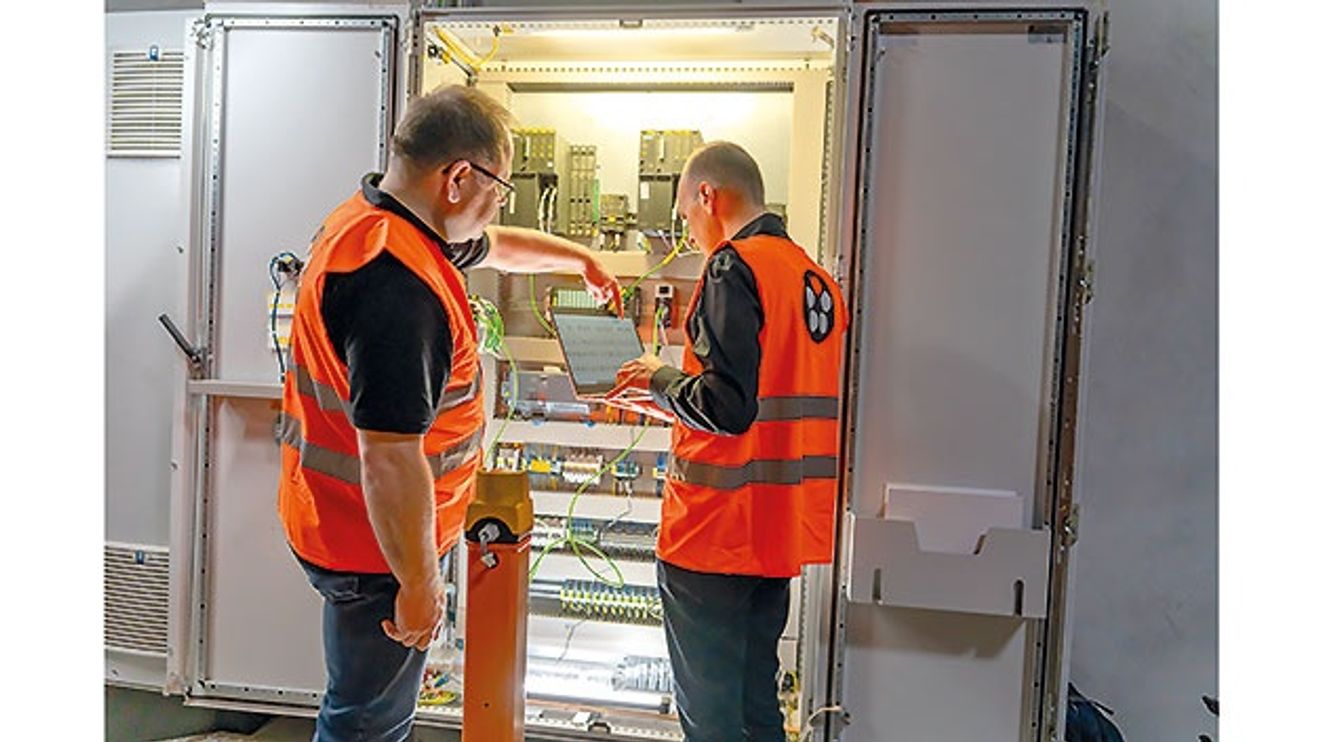
For both manufacturers and their customers, such a change over the five stages brings many advantages. After all, the purchase of new machines is usually a significant investment. This can be difficult to shoulder, especially in sectors such as wood or metalworking, which in Germany consist mainly of small and medium-sized companies. And once the machines have been purchased, there is pressure to utilize them 24/7 in order to justify the costs - which is not always possible.
For example, a metalworking company that no longer buys and operates its machines itself, but instead purchases machining as a service, can significantly reduce the economic pressure. Usage-based billing takes the worry out of order-related machine downtime and can even make the production of small batches and one-offs economical. Meanwhile, the providers of the overall solution in the operator model, in this case machining, benefit from the fact that their machines are utilized to the maximum, as many different customers access them.
For such business models to work, providers and customers must exchange data on a large scale - when the customer orders or pays for a service and when the provider tracks and invoices usage or monitors and optimizes processes. High system availability and the networking of the machine with higher-level business processes and their production data are prerequisites for the transformation in terms of the Industrial Internet of Things (IIoT). This is where Lapp comes in with its 'Health Check Service' model for network technology.
'Health check' for network technology

The author: Dr. Patrick Olivan reports as Senior Manager Business Development Services at Lapp in Stuttgart.
© LappBackground: According to the Indu-Sol Vortex Report, 50% of all machines failed in 2021 due to connection problems with plugs, cables and switches - for example due to mechanical stress, ageing, inferior products, incorrect earthing and other factors. However, if industrial machines and their data connections fail, it quickly becomes costly and also detrimental to usage-based business models. Lapp wants to avoid this: The 'Health Check Service' analyzes Ethernet and Profinet systems, detects current and impending errors or weak points and offers suggestions for improvement. Support is not only available for existing machines, but can also be used during machine planning and commissioning in order to identify probable malfunctions and failure factors in advance. Customers receive a reliable status analysis of their network technology, which enables higher machine availability and production efficiency. Lapp ensures that suitable components are used and identifies any need for further development in its own product portfolio in response to individual customer requirements.


You might also be interested in
Generation change heralded
From October 1, 2022, the third generation will take the helm at the Stuttgart-based family business Lapp: Matthias Lapp (39), the grandson of company founder Ursula Ida Lapp, will become CEO of Lapp Holding.
 read more...
With a focus on artificial intelligence
The e-paper of issue 05/06-22
Three trade fairs and the special issue Sensor&Vision await you in issue 5/6 of Computer&Automation. Find out in our special Robotics&Automation section why high plant efficiency does not depend on full automation and how SMEs can use...
read more...The interactive e-paper of the winners
The interactive e-paper Computer&Automation "Products of the Year 2022" offers twelve categories, 36 winners and video interviews with the award winners at a glance! Click right in and experience the industry's pacesetters up close.
read more...Kontron Begins Production of 5G Modules in Düsseldorf
Kontron has launched mass production of 5G communication modules in Düsseldorf. The modules, which were developed in Berlin, are used in a variety of sectors, including industry, transportation, and critical infrastructure.
read more...Embedded module for CRA-compliant communication
With the 'comX 90' embedded module, Hilscher is expanding its industrial communication portfolio with a new generation of compact communication modules.
read more...Softing Industrial Automation takes over Delta Logic
Softing Industrial Automation has acquired 100% of the shares in Delta Logic Automatisierungstechnik in Schwäbisch Gmünd.
read more...Range of embedded communication interfaces expanded
HMS Networks is launching another version of the embedded communication interfaces 'Anybus CompactCom'. Anybus CompactCom B40 Mini' complements the 40 series with a communication interface that is optimized for automated production.
read more...Update brings support for TIA V19
Delta Logic has updated the 'Accon OPC UA Server' software to version 1.4.0.0. The new features include support for TIA Portal projects of version V19 and for the latest firmware for CPUs of the Siemens S7-1200 and S7-1500 controllers.
read more...The e-paper for the special issue
Communication & networking 09/24
Communication and networking form the backbone of industrial automation. It enables flexible production processes and creates the basis for innovations and new business models. The news is now available in this e-paper.
read more...