
Switch cabinets
Pressure-resistant encapsulation modernized
Instead of heavy cast iron and steel constructions, modern material combinations and technologies can be used to create control cabinets that hardly differ from their relatives in the safe industrial sector - and can be used without restrictions in Zone 1!

Above a certain enclosure size, flameproof enclosures become very heavy and bulky. The reason for this is the high explosion pressure that the flameproof enclosures have to absorb in the event of ignition of an explosive atmosphere. Depending on the size and geometry of the inner volume of the flameproof enclosure, the composition of the ignited explosive atmosphere and the location of the ignition source, explosion pressure peaks in the range of 8 to 15 bar can occur. This often results in very high installation and operating costs because the supporting systems and building components have to be designed to be correspondingly stable and spacious.
Another disadvantage of conventional technology becomes apparent with more extensive control and distribution systems: while they can be installed in sufficiently large control cabinets in safe industrial areas without any particular effort, the required pressure resistance of the enclosures in the Ex d area requires wall thicknesses of 10 to 20 mm. This limits an economically and technically sensible size to a maximum enclosure volume of around 500 liters. Large and complex electrical control systems and distribution boards must therefore be divided into various smaller flameproof enclosures, which must be combined with each other. The planning and manufacture of such enclosure combinations is considerably more complicated and time-consuming than that of conventional industrial control cabinets. The necessary electrical connections between the various Ex d enclosures are made using flameproof cable bushings, which are relatively complex to manufacture and install due to the explosion protection requirements. In addition, the entire enclosure combination must be mounted on special support frames. Overall, it is not only the planning and manufacture of such control and distribution systems suitable for potentially explosive atmospheres that is time-consuming and cost-intensive, but also operation, maintenance and repair. Subsequent changes to the internal electrical wiring inevitably lead to extensive and expensive conversion work, which usually has to be approved by experts before the system can be put back into operation.
Pressure relief as a solution
This dilemma was addressed by the company R. Stahl, which developed and produced plastic enclosures for the 'flameproof enclosure' type of protection back in the 1960s.

Ex d enclosure with solid walls (left) versus Expressure design with pressure relief elements marked in blue (right). With the same dimensions, Expressure provides more installation space with a lower enclosure weight.
© R. Stahl switchgearIn order to eliminate the disadvantages and limitations of the previous technology described above, the company turned its attention to modern lightweight construction principles. Among other things, tests were carried out with various porous materials. The aim of these tests was to find efficient and safe ways of improving the effect of the flameproof gap, resulting in significantly higher and faster pressure relief after an internal explosion. For example, a pressure relief element made of porous sintered material was developed, with which a pressure reduction of up to 30% could be achieved compared to conventional flameproof enclosures. The element received ATEX certification in 2015.
R. Stahl continued its search for even more suitable materials in close cooperation with German universities and the PTB and Dekra Exam test centers. The result is a special wire mesh fabric that was developed specifically for the purpose of flameproof, efficient pressure relief.
A wire mesh fabric

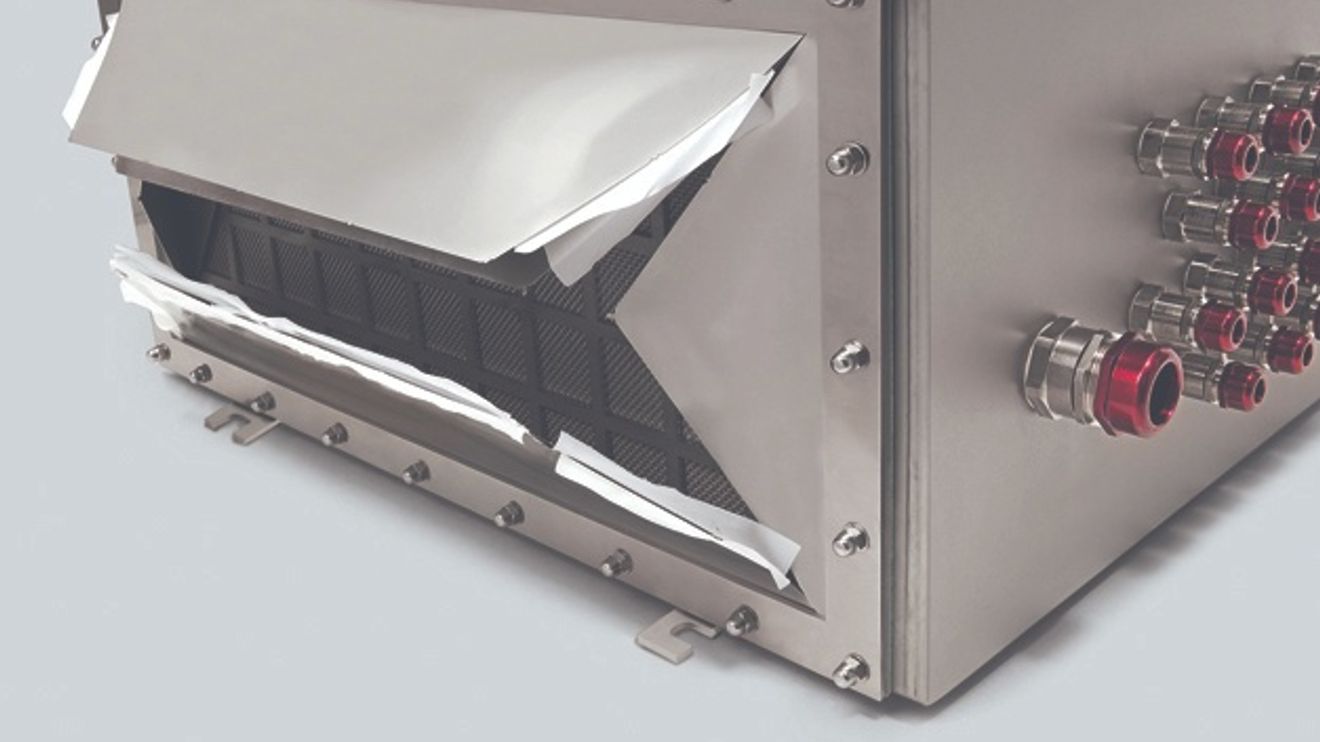
R. Stahl's 'Expressure' technology is based on a multi-layer stainless steel mesh with flow channels in which explosion energy is safely dissipated.
© R. Stahl switchgearThe metal mesh woven from fine stainless steel wires is built up in several superimposed layers. Each of these layers has been optimized in the course of numerous tests with regard to its geometric and technical parameters such as wire thickness, mesh size and weave type. The different layers are sintered to form a stable composite. As a result, the finished wire mesh has high gas permeability, mechanical strength and heat capacity with relatively low thermal conductivity in addition to its resistance to ignition breakdown, making it suitable for integration into flameproof enclosures. Using special processes, it can be cast into cast aluminum housings as well as welded into stainless steel housings. A ratio between gas-permeable surfaces and closed side walls of 10 to 15 % has proven to be ideal.

The side walls with permeable pressure relief elements are sealed on the outside by bursting discs and protected to IP66.
© R. Stahl switchgearIf an explosive atmosphere ignites inside an enclosure prepared in this way, the energy released is dissipated quickly and efficiently. Various physical effects take effect (shown in very simplified form below). The gas-permeable fabric enables rapid pressure reduction to the outside. Depending on the position of the ignition source in the pressure chamber, a certain amount of the unburned gas-air mixture is also forced out and cannot become explosive. A not inconsiderable part of the resulting reaction heat is absorbed by the grid-air structure of the wire mesh and is therefore not available for internal pressure build-up. The result: while peak pressures of around 10 bar are measured in a conventional Ex d enclosure of the same size, the peak pressure measured in the new enclosures is well below 1 bar. A suitable arrangement also reliably prevented the outer surface of the grid layers from being raised to temperatures above the permissible value for temperature class T4.
However, good protection of the external grille surfaces is necessary to ensure that the solution functions reliably under a wide range of harsh environmental conditions such as contamination or icing. This is made possible by the installation of conventional bursting discs, which guarantee protection class IP66 in normal operation, but open at a set pressure value of 0.1 bar in the event of an explosion, thus paving the way for the escaping gas to escape.
3 mm wall thickness
The pressure reduction described above makes new designs for flameproof enclosures possible. The enclosures developed by R. Stahl under the brand name 'Expressure' have wall thicknesses of around 3 mm and are therefore not far removed from the corresponding dimensions of industrial enclosures. This has a significant effect on the weight and compactness of the design. Comparative sample calculations showed savings of 30 to 50 % in weight and 25 % in external dimensions compared to conventional switchgear combinations. This is particularly relevant when it comes to tightly packed installations in the offshore sector.
A large-format housing is all you need
It is also possible to build flameproof enclosures with very large dimensions. The largest expressure enclosure currently available has a height of 1400 mm with a width of 100 mm and a depth of 700 mm; even larger enclosure dimensions are planned. This makes project planning much easier. Whereas conventional technology required a combination of several enclosures to accommodate complex control units and distribution boards, a single Expressure enclosure is now generally sufficient. Large equipment such as transformers or frequency converters, for example, which previously either could not be made suitable for hazardous areas at all or only with a great deal of effort, can now be safely installed in the large-volume enclosures.
The ATEX and IECEx certifications were carried out in parallel at the two German test centers, and the necessary certificates have already been obtained for the first four enclosure sizes. For the ATEX area, pure Ex d certificates were issued using Annex II of Directive 2014/34/EU (this annex deliberately enables innovative solutions that are not yet 100% included in the relevant harmonized standards). Both the IEC 60079-1 standard and the IEC 60079-33: Special protection standard were used for the IECEx certificates. Both test bodies mentioned acted as the two 'independent verifiers' required by 60079-33.
Author:
Prof. Dr. Thorsten Arnhold is Vice President Strategy & Technology at R. Stahl Schaltgeräte and Chairman of the IECEx system in Waldenburg.


You might also be interested in
The lubricant problem in food production
Lubricants for components used in food production machinery must be safe for human consumption. However, as these are very expensive, alternatives are in demand - for example in drive chains.
 read more...
IO-Link for the vacuum
To make electric vacuum generators, grippers or compact ejectors visible for the smart factory, they must supply digital energy and process data in real time. This works using interfaces such as IO-Link, Ethernet or NFC in the vacuum components.
read more...Integrated microchips
Whether medical devices, product tracking, vehicle systems or 5G communication - the demands on safety, performance, documentation and user-friendliness are increasing. What is the significance of microchips integrated into connectors or cable...
read more...RJ45 - fit for the IIoT
Industrial-grade RJ45 connectors are a good solution for applications without increased protection against dust, dirt or splash water. What must the data interface look like so that the 'dinosaur of data transmission' can serve industrial...
read more...Engineering with a digital twin
There is simply not enough time for time-consuming activities such as drawing up parts lists based on circuit diagrams in control cabinet construction. How can the process - from planning to installation to operation - be optimized?
read more...The effects of the F-Gas Regulation
Can refrigeration units and chillers still be used when the F-Gas Regulation on climate protection comes into force on January 1, 2020? What do the bans on the use of refrigeration and air conditioning systems and new regulations for their...
read more...Choosing the right heat sink
In order to equip a data center with high-speed modules for optical interfaces, AFCI was looking for a suitable solution for cooling the high-performance servers. Pin heat sinks were the solution.
read more...(Ethernet) cables put to the test
The dynamic requirements for cables and the associated energy chains are high. How must (Ethernet) cables be designed so that they can be safely routed in energy chains even under the highest bending stress?
read more...Predictive maintenance of cables subject to wear
A sophisticated concept is needed to be able to maintain cables subject to wear and tear in a predictive manner. Lapp is currently developing one for Ethernet cables that uses machine learning approaches, among other things.
read more...