
Energy chains
New sensor concepts for predictive maintenance
Predictive maintenance is currently one of the hot topics in mechanical and plant engineering. Equipped with the appropriate sensor technology, the energy chain will make a significant contribution to this in the future.
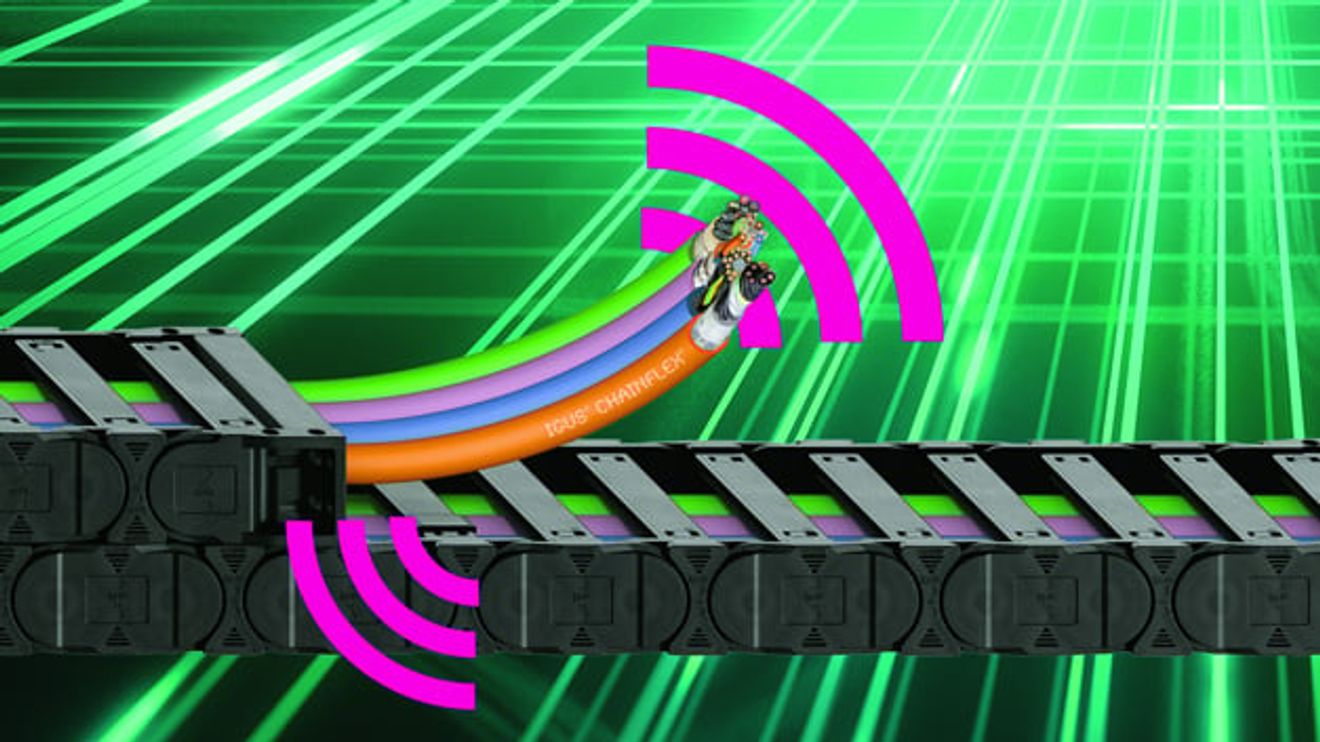
The digital networking of machines and products makes it possible to continuously record the status data of machine components and combine it with other systems. Predictive maintenance makes production processes simpler and safer, as the permanent monitoring of all machines and components means that faults can be identified and wear can be predicted before a standstill occurs. As a result, maintenance and repair measures for affected parts can be initiated at an early stage. This reduces expensive downtimes compared to periodic maintenance. Predictive maintenance is therefore an important element within Industry 4.0.
At the recent Hannover Messe, for example, Igus presented sensors and monitoring modules for the first time under the name 'isense', which are installed in or on the plastic components of the energy chain. Energy chains and the cables within them supply machines and systems with energy and data. If these suddenly fail, the system would come to a standstill. An interrupted production run costs the plant manufacturer dearly. It is understandable that plant managers would like to prevent a possible failure.
In future, this will be possible with the 'isense EC.W(ear)' wear monitoring system: A sensor installed in the opening bar of the energy chain continuously measures the condition of the gliding chain during the travel path: if the wear is so advanced that the end of the chain's service life is approaching, the sensor reports and triggers a signal. An antenna unit in the immediate vicinity receives the data by radio and forwards it to a reader module. This processes the antenna signal and then reports it to the central communication unit. The so-called icom module processes the data and forwards it to the installation system. In this way, the system operator can integrate the replacement of the worn part into his maintenance process in good time.
Igus introduced its first products for predictive maintenance a few years ago: The PPDS push-pull force detection system and the EMA diagnostic tool for identifying a broken chain link. Since then, these components have been successively developed further and have now been integrated into the new isense family. This means that the abrasion monitoring unit (EC.W) can now be combined with other conditioning monitoring solutions such as the breakage alarm (EC.B - formerly EMA) and the tensile and shear force monitoring (EC.P - formerly PPDS).
In the case of tension/push force monitoring, a load cell is installed in the connecting element of the energy chain to monitor the displacement forces. For travel distances of over 100 meters, the force sensor is installed in the so-called floating carrier, which compensates for lateral tolerances on the carrier travel: If a foreign object - for example a tool that has fallen into the travel range of the chain - blocks the movement, the displacement forces increase. From a defined threshold value, the sensor emits a signal - similar to abrasion monitoring - which is recorded by an evaluation box and forwarded to the icom communication module. If the permissible forces are exceeded, the system shuts down the installation before any major damage can occur.
The system is doubly fail-safe with breakage monitoring (EC.B module): Mechanical impact or overloading of a chain can cause the side section to break. If this happens, a polymer sensor installed in special separators reports the breakage to a sensor unit. The user is warned by the maintenance signal and can repair the damage to prevent major consequential damage. Replacing a single damaged chain link usually takes just a few minutes. This prevents the second side part from also breaking and the system coming to an unplanned standstill with major damage. Both signals can be read out via a reader module, as one reader unit can process up to four antennas. It would therefore be possible to connect up to four energy chains to one module. All data is processed in the communication unit and forwarded to the installation's system.
Fail-safe cables

A sensor installed in the opening bar of the energy chain measures the condition of the chain in real operation: If the wear is so advanced that the end of the chain's service life is approaching, the sensor reports this and triggers a signal.
© igusHowever, even the safest chain is only worth half as much if the cables inside it do not hold. And the challenges for energy chain cables are known to be many times greater than for cables in flexible applications. For this reason, Igus has been developing its own cables for moving applications for 25 years under the name Chainflex and guarantees the reliability of the cable for movements in all directions for up to 36 months. However, the isense concept goes one step further - with a failure monitoring module for cables called isense CF.Q (electrical conductor quality). Intelligent sensors continuously check the measured values of the cables and indicate when the limit values, whose calculation is based on empirical values from millions of results from the test laboratory, are exceeded. This means that the 'intelligent' cable also provides information about its remaining service life during operation - before it fails.
The isense sensors were first used in the production facilities of various German car manufacturers. However, they can also be used wherever predictive maintenance is required for cost reasons or to increase system efficiency and reduce energy consumption - for example in energy chains on long travel paths in port facilities or crane systems. The corresponding solutions can be installed in many products and some can also be retrofitted into existing systems.
Scenario of the future: global test laboratory
As the central module of the isense series, the icom communication unit now networks all the data from the monitoring modules and then forwards it to the production systems on site. Isense can also be connected to the Igus data center and compared with the parameters of the respective system and the data from millions of results from the test laboratory.

A force sensor in the floating carrier monitors the chain during operation: If a foreign object blocks the chain, the displacement forces increase.
© igusThe service life can even be calculated individually. This allows the system operator to receive after-sales services such as the optimization of their business processes through automated spare parts procurement and maintenance orders. The ultimate aim is to use sensors on various components to make increasingly accurate predictions about the service life of the energy chains.
Collecting and evaluating machine data is an important cornerstone for greater planning reliability and efficient maintenance in the factory of the future. Today, simple digital I/O signals are still sent when a limit value is exceeded. The icom module forwards the maintenance information to the user's systems via cables. In the future, a solution would be conceivable that not only evaluates local production data, but is also fed with abstracted data from other applications and the many test results from the database. Whether this takes place in the form of an application on the user's premises or in the cloud could ultimately be decided by the user themselves.
In a nutshell: comparable to a global test laboratory, numerous statistical values could be determined by analyzing and evaluating specific data from a wide range of applications, which would enable even more accurate predictions to be made and could also be fed back into the research and development of new products.
Author: Harald Nehring is an authorized signatory at Igus.


You might also be interested in
The lubricant problem in food production
Lubricants for components used in food production machinery must be safe for human consumption. However, as these are very expensive, alternatives are in demand - for example in drive chains.
 read more...
IO-Link for the vacuum
To make electric vacuum generators, grippers or compact ejectors visible for the smart factory, they must supply digital energy and process data in real time. This works using interfaces such as IO-Link, Ethernet or NFC in the vacuum components.
read more...Integrated microchips
Whether medical devices, product tracking, vehicle systems or 5G communication - the demands on safety, performance, documentation and user-friendliness are increasing. What is the significance of microchips integrated into connectors or cable...
read more...RJ45 - fit for the IIoT
Industrial-grade RJ45 connectors are a good solution for applications without increased protection against dust, dirt or splash water. What must the data interface look like so that the 'dinosaur of data transmission' can serve industrial...
read more...Engineering with a digital twin
There is simply not enough time for time-consuming activities such as drawing up parts lists based on circuit diagrams in control cabinet construction. How can the process - from planning to installation to operation - be optimized?
read more...The effects of the F-Gas Regulation
Can refrigeration units and chillers still be used when the F-Gas Regulation on climate protection comes into force on January 1, 2020? What do the bans on the use of refrigeration and air conditioning systems and new regulations for their...
read more...Choosing the right heat sink
In order to equip a data center with high-speed modules for optical interfaces, AFCI was looking for a suitable solution for cooling the high-performance servers. Pin heat sinks were the solution.
read more...(Ethernet) cables put to the test
The dynamic requirements for cables and the associated energy chains are high. How must (Ethernet) cables be designed so that they can be safely routed in energy chains even under the highest bending stress?
read more...Predictive maintenance of cables subject to wear
A sophisticated concept is needed to be able to maintain cables subject to wear and tear in a predictive manner. Lapp is currently developing one for Ethernet cables that uses machine learning approaches, among other things.
read more...