
Rosenberger OSI
Data volume demands infrastructure
Big data, cloud computing, IoT, Industry 4.0 and digital workplaces - data growth is enormous and the digital transformation is changing the IT world forever. How must the cabling be designed so that the network infrastructure can cope with the data throughput?
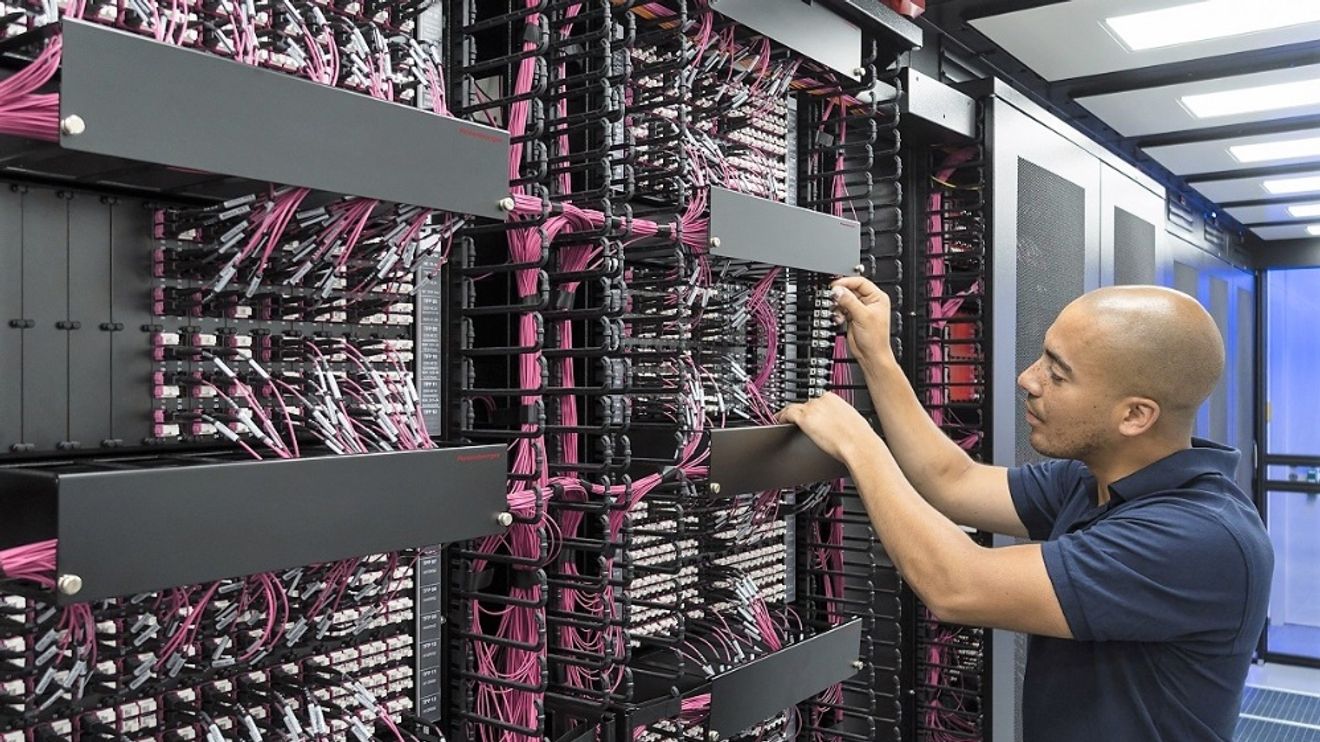
Data is the most important raw material for companies around the world. A rapidly growing number of consumers and companies are generating and sharing data with a wide variety of end devices. There is no end in sight to this development, as the 'IDC Data Age 2025' study predicts. According to the study, the amount of data worldwide is set to increase tenfold to 163 Zbytes by 2025. According to the analysts' estimates, companies will generate 60% of this global data volume.
Although many organizations are still in the early stages of their digital transformation strategy, it is already clear that the more business processes are digitized and the larger the data volumes become, the more important the underlying infrastructure becomes. If the data throughput is not right, the performance of processes suffers and the effect of innovative ideas fizzles out. Companies therefore need a high-performance IT infrastructure in order to be able to flexibly adapt their business processes to the requirements of customers, markets and technical developments in the medium to long term. The foundation is therefore a reliable network with future-oriented cabling.
Fiber optics in buildings and data centers
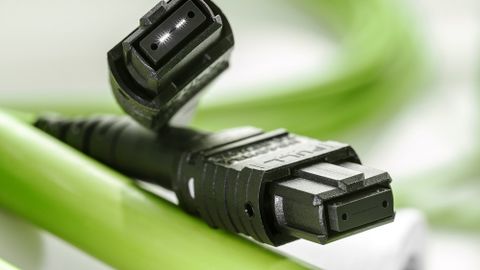
OM5 fibers can handle high data volumes: The new generation of optical fibers for data-intensive applications is capable of transmitting up to 100 Gbit/s per fiber pair thanks to SWDM (Shortwave Wavelength Division Multiplexing) technology.
© Rosenberger OSIEthernet has become the preferred technology in the field of building and data center cabling. The international standardization committees are continuously working on the further development of standards so that uniform solutions can be created to meet the challenges of the future. In October 2017, OM5 was defined as the standard for the cabling classification of broadband multimode fiber optic cables.
In addition, the designation is intended for inclusion in the editions of the standardization organizations ISO/IEC 11801, DIN EN 50173-1 and ANSI/TIA-568.3-D.
Rosenberger Optical Solutions & Infrastructure(Rosenberger OSI), for example, a manufacturer of cabling solutions based on fiber optic technology, has already adapted this standard for its product range. Their OM5 products can optimally transmit 100 Gbit Ethernet over two fibres. Using the wavelength division multiplex method, data can be transmitted simultaneously at four different wavelengths.
In the past, the focus was on optimizing the transmission properties at a single wavelength.
This fiber was optimized at 850 nm and became known as 'New Fiber' around the turn of the millennium. Today it is classified as 'OM3'. The OM3 fiber allows the implementation of a relatively cost-effective solution. With a transmission length of 300 m, a data transmission rate of 10 Gbit/s is possible.
Due to the global data volume and the desire for higher throughput rates, the further development of the standard was a logical consequence - because an increase in data rate always goes hand in hand with a reduction in data length. In order to achieve an increase in transmission rates, the further development of multimode fiber was therefore necessary. The specifications for an OM4 fiber were therefore defined in ISO/IEC 11801 in 2010. This made an improved bandwidth possible. The maximum transmission length of an OM4 fiber is a specified 550 m with a data throughput of 10 Gbit/s.
High data throughput for complex applications

With OM5 fiber, wavelength division multiplexing can now also be optimally implemented for multimode fibers - a technology that has already been established for a very long time for singlemode fibers. With the help of SWDM technology (Shortwave Wavelength Division Multiplexing), which makes it possible to transmit data streams at different wavelengths via one fiber, up to 100 Gbit/s can now be transferred per fiber pair. In this way, four data streams of 25 Gbit/s each (100 Gbit Ethernet) can be transmitted with OM5 cabling.
Another option is to project the established bidi technology for single-mode fibers onto multimode. However, for the same performance - 100 Gbit/s per fiber pair - a 50 G transceiver technology is then required, which transmits 50 Gbit/s per fiber in both directions over two different wavelengths.
The aforementioned technologies can only be implemented to a limited extent with conventional fibers. The full potential for a cable length of up to 150 m is only possible with OM5 fiber. It is specified over a larger wavelength range with the same performance as an OM4 fiber. SWDM signals at 850 nm, 880 nm, 910 nm and 940 nm are transmitted in parallel via one fiber. With Bidi, signals are transmitted simultaneously in one direction at 850 nm and in the opposite direction at 1300 nm.
This means that cabling infrastructures based on OM5 fibers are predestined for complex applications in which a high volume of data is generated and extreme demands are placed on data throughput at the same time. In this way, real-time applications can be implemented in a productive environment, such as those required for Industry 4.0 or Big Data.
OM5 multimode fibers are particularly suitable for working with high-performance switches and for connecting high-performance servers. A high-performance 100 Gbit Ethernet connection can be established with just two OM5 multimode fibers. The cable length of 150 m qualifies OM5-based cables for cross-floor building cabling or for use in server rooms, for example.
In data centers, with their high number of components and applications with a high data volume, 400 Gbit Ethernet will be the ideal solution in future. This can be achieved with eight OM5 fibers.


You might also be interested in
One PVC and one Ethercat version
Escha is offering two new cable qualities, a PVC cable and an Ethercat cable. The S5200 PVC cable is designed for industrial Ethernet applications in which only low requirements are placed on drag chain and torsion properties.
 read more...
Real-time data transmission in smart grids
Phoenix Contact launches robust multi-fiber data connectors on the market. The M17 MPO (multi fiber push-on) series fiber optic connectors are particularly suitable for real-time data transmission in intelligent power networks.
read more...Kontron Begins Production of 5G Modules in Düsseldorf
Kontron has launched mass production of 5G communication modules in Düsseldorf. The modules, which were developed in Berlin, are used in a variety of sectors, including industry, transportation, and critical infrastructure.
read more...Embedded module for CRA-compliant communication
With the 'comX 90' embedded module, Hilscher is expanding its industrial communication portfolio with a new generation of compact communication modules.
read more...Softing Industrial Automation takes over Delta Logic
Softing Industrial Automation has acquired 100% of the shares in Delta Logic Automatisierungstechnik in Schwäbisch Gmünd.
read more...Range of embedded communication interfaces expanded
HMS Networks is launching another version of the embedded communication interfaces 'Anybus CompactCom'. Anybus CompactCom B40 Mini' complements the 40 series with a communication interface that is optimized for automated production.
read more...Update brings support for TIA V19
Delta Logic has updated the 'Accon OPC UA Server' software to version 1.4.0.0. The new features include support for TIA Portal projects of version V19 and for the latest firmware for CPUs of the Siemens S7-1200 and S7-1500 controllers.
read more...The e-paper for the special issue
Communication & networking 09/24
Communication and networking form the backbone of industrial automation. It enables flexible production processes and creates the basis for innovations and new business models. The news is now available in this e-paper.
read more...Test digital simulation live
On September 26 and 27, students at Amberg-Weiden University of Applied Sciences will be able to find out how computer simulation can be applied directly to research and development projects. CADFEM and Ansys invite you to the big live simulation...
read more...