
Housing
Construction kit for the display
Enclosures with matching displays from a single source - a wish of many electronics developers. A modular system including an online configurator makes it possible.

As the development of industrial electronics progresses, the demands on electronic housings are growing. Comprehensive system solutions are increasingly coming to the fore. However, device manufacturers are primarily specialized in the sophisticated electronics in the device itself - if an enclosure is then required for the 'packaging', electromechanical experts are in demand. The market, in turn, offers a wide range of housing solutions designed for display integration. It is often left to the electronics developer to select a suitable display and to take care of the electromechanical integration of the display unit. The extensive range of displays on offer does not make selection and integration easy.
Integration must become easier

Displays have become an integral part of many areas of everyday life and are increasingly being used in professional and industrial applications.
© Japan Display Inc.For years now, it has been apparent that the operating habits of so-called smart devices from the leisure and consumer electronics sector are also spreading to industrial device technology. For example, Japan Display Inc. - a joint venture between Sony, Toshiba and Hitachi that manufactures liquid crystal displays - estimates that around 700 million display units will be used in new industries outside of consumer electronics by 2022. In this context, the focus is also shifting to housings for the numerous and varied displays and touchscreens.
Phoenix Contact now wants to position housing solutions for the integration of displays in this market and thus make the work of electronics developers easier. Custom-fit liquid crystal displays (LCDs) with a resolution of up to 1024 x 768 pixels are offered - both TFT color LCDs and other passive LCDs. The areas of application extend to DIN rail, handheld or large display carrier devices. Possible applications include energy measuring devices in installation distribution boards, barcode scanners in logistics or operating terminals on machine tools.
Mounting rail or handheld
The modular electronic enclosure systems for DIN rails offer functions ranging from device connection technology to high-pole DIN rail bus connectors.
The enclosures can also be prepared for the installation of a TFT display. This display with a specially designed frame is snapped into place on the front. The cut-out provided for this purpose is milled to the exact position required by the customer. Stepped snap-in hooks on the frame also allow installation in different enclosures with different wall thicknesses.

The 2.4-inch TFT LCD from Phoenix Contact can be easily snapped into the modular 'ME' and 'ME-IO' housings thanks to its specially designed frame.
© Phoenix ContactThe handheld housings and display carrier housings have been designed for mobile and stationary use. The housings are also prepared for the installation of passive LCDs. These can be attached using mounting kits, which include a mounting plate, spacer sleeves and screws. The window can be fitted with acrylic glass or a touchscreen. There are openings on the front sides for the connection cable and other device interfaces.
An optional round cord seal achieves a protection rating of IP54. Enclosures are also available for the installation of membrane keypads. When working with hand-held devices for data collection - for example in the logistics environment - the strain on the operator is quite high, and a touchscreen would tend to hinder them as they have to concentrate heavily on the screen. In this case, physical operation is advantageous.
The Liquid Chrystal Displays
The displays for electronic housings from Phoenix Contact use special liquid crystals that can influence the polarization direction of light in order to display characters and graphics. Background light is polarized by a film, which then passes through a liquid crystal layer. Depending on the desired brightness, the light rotates in the direction of polarization and exits through a second polarization filter.
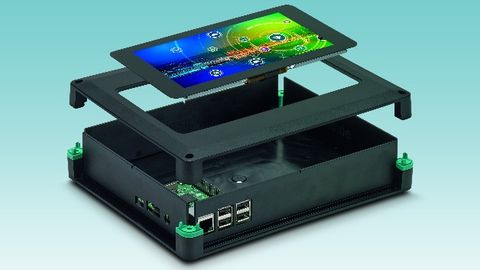
In the 'Universal Case System' (UCS) with 7-inch touch display, the high-resolution touch display is integrated flush into the housing.
© Phoenix ContactThe dominant display technology is the TFT-LCD with thin-film transistors. These displays contain a matrix of thin-film transistors, also known as an active matrix. Here, a transistor is controlled behind each pixel so that large-area electronic circuits can also be produced. For the color, each pixel of a TFT matrix is divided into three sub-pixels, which have a color filter in red, green or blue. The light source in the displays is LEDs, which are usually located behind, but sometimes also on the side or above the display. Their light is distributed evenly over the entire display surface by reflection. There is a horizontal polarization filter in front of the backlight, which only allows the horizontally aligned - i.e. polarized - parts of the light to pass through.
In contrast to TFT LCDs, passive LCDs are only controlled by two electrodes. These electrodes are strips of transparent indium tin oxide (ITO) that are rotated by 90° to each other. This creates a cross matrix that can be used to control each LC cell individually. LCDs can be produced in positive and negative mode. In positive mode, the driven segment is darker than the background, so LCDs use ambient light and/or a backlight. In negative mode, on the other hand, the driven segment is brighter than the background. It is mainly used when high contrast with backlighting is required.
Configure housing online
In order to combine the desired enclosure with the appropriate display and the necessary accessories such as membrane keypads and sealing kits, solutions can be put together web-based using the configurator for electronic enclosures. The PCB requirements can also be taken into account when configuring the mobile or stationary enclosure system. With the online configurator, the user receives the required 2D and 3D data for initial preliminary clarifications after the compilation. In the next step, the assembled parts can be ordered in quantities of one or more and initial prototypes can be developed.
Author:
Hermann Langlitz is Product Manager in the Device Connectors Solutions business unit at Phoenix Contact in Blomberg.


You might also be interested in
The lubricant problem in food production
Lubricants for components used in food production machinery must be safe for human consumption. However, as these are very expensive, alternatives are in demand - for example in drive chains.
 read more...
IO-Link for the vacuum
To make electric vacuum generators, grippers or compact ejectors visible for the smart factory, they must supply digital energy and process data in real time. This works using interfaces such as IO-Link, Ethernet or NFC in the vacuum components.
read more...Integrated microchips
Whether medical devices, product tracking, vehicle systems or 5G communication - the demands on safety, performance, documentation and user-friendliness are increasing. What is the significance of microchips integrated into connectors or cable...
read more...RJ45 - fit for the IIoT
Industrial-grade RJ45 connectors are a good solution for applications without increased protection against dust, dirt or splash water. What must the data interface look like so that the 'dinosaur of data transmission' can serve industrial...
read more...Engineering with a digital twin
There is simply not enough time for time-consuming activities such as drawing up parts lists based on circuit diagrams in control cabinet construction. How can the process - from planning to installation to operation - be optimized?
read more...The effects of the F-Gas Regulation
Can refrigeration units and chillers still be used when the F-Gas Regulation on climate protection comes into force on January 1, 2020? What do the bans on the use of refrigeration and air conditioning systems and new regulations for their...
read more...Choosing the right heat sink
In order to equip a data center with high-speed modules for optical interfaces, AFCI was looking for a suitable solution for cooling the high-performance servers. Pin heat sinks were the solution.
read more...(Ethernet) cables put to the test
The dynamic requirements for cables and the associated energy chains are high. How must (Ethernet) cables be designed so that they can be safely routed in energy chains even under the highest bending stress?
read more...Predictive maintenance of cables subject to wear
A sophisticated concept is needed to be able to maintain cables subject to wear and tear in a predictive manner. Lapp is currently developing one for Ethernet cables that uses machine learning approaches, among other things.
read more...