
Wireless communication
Cable as antenna
Why would anyone want a cable that behaves like an antenna? After all, a lot has been invested in the research and development of cable shielding to prevent exactly that!
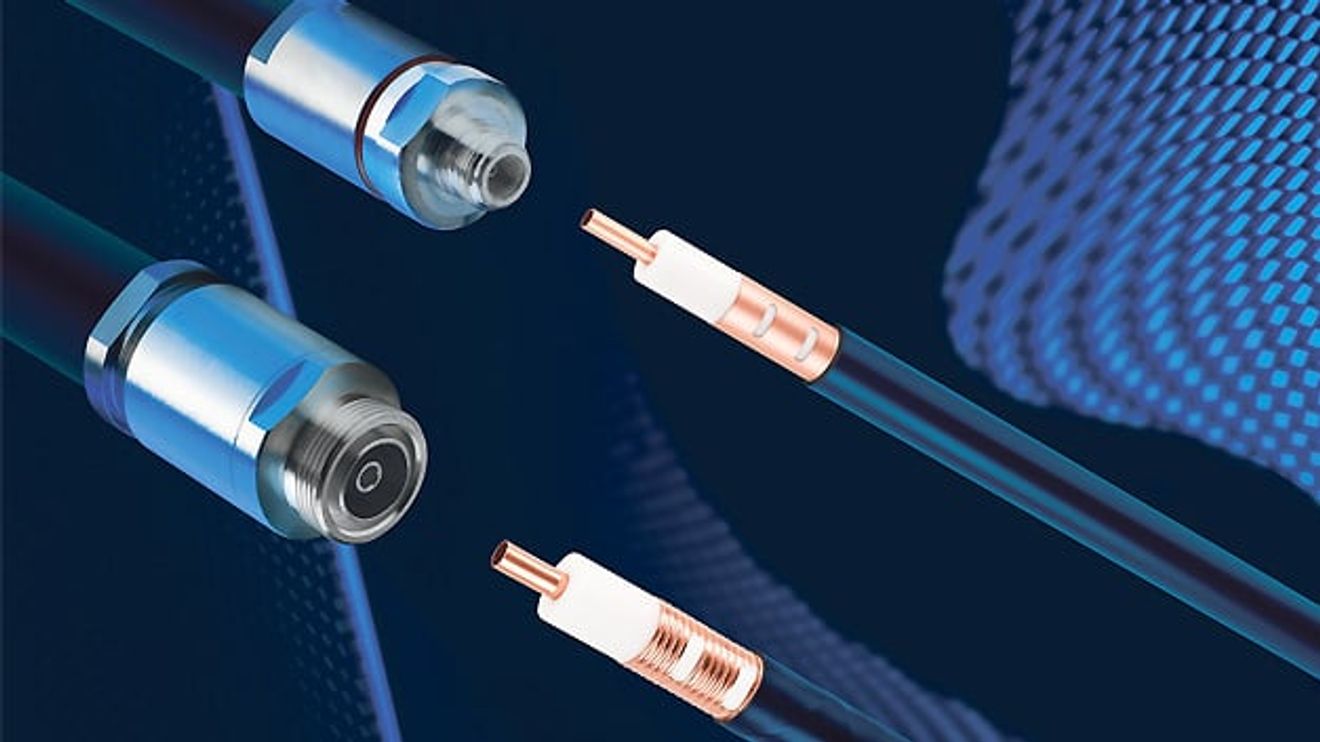
Who isn't familiar with the classic antenna or coaxial cable? The inner conductor is usually protected by an outer metallic cable shield. This prevents interference from being picked up from the environment. The signal strength within the cable is good and there is no interference with other radio signals. Those who still remember analog cable television will be familiar with the phenomenon of 'ghost images' that were sometimes seen on certain channels. In addition to the signals transmitted by the cable operator via the coaxial cable, the signal reflections of the same transmitter were also received, as the coaxial cable picked these up from the environment like an antenna. In this case, unwanted signal paths were created, i.e. it was an unintended side effect, as the coaxial cable acted like an antenna.
The same signal paths that led to blurred television pictures in analog cable television are now used in radiating cable. A radiating cable - also known as a leaky feeder cable - is a long, flexible antenna with slots for radiating RF signals. It can be routed around corners, along monorail systems and through tunnels. This makes it suitable for wireless applications where the use of traditional antennas is difficult or impossible. Since the antenna cable can be mounted just a few centimeters away from the signal input, it is easy to prevent the signal from reaching other machines in the respective production facility.
The difference between a radiating cable and a poorly shielded television cable is that the shielding of the radiating cable is provided with slots that only allow the transmission of signals of a very specific frequency. This means that the radiating cables are precisely tuned to the wireless network to which they are connected. The cable shielding still prevents any interference radiation. However, signals of the correct frequency can be emitted and received. This means that the radiating cable actually fulfills the function of an antenna.
Precise radiation in full factory halls
The use of a radiating cable is often also advantageous because the radio waves can be aligned very precisely. This is important because the expansion of wireless communication solutions in companies is continuing apace. This in turn means that countless radio waves are transmitted on the usual frequencies on factory floors. This is a serious problem for machine manufacturers who rely on wireless data transmission.

The advantages of radiating cables are particularly evident in factories where machines move along predefined paths or ...
© iStockWith a radiating cable, on the other hand, new machines can be integrated into the factory without causing interference between the different radio sources. This is because radiating cables only send the radio waves in one direction and only require as much power as is needed to connect to another antenna over a certain distance. So while the factory's general Wi-Fi network 'shouts' through the entire factory floor, the machine equipped with a radiating cable works in 'whisper mode'.

... when certain locations in a production facility are difficult to reach with broadband radio solutions. The selectable cable length makes the antenna cable suitable for use in a wide range of applications.
© iStockThe technology described is particularly advantageous for systems with moving parts, where transmission is usually carried out via slip ring contacts, for example. This is because the installation of slip rings is usually associated with high costs and the maintenance effort is also high. In addition, the data transmission rates are lower due to interference at the rings and scanners. Although conventional wireless communication technologies can be an alternative solution to slip rings under certain circumstances, very powerful antennas are usually required to ensure interference-free communication, which further increases the radio wave exposure. In such cases, radiating cables can provide clear, consistent signals to rotating antennas without interfering with nearby wireless systems.
Last but not least, radiating cables - like all cables - are extremely flexible. This opens up a wide range of communication paths, as wireless signals can now be emitted in places that cannot be reached by antennas. One of the first applications for radio cables was an emergency communication system for the emergency services in highway and railroad tunnels. But even in industrial environments, there are many hard-to-reach places or dead spots due to obstacles that prevent a reliable radio connection at all times. One example of this is a logistics center, where the metal shelves or the goods stored there hinder the propagation of radio waves or reflect the signals of traditional antennas. Radiating cables, on the other hand, can be laid along the aisles between the shelves to generate a strong signal in exactly the right places.
In short, the use of a radiating antenna cable can offer great advantages in industrial communication systems. The cable antennas are particularly interesting in communication solutions in which the signals run along a route, as a replacement for sliding contacts in systems with moving parts or for radiating a clear RF signal when obstacles or the factory layout prevent a clear line of sight and therefore rule out the use of a traditional antenna.
Author:
Keith Blodom is a specialist in wireless communication solutions at Prosoft.


You might also be interested in
Philip Harting Appointed to the Executive Board
The German Engineering Federation (VDMA) has appointed Philip Harting to its Executive Board. As CEO of the Harting Technology Group, he will work to advance the interests of the German and European engineering industries.
 read more...
Industry is once again facing more frequent material shortages
According to the ifo Institute, material shortages in the industrial sector worsened in June. The chemical, electronics, and electrical industries have been particularly hard hit.
read more...Weidmüller Builds Asian Headquarters in Suzhou
Weidmüller is investing in a new corporate headquarters in Suzhou. The facility will bring together development, manufacturing, and logistics, and production capacity is expected to more than triple.
read more...Maryannick Dauba appointed Head of Avnet Silica
Avnet Silica has appointed Maryannick Dauba as president. The long-time executive will take over leadership of the company in the EMEA region effective July 1, 2026.
read more...Rosenberger joins the EBO MSA initiative
Rosenberger has joined the newly formed Expanded Beam Optical Multi-Source Agreement (EBO MSA). This industry initiative is developing open and interoperable standards for optical connectivity in next-generation AI data centers.
read more...Markus Grabmeier becomes CEO Electrical Products
Siemens has appointed Markus Grabmeier as CEO of the Electrical Products (EP) business unit at Smart Infrastructure as of June 1, 2026. He succeeds Andreas Matthé, who has led the business since 2010 and will retire at the end of September 2026.
read more...Authorized distributors made visible online
Lapp is expanding its digital service portfolio and is the first B2B industrial company to provide its authorized distributors with a verifiable online seal from authorized.by. The company aims to create more transparency and security for buyers and...
read more...Rittal wins Electrifying Ideas Award 2026
The ZVEI has chosen Rittal as the winner of the Electrifying Ideas Award 2026. With this award, the German electrical and digital industry honors innovations and solutions that use energy efficiently, conserve resources and have an economic and...
read more...Computer&Automation International May 2026
Artificial intelligence is reshaping industrial automation across procurement, production, and cybersecurity. Its relevance lies not in the technology itself, but in its ability to create faster, more resilient, and more efficient operations. Read...
read more...