

Lapp
Bio-cable goes into series production
Last year, Lapp presented the first prototypes of cables with bio-based sheaths. Now the company is going into series production with the 'Etherline FD bioP Cat.5e'.
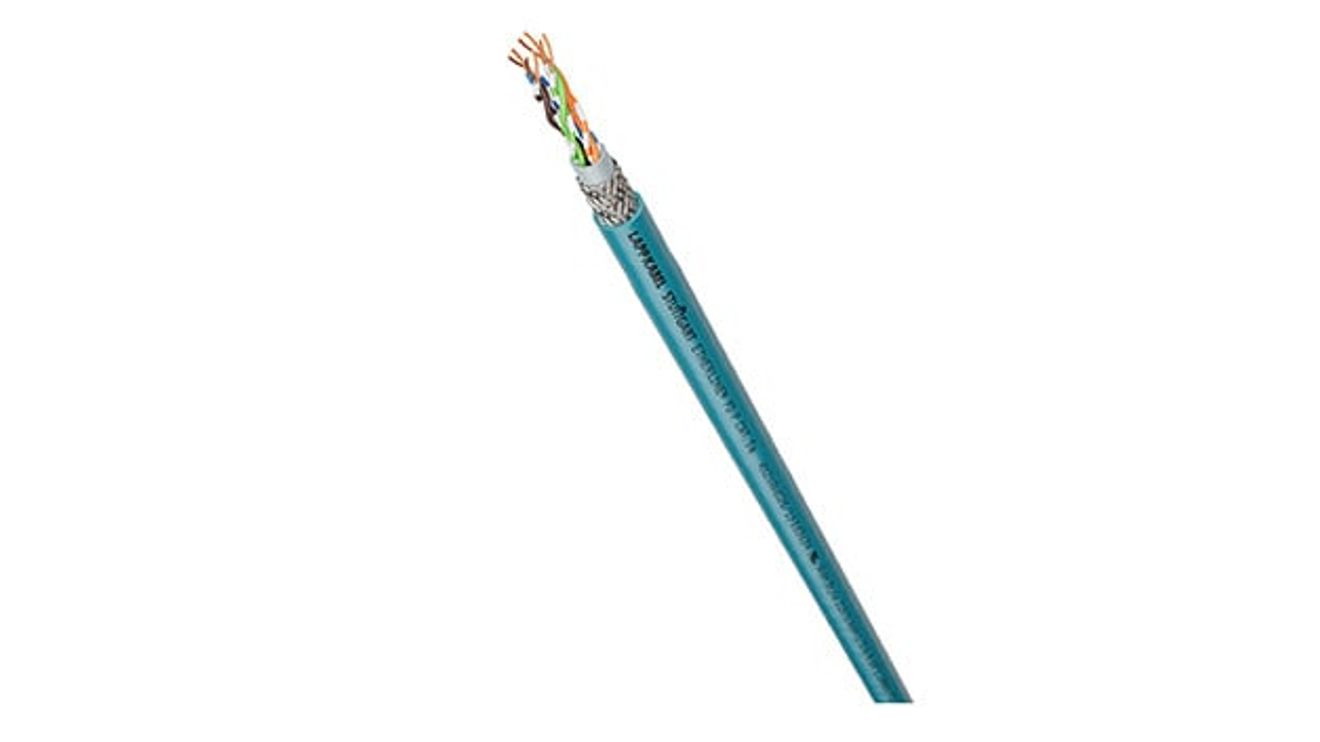
The data cable consists of a partially bio-based jacket material. The sustainable variant with a bio-based outer sheath consists of 43% renewable raw materials (in accordance with ASTM D6866). The product properties are the same as the standard version made purely from fossil raw materials. According to the company, this reduces the carbon footprint by 24% compared to the fossil-based TPU jacket.
Both the fossil-based and bio-based versions are suitable for patch cable assembly up to 60 m cable length for particularly demanding applications: for example, for continuous motion use in drag chains, in moving machine parts or for Ethercat and Ethernet/IP applications. Thanks to the Cat.5e performance of up to 1000 Mbit/s, the data cable enables fast information exchange and is used to transmit analog and digital signals in the frequency range up to 100 MHz. In addition, the copper shielding braid with a high degree of coverage protects against electromagnetic interference. Halogen-free and flame-retardant materials reduce potential hazards in the event of fire. The Bio-TPU outer jacket is insensitive to mineral oil-based lubricants and is resistant to many chemicals. The highly flexible Cat.5e Ethernet cable has been tested in Lapp's own test center for over 1 million bending cycles in the drag chain. UL/CSA certification in accordance with the technical data also allows the product to be used in North America.
Next prototype in the pipeline
The next more sustainable variant in the pipeline is the 'Ölflex Classic FD 810'. An initial prototype was recently presented. The challenge here is that it is not yet technically possible to produce polyvinyl chloride - PVC for short - entirely on the basis of bio-based raw materials. One starting point is therefore a partially bio-based coating made from a PVC compound with a bio-based content of 42% according to ASTM6866.
Incidentally, Lapp is already working on ideas for recycling secondary materials from plastic waste in production. They are to be used as filler in the cables, for example.


You might also be interested in
A long way to go
At Hannover Messe 2023, there was a lot of publicity for direct current (DC), as it could make an important contribution to the energy transition and sustainability, as the use of DC grids significantly reduces energy requirements in existing...
 read more...
In focus: Connection technology
The e-paper of issue 07/23
Communication and networking is the central theme of the current issue: first insights into the program of the TSN/A-Conference 2023, the cover story is all about SPE at field level and the "Digital Twin" series deals with the digital twin as an...
read more...Authorized distributors made visible online
Lapp is expanding its digital service portfolio and is the first B2B industrial company to provide its authorized distributors with a verifiable online seal from authorized.by. The company aims to create more transparency and security for buyers and...
read more...Axel Barnekow Widmark becomes CEO
Habia, a global supplier of customized high-performance cables, announces changes in the company's management: On April 1, Axel Barnekow Widmark took over the position of Chief Executive Officer. He succeeds Carl Modigh, who will remain with the...
read more...Avoid wear and tear
Tsubaki Kabelschlepp has added a new function to its condition monitoring system so that wear can also be monitored outside the chain without the need for additional cables in the cable carrier. The system also monitors the push/pull forces during...
read more...Cables in a modular system
The 'Heluchain' system from Helukabel is a modular system that is available in three expansion stages and combines cable drag chains, highly flexible cables, individual assemblies and matching accessories.
read more...Cables for stage technology
Igus wants to tap into the stage technology market and has developed a plainly colored series of highly flexible 'Chainflex' cables.
read more...Strengthening fiber optic cable production in Germany and Europe
The production of fiber optic cables in Germany has fallen by over 43% in the last ten years. In order to avoid long-term strategic dependencies, the ZVEI is calling for the maintenance and expansion of industrial capacities for network components...
read more...Energy chain series switched to recycled material
Igus is converting the entire catalog range of its standard energy chain series 'E2.1' to the new recycling material 'igumid CG LW'.
read more...