
Lapp
A long way to go
At Hannover Messe 2023, there was a lot of publicity for direct current (DC), as it could make an important contribution to the energy transition and sustainability, as the use of DC grids significantly reduces energy requirements in existing systems. The status quo.
The use of direct current is particularly efficient when the source of electricity generation comes from renewable energies such as photovoltaic systems. These produce direct current, which must be converted into alternating current (AC) for further use via inverters. However, if the end consumer is also a digital device such as a laptop or smartphone, an LED light or the charging point for electric vehicles, it must be converted twice, as these end consumers only work with direct current. This results in conversion losses. Intelligent production units - such as speed-controlled drives or robots in a factory - also often contain an internal DC intermediate circuit, for which a DC supply would eliminate a conversion stage.
By saving on converters (AC-DC) or conversion stages, around 3 to 4 % energy can be saved or energy losses avoided. Even when using recuperation energy, i.e. the braking energy of motors, the braking energy of motors or drives could be fully utilized or fed back by using modern feed-in rectifiers as AICs (active infeed converters) instead of bridge rectifiers, resulting in energy savings of at least 4 to 5 %. With conventional converters, the braking energy is often converted into heat by resistors, i.e. it is wasted and cannot be used.
Fewer conversion steps
Experts believe that the consistent use of direct current in industry not only makes it easier to integrate renewable energy sources, but can also avoid conversion losses between AC and DC in the single to double-digit percentage range, depending on the application. In addition, the use of DC offers further advantages in terms of energy efficiency: fewer conversion steps and fewer cores with often reduced conductor cross-sections lead to material savings and increased resource efficiency compared to AC. This means that direct current will play a key role in industrial power supply in the future.
Sustainable energy efficiency and the rapid transition to renewable energies can only be successfully achieved if there is a consistent switch to direct current and conversion losses are avoided. This is the only way to achieve a turnaround. Lapp, a provider of integrated solutions in the field of cable and connection technology, has been involved with the topic of direct current from an early stage and is active in the development of cables and wires for low-voltage direct current networks for industrial applications.
The research projects
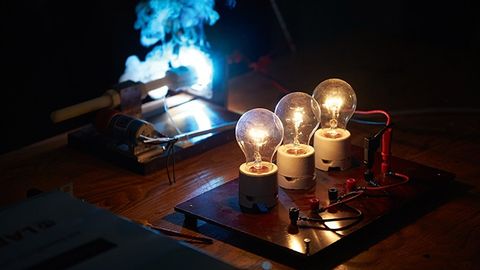
With direct current, new components are required, for example suitable DC circuit-breakers, so that the arc fault is extinguished.
© LappHowever, DC cables and other components alone are not enough to ensure reliable operation. There are current construction sites, for example, in the standardization of DC technology. For example, the DC Industry1 research project focused on the implementation of a production cell using a complete DC supply (or a DC network). The project ran from 2016 to 2019 and was led by the Ostwestfalen-Lippe University of Applied Sciences and Prof. Holger Borcherding, whose idea for such a DC project dates back to 2013.
In the DC Industry2 research project (October 2019 to March 2023), the findings and concepts from DC Industry1 and the implementation of a DC grid were extended from the production cell to an entire factory building with several load zones (e.g. several production cells). A total of 40 partners from universities and industry were involved. The main focus was on aspects of grid stability and grid management, including the influence of energy storage systems. In addition, the focus was on reliable operation by detecting and switching off fault currents and discharging overvoltages. Another topic was the development of long-term stable components. This also included the investigation of the long-term stability of typical insulating materials of AC cables under DC stress, which Lapp dealt with.
A question of insulation
Lapp and the TU Ilmenau had already discovered in earlier tests that insulation materials can exhibit different ageing behavior in a DC voltage field than in an AC voltage field. For example, researchers at Ilmenau Technical University exposed individual wires with different insulation materials to 1 kV DC voltage in a water bath at +80 °C over a period of around 2,500 hours in order to understand the effects in fast motion. The results: Some cables with PVC or halogen-free polyolefin-based compounds failed significantly faster than all test specimens with TPE insulation. In the following years, these research results were further investigated and put to the test in the DC-Industrie2 project. Extensive laboratory tests on the accelerated ageing of typical insulating materials for AC cables and lines were again carried out over 2,500 hours at +70 °C and an ageing voltage of 1 kV. In accordance with DIN VDE 0276-603, the tests were carried out in parallel in a water bath and in a heating cabinet. The insulating materials tested included different compositions of PVC, (cross-linked) polyethylene (PE and XLPE), polypropylene (PP), thermoplastic elastomers (TPE-E, TPE-V) and halogen-free mixtures.
The results of the project are as follows: Based on the test conditions, many of these insulating material compositions exhibit DC voltage resistance at the selected reference temperature of +70 °C. However, there is also a considerable influence of the ambient medium, for example air, humidity or water. While the insulating materials showed no signs of failure under dry ambient conditions, breakdowns can occur in water for insulating materials with fillers and additives. These insulating materials include some PVC and halogen-free PO-based compounds. For this reason, Lapp took the project results on insulation materials into account during the project-related development of a DC cable and wire portfolio and optimized them by selecting appropriate insulation materials. However, it is not possible to derive a generally valid statement about the usability, for example in the case of a temperature deviation of 70 °C. In addition, the results cannot be applied to cable insulation materials in the high-voltage range with voltages above 1.5 kV. Due to the higher electric field strength and altered conduction processes, other insulating material mixtures and compositions, for example chemically purer polymers or special compounds, are required for sufficient dielectric strength.
Opportunities for material savings
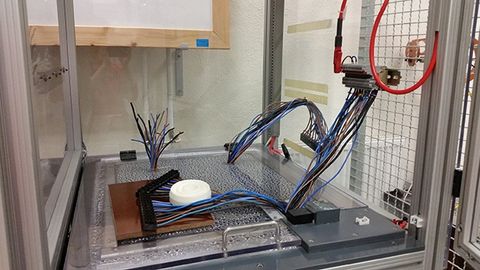
In tests at Ilmenau Technical University, individual wires were tested with various insulation materials in a water bath over a period of around 2500 hours.
© LappLapp has also worked intensively on possible material savings. However, it is difficult to make a general statement with a concrete statement on savings. On the one hand, there are material savings due to fewer converters or conversion stages. On the other hand, a distinction is made between copper savings in cables or lines. Here the saving depends on the actual conductor current, the distortion in AC due to harmonics (harmonic content) and the number of conductors in the DC network compared to AC. In DC systems, a distinction is made between cables with three (two phases and PE protective conductor) or four conductors (two phases, protective conductor, earthed center conductor) depending on the earthing concept. In three-phase systems (AC), the cables in the low-voltage level are generally constructed with five conductors (three phases, PE conductor, neutral conductor).
Due to the converter technology, the supply voltage in the DC network is generally higher than in the AC network, e.g. 650 V(DC) compared to 400 V(AC). This results in a lower conductor current for DC, which generally requires a smaller cross-section. If, for example, a DC system with three conductors is compared with a three-phase system with five conductors, the greatest copper savings tend to be between 40 % and slightly more than 70 %. The smallest savings are achieved if the conductor current in AC is ideally sinusoidal. The reason for this is that a sinusoidal AC current requires a smaller cross-section than a highly distorted AC current. However, when comparing a DC system with four conductors to a three-phase system, the savings could also be zero if the AC conductor current is not distorted by harmonics. Nevertheless, the bottom line is that DC offers great potential savings in terms of energy and materials.
New dynamics for direct current

The author: Dr. Susanne Krichel is head of research and advance development at Lapp Holding in Stuttgart.
© LappThe Open Direct Current Alliance (ODCA), an alliance of companies, research institutions and the ZVEI, has been in existence since fall 2022 with the aim of giving DC technology new momentum. The ODCA is therefore the international and practical continuation of the German DC research projects DC-Industrie1 and DC-Industrie2. In addition, there is close cooperation with the Current/OS foundation. The ODCA concentrates on six focus topics:
- Building an international DC ecosystem and establishing DC technology for many applications
- Close cooperation between users, planners, manufacturers, suppliers, research institutions, standardization organizations and associations
- International dissemination of knowledge and solutions for DC grids
- Investment protection through the development and establishment of an innovative and sustainable DC system
- Platform for the design of further research projects
- Informing and convincing politicians and society about the opportunities of direct current on the way to a resource-conserving and CO2-neutral world.
| The current DC portfolio |
|---|
| Lapp has developed a DC portfolio that includes, for example, the 'Ölflex DC Grid 100' - a DC cable for power distribution in buildings and for connecting industrial systems - and the 'Ölflex DC 100' with new color coding of the cores in accordance with the DIN EN 60445 (VDE 0197) standard for DC cables, which was updated in 2018. Other cables include the 'Ölflex DC Servo 700' DC hybrid cable for stationary applications, the 'Ölflex DC Chain 800' made of TPE for moving applications, the 'Ölflex DC Robot 900' DC robot cable with TPE core insulation and a PUR sheath and the halogen-free, highly flame-retardant 'Ölflex DC ESS SC' single-core cable for DC applications up to 1.5 kV for use in energy storage systems (ESS). |


You might also be interested in
25 years of Computer&Automation - The e-paper
For 25 years, Computer&Automation has accompanied the growing influence of IT in automation technology. Ultimately, IT and automation can no longer be clearly separated. In this anniversary issue, you can read about the importance that...
 read more...
Interview with Karsten Fuchs, Lapp
DC voltage in the industry
What are the prospects for DC voltage technology in industry? Andreas Mühlbauer spoke about this with Karsten Fuchs, research engineer in the Innovation and Advanced Technology department at Lapp Holding.
read more...Interview with Maria Dobritzsch, Lapp
Green copper
Lapp aims to reduce the carbon footprint of its products by 20 percent by 2025, based on the 2020/2021 financial year. Maria Dobritzsch, responsible for sustainability at Lapp, explains the role of copper as a raw material in this.
read more...DC/DC converter with wide-range input
Bicker Elektronik presents the 'DC300WS', a contact-cooled 300 W DC/DC converter with up to 98 % efficiency.
read more...22.5 mm wide electronic circuit breaker
The electronic 4-channel circuit breakers (ECBs) 'Pisa-M' from Puls are aids for protection and power distribution in applications with power requirements from 90 W to 480 W.
read more...3-phase power supply delivers 3.5 kW
Cosel launches the 'HFA3500TF', a flat, three-phase, three-wire, closed 3500 W AC/DC power supply optimized for industrial equipment such as semiconductor manufacturing, laser processing machines and robotics.
read more...Power supply for high-performance computer systems
The ATX power supply units of the 'Delta GPS' series from Bicker are suitable for high-performance computer systems and graphics-intensive applications.
read more...Power supply units with Ethercat connection
Puls offers three DIN rail power supply units with 240 W and 480 W output power and an integrated Ethercat interface, which provide power supply and application data such as voltage and current characteristics on the input and output side.
read more...Christopher Haas succeeds Gustav Erl
Christopher Haas took over the management of TDK-Lambda Germany on April 1. He succeeds Gustav Erl, who is retiring on June 30.
read more...