
Hybrid cable
A question of shielding and material
Single-cable solutions shorten installation times and help save costs. However, hybrid cables place special demands on shielding and their materials.
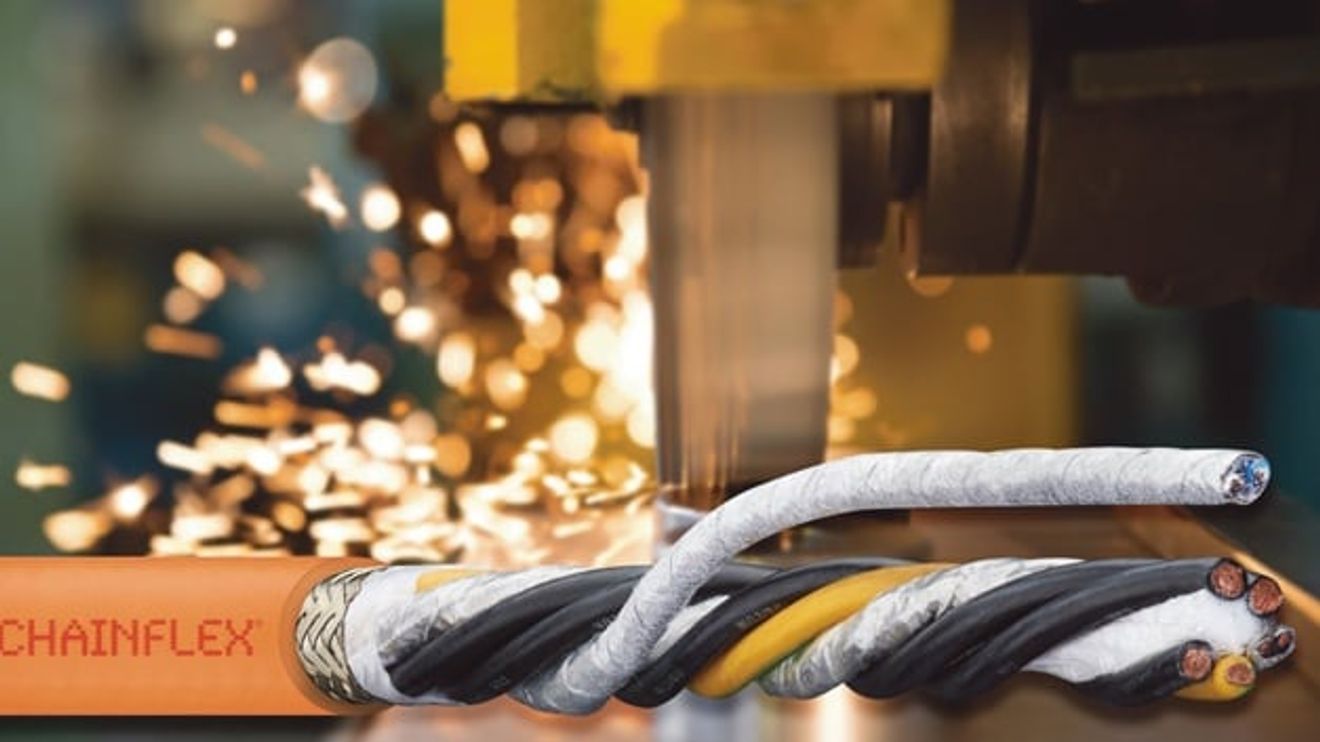
Until now, servomotors and inverters have always been connected with two cables: one cable for the power supply and one for the encoder signal, which provides information about the speed and position of the motor, for example. However, more and more drive manufacturers are offering servomotors with single-cable solutions. With so-called hybrid cables, the power supply and data transmission run via a single cable by integrating the encoder cable into the servo cable. This eliminates the need for cabling with a separate measuring system cable for the encoder.
Another advantage of hybrid cables is the simple and shorter assembly time compared to a two-cable solution. Machines can be installed and commissioned more quickly. In addition, the installation space in the energy chain is reduced so that a smaller and more cost-effective model can be used. Last but not least, the connection to the controller or motor is also more compact, meaning that the customer only needs one plug for the entire system.
Secure data transmission

The 'Chainflex' hybrid cables are equipped with an integrated bus element. They were developed for highly dynamic applications, for example in processing machines and machine tools.
© IgusWhen combining the servo and encoder cables into a hybrid cable, it is important to realize the necessary data transmission properties and to ensure the interference-free function of the cable for many millions of double strokes. Reliable transmission of the bus signals over the maximum cable length with many movement cycles places special demands on the insulation materials used for the bus cores. On the one hand, the material must meet the high mechanical demands of the movement, and on the other hand, the electrical properties required for data transmission must be maintained 100%. In this segment, Igus can draw on the material experience gained from many tests. In addition, elements with shielding also come into play here. The shield protects the data pair from internal and external interference, which is extremely important for an extremely compressed cable.
In the case of hybrid cables from Igus, for example, the braided shielding ensures a long service life. The company uses a particularly narrow shield. As the braiding runs at a flat angle with high optical coverage, the forces acting on the shield wires are not too great and durability is increased. The shield structure is specially adapted depending on the type of cable. The fixed design gives the entire cable construction the necessary freedom of movement. The short lay length of the stranding provides additional safety for all 'Chainflex' cables. Particularly important here is the additional support of the stranding system by so-called gusset-filling extruded inner and outer sheaths, which completely fill the spaces between the cores with the sheath material. This prevents the stranding from untwisting.
Hybrid cables in the energy chain
In static applications, the shielding can withstand almost unlimited forces. However, if the cable is set in motion within an energy chain, for example in machine tools or handling systems, the cable is subjected to new stresses. Igus tests the complete range of cables in its in-house test laboratory in motion under real conditions. In addition to the mechanical tests in the energy chain, the transmission properties of the bus systems are analyzed here. The bus systems are measured separately and checked to ensure that data transmission is maintained over the entire test period, which lasts several million double strokes.
In the practical test
The fact that the hybrid cables from Igus work, reduce assembly time and save costs is demonstrated by their use at IMA Klessmann: up to 50 servo axes in a confined space, high dynamics, high expectations in terms of service life and small bending radii were the requirements that the hybrid cables had to meet in a new automatic drilling machine. The 'Chainflex' single-cable technology combines the power and feedback system in the servo cable. This significantly reduced the amount of material and commissioning required, but it presented those responsible at IMA Klessmann with a real challenge in the first step. Depending on the position of the control cabinet - which is specified by the customer - the company installs up to 4 km of cables. A tailor-made test program ensured that the single-cable technology used would function reliably: Here, the hybrid cables were tested and inspected with over four million strokes in the IMA-specific bending radii.
Author:
Andreas Muckes is Head of Product Management 'Chainflex' cables at Igus in Cologne.


You might also be interested in
The lubricant problem in food production
Lubricants for components used in food production machinery must be safe for human consumption. However, as these are very expensive, alternatives are in demand - for example in drive chains.
 read more...
IO-Link for the vacuum
To make electric vacuum generators, grippers or compact ejectors visible for the smart factory, they must supply digital energy and process data in real time. This works using interfaces such as IO-Link, Ethernet or NFC in the vacuum components.
read more...Integrated microchips
Whether medical devices, product tracking, vehicle systems or 5G communication - the demands on safety, performance, documentation and user-friendliness are increasing. What is the significance of microchips integrated into connectors or cable...
read more...RJ45 - fit for the IIoT
Industrial-grade RJ45 connectors are a good solution for applications without increased protection against dust, dirt or splash water. What must the data interface look like so that the 'dinosaur of data transmission' can serve industrial...
read more...Engineering with a digital twin
There is simply not enough time for time-consuming activities such as drawing up parts lists based on circuit diagrams in control cabinet construction. How can the process - from planning to installation to operation - be optimized?
read more...The effects of the F-Gas Regulation
Can refrigeration units and chillers still be used when the F-Gas Regulation on climate protection comes into force on January 1, 2020? What do the bans on the use of refrigeration and air conditioning systems and new regulations for their...
read more...Choosing the right heat sink
In order to equip a data center with high-speed modules for optical interfaces, AFCI was looking for a suitable solution for cooling the high-performance servers. Pin heat sinks were the solution.
read more...(Ethernet) cables put to the test
The dynamic requirements for cables and the associated energy chains are high. How must (Ethernet) cables be designed so that they can be safely routed in energy chains even under the highest bending stress?
read more...Predictive maintenance of cables subject to wear
A sophisticated concept is needed to be able to maintain cables subject to wear and tear in a predictive manner. Lapp is currently developing one for Ethernet cables that uses machine learning approaches, among other things.
read more...