
Understanding Microstepping in Motion Control
Mastering Precision
Stepper motors are vital in precision applications where there is a need for smooth movement and high resolution positioning. Recognizing the differences between fullstepping, halfstepping, and microstepping control is essential for meeting these requirements. This article closes the knowledge gap by summarizing the basics of microstepping.

Stepper motors are widely used in industrial, medical, and 3-axis positioning system applications such as 3D printers and computer numerical control (CNC) machines, due to their precision and relatively simple control schemes. Although AC motors and brushless DC motors can obtain high precision, stepper motors have the additional advantage of high precision while operating with open-loop control and having high torque at low velocity. Additionally, stepper motors are often more cost-effective and less complex than servo motors. Unlike brushed DC motors, stepper motors can hold their position with high torque.
Microstepping is highly useful in stepper motor control by allowing the motor to move by smaller increments, resulting in a significant increase in the number of discrete positions per revolution and a subsequent decrease in motor noise and vibration. Analog Devices’ Trinamic Motion Control has stepper motor driver ICs, board-level modules, and complete solutions that are capable of operating stepper motors with up to 256 microsteps.
Structure and mode of operation
A stepper motor, frequently referred to as a stepper, consists of a magnetic rotor and stator coils. Hybrid 2-phase steppers have a rotor with two magnetic cups, each with typically 50 teeth as shown in Figure 1. These magnets have opposite magnetic polarity and are physically offset from each other. The stator consists of two coils of wire placed in multiple positions around the central rotor. Energizing each phase in sequence causes the motor to rotate.

A stepper motor moves in discrete steps by dividing a full rotation into equidistant steps. For instance, a stepper motor with 200 discrete positions per revolution of the motor will have a 1.8° step angle. The step angle is derived from dividing the 360° of a revolution by the number of full steps.
Equation (1): Step Angle = 360° / # of Full Steps
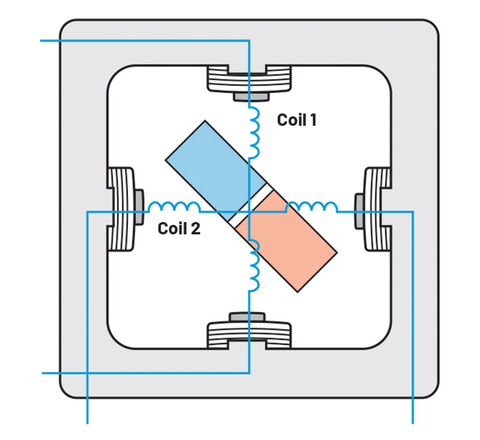
As shown in Figure 2, when current is applied to the motor’s coils, a magnetic field is produced that attracts or repels the permanent magnet rotor, and the rotor will rotate to align with this magnetic field. To keep the motor rotating, each coil must be alternately energized to keep the magnetic field ahead of the rotor.
Full-step operation

To better understand the stepping behavior of a stepper motor, we will evaluate a simplified 2-phase stepper motor model with one magnetic pole-pair as shown in Figure 3.
In full-step mode, the driver energizes the two coils with either positive or negative current. Both phases are simultaneously energized, which achieves maximum torque. Switching the direction of current through the coils causes the shaft to rotate. The switching pattern, often referred to as commutation, typically adheres to the periodic sequence shown in Figure 4.
Fullstepping allows for precise steps, speed control, and high holding torque. In addition, fullstepping can maximize a motor’s torque output when operating at high speeds. However, Figure 5 illustrates how fullstepping can cause excessive vibration and noisy operation. This vibration and noise are primarily due to large position jumps that cause the motor to overshoot its target position, which results in high resonance at specific speeds and reduced applied torque.
Since the simplified motor with a single magnetic pole-pair achieves four discrete positions per revolution using full-step commutation, expanding this concept to a motor with 50 magnetic pole-pairs translates to 200 full steps per revolution.
Equation (2): 200 Full Steps per Resolution = 50 Pole-Pais × 4 Positions
The setup enables the motor to be directed to specific positions when the rotor’s teeth align with the magnetic field of the coils.
Half-step operation
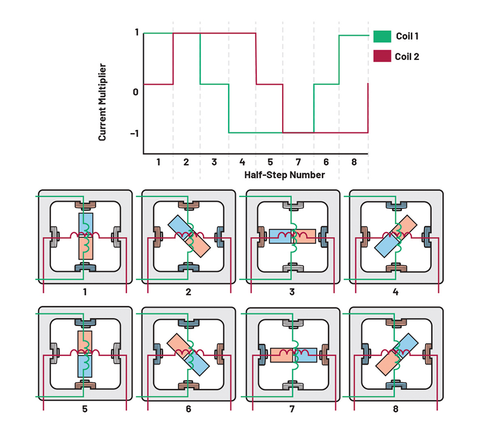
IReducing the size of the steps improves position overshoot, vibration, and noise issues. The step-size reduction can be realized by implementing an additional current state as shown in Figure 6. The half-step model increases the number of rotor positions to eight per magnetic pole-pair, which results in the doubling of position resolution. The motor driver alternates between single-phase and double-phase excitation to arrive at the half-step behavior. The half-step model allows for higher position resolution with reduced vibration. Rotational torque increases slightly at low speeds, but the motor’s holding torque in the new half-step position is reduced. This is commonly referred to as incremental torque.
Despite these improvements, the half-step model is not without issues. The motor still makes relatively large position jumps, meaning the motor’s rotation is not perfectly smooth. The problem is especially apparent at low speeds and is the driving force behind the need for microstepping.
Microstepping

Microstepping is a method of controlling stepper motors such that the motor can rotate to multiple intermediate positions between full steps. It is typically used to achieve higher position resolution and smoother rotation at low speeds. This is accomplished by dividing each full step into equidistant microsteps as shown in Figure 7. Increasing the microstep resolution results in a smaller travel distance that reduces position overshoot and ringing, thus improving vibration and noise.
Microstepping is implemented by providing sinusoidal waveforms to the motor as shown in Figure 8. The motor driver utilizes current regulation to precisely deliver these sinusoids to each motor coil. However, it is impossible to generate perfect sinusoids. The sinusoidal wave quality, and therefore the quality of microstepping, is limited by the resolution of the stepper driver’s analog-to-digital converters (ADCs) and digital-to-analog (DACs) converters. Each of ADI Trinamic’s stepper motor drivers has at least 8-bit ADCs and DACs, which enables up to 256 microsteps per full step. Since a hybrid stepper motor typically has 200 full steps per rotation, the use of 256 microsteps allows for up to 51,200 discrete positions per revolution. This results in an impressive step resolution of 0.00703125°.
Microstepping has many benefits, but it comes with two key challenges: positional accuracy and incremental torque.
Position accuracy refers to the error between the motor’s actual position and its commanded position. Although microstepping increases position resolution with more discrete positions, it does not improve position accuracy. Accuracy of the motor is still a function of construction tolerance, the load on the motor, and the driver’s ability to accurately provide the desired current levels to the motor coils. These limiting factors affect the motor’s accuracy regardless of fullstepping or microstepping.
Incremental torque is defined as the amount of torque required to pull the motor out of position when the motor is at standstill. When using fullstepping, the magnetic rotor is perfectly aligned with the motor coils, creating maximum holding torque equal to the motor’s specified holding torque. However, when microstepping is used, the incremental torque decreases based on the microstep position at which the motor is being held.
Incremental torque can be approximated using Equation 3:
Equation (3): TINC =THOLD × sin (90°/SDR)
TINC is the incremental torque in Nm
THOLD is the full-step holding torque in Nm
SDR is the step-division ratio or the denominator of simplified fraction. The phenomena is best illustrated with a few examples. Considera motor using 256 microsteps, stopped at a half-step position:
Equation (4): Step Position / Step Resolution = 128 / 256 = 1/2
The SDR is simply the denominator of the simplified fraction;therefore, the SDR is 2. The incremental torque decreases to70.709% of the motor’s holding torque.
Equation (5): TINC =THOLD × (90°/2) =THOLD × 0.70709
In the following example, the motor is held in the microstep position 7/256:
Equation (6): Step Position / Step Resolution = 7 / 256
Here SDR is 256 and the incremental torque is reduced to 0.61 % of the holding torque.
Equation (7): TINC =THOLD × (90°/256) =THOLD × 0.00614
The relationship between SDR and incremental torque is summarized in Table 1.
| SDR | TINC/THOLD |
| 1 | 100,00 % |
| 2 | 70,709 % |
| 4 | 38,267 % |
| 8 | 17,508 % |
| 16 | 9,801 % |
| 32 | 4,907 % |
| 64 | 2,454 % |
| 128 | 1,227 % |
| 256 | 0,614 % |
Importantly, while incremental torque reduces the torque available to hold the motor in these microstep positions, rotational torque is largely unaffected. When the motor is rotating, the effects of reduced incremental torque will not be seen. From a practical standpoint, if high holding torque is needed, the user should try to stop the motor on full-step or half-step positions.
Applications of microstep operation
Many applications using stepper motors stand to benefit from microstepping. As an example, 3D printing requires high position resolution and minimum vibration in order to produce high quality prints. Medical imaging and surgical robotics need quiet operation and precise positioning to ensure patient comfort and safety. Microstepping fulfills these requirements.
In addition, due to the smaller step size, position overshoot is significantly reduced. This brings a number of advantages: decreased vibration, increased efficiency, and smoother motion. Mechanical vibration consumes energy and, in some applications such as CNC milling machines, introduces extra wear and compromises reliability. By reducing mechanical vibration and noise, microstepping also reduces waste in the cost and energy associated with operating a motor control system.
Other applications that use microstepping include medical research equipment, valve control, air pumps, CCTV, robotics, and factory automation.
ADI Trinamic’s stepper motor products offer various features that can assist with incorporating microstepping. Microstepping, up to 256 microsteps, is standard for all of ADI Trinamic’s stepper motor products.
In addition, some ADI Trinamic parts offer MicroPlyer technology, a microstep interpolation technique meant to enable older applications to easily utilize high microstep resolution.
The ADI Trinamic product portfolio includes complete, efficient, and small footprint solutions to support any space and performance requirements. These parts can help reduce complexity and time to market in stepper motor applications.
| The MicroPlyer microstep interpolator |
|
Some Trinamic components are equipped with MicroPlyer technology. This interpolation technology makes it possible to upgrade existing systems with a low microstep resolution to a higher resolution without adapting the motion control logic. |
The authors
Cindy Chang is an application engineer in the Central Applications Group at Analog Devices.
Tea Tran is an application engineer in the Central Applications Group at Analog Devices.


You might also be interested in
TSN/A Conference 2025 | September 24, 11:30...
IEEE TSN Stream Configuration in UAFX Connection Manager
This talk elaborates on the OPC UA FX adoption of IEEE TSN as a transport layer, reflecting on UAFX integration of the CNC/CUC concept and network configuration.
 read more...
TSN/A Conference 2025 | September 24, 02:30...
IEEE TSN and Industrial Ethernet adoption challenges
It becomes evident that TSN adoption will happen over a period of time where new technology will coexist with legacy Ethernets and fieldbuses.We would like to challenge the existing testbeds, plugfests, and IA vendors with accommodating the missing...
read more...ebm-papst is growing again thanks to AI and data centers
ebm-papst returned to a growth trajectory in fiscal year 2025/26. Air Technology, data center applications, and artificial intelligence are driving revenue and investments.
read more...Synapticon and Generative Bionics Partner Up
Synapticon and Generative Bionics have entered into a partnership to develop propulsion systems for humanoid robots. The goal is to establish a European supply chain for the development, manufacturing, certification, and integration of the...
read more...Triton Partners takes over Flender
Global investment firm Carlyle has signed an agreement to sell Flender, a provider of mechanical drive technology, to Triton Fund 6, advised by Triton. The terms of the transaction were not disclosed and is expected to close in the fourth quarter of...
read more...New approaches in drive technology
Nabtesco develops physical AI solutions
Nabtesco is working on intelligent drive systems for industrial applications. The focus here is on the use of physical AI, the combination of artificial intelligence with real physical systems.
read more...More than 900 exhibitors already registered
Around six months before the start of the trade fair, more than 900 companies have registered for SPS 2026 in Nuremberg. The trade fair focuses on industrial AI, cyber security and digital transformation.
read more...Takeover of Invent Smart Intralogistics Solutions
Comau has signed a binding agreement to acquire Invent, a Brazil-based company specializing in intralogistics and warehouse automation solutions, with a strong focus on e-commerce and high-throughput distribution environments.
read more...Extended three-member Management Board for Deutsche Messe
Deutsche Messe AG is reorganizing its personnel and consistently focusing its Management Board on the further development of the company and the exhibition grounds in particular. With an expanded three-member Management Board, the company is...
read more...