
Project 'DC Industry' - Part 2
Power distribution and drive technology in the DC grid
Research and industry are working on redesigning the power supply for industrial systems via a smart DC grid. This article describes the feed-in, energy distribution and drive technology of the system specification developed in the 'DC Industry' project.

For many years now, manufacturer-specific, spatially concentrated DC systems have been state of the art in the field of industrial drive technology. These systems usually consist of a supply module (AC/DC converter) and several connected drive inverters. Due to the direct DC link coupling of the inverters, braking energy can be utilized without additional effort. Studies show that energy savings of typically up to 30 % can be achieved in this way for intermittent motion sequences or lifting applications.
Although almost all industrial drives have an internal DC link and almost every manufacturer of drive technology offers proprietary DC links, a manufacturer-independent DC link coupling has not yet been possible. The reason for this is that there are no generally recognized rules on how devices - such as drive inverters - should behave at their DC connections.
The energy supply of the DC grid
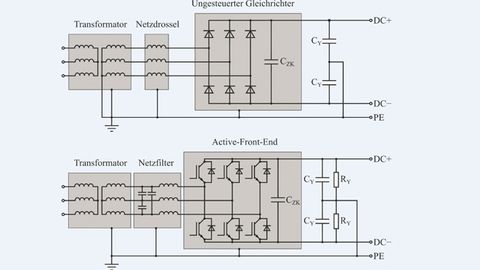
Figure 1: Possible suppliers in the DC grid and earthing concepts: Uncontrolled rectifier on the earthed AC grid (top) and active front-end on the isolated AC grid (bottom).
© LTI MotionThe DC grid contains one or more supply devices that supply the open DC grid with power from the AC grid. The drive inverters are grouped into logical load zones and connected to the grid using fast semiconductor-based circuit breakers (editor's note: the protection concept is explained in detail in another part of this series of articles). The claim of the DC-Industry system concept is that it can be used to implement small, spatially concentrated DC grids as well as large or spatially extended systems.
For small DC systems, cost-effective, uncontrolled rectifiers(Fig. 1, top) can be used, which are operated as usual on the earthed AC supply. If an entire production hall needs to be supplied, the current flow and DC voltage can be controlled with regulated power supplies - so-called active front-end rectifiers. This additional degree of freedom is used for intelligent grid management.
In principle, however, an AFE converter generates a high-frequency common-mode voltage from the DC connections to the star point of the upstream AC grid. This common-mode shift is avoided by an isolating transformer connected upstream (on the AC side). This is not earthed on the output side. In this case, the system concept provides for a high-impedance and capacitive earthing of the DC grid - i.e. a so-called 'quasi-IT grid'(Figure 1, below). This earthing concept offers further advantages: For example, the DC grid can continue to operate for a limited time if an earth fault occurs. Parallel operation of several feed-in devices is also possible without any problems, provided each device is assigned an independent secondary winding. When supplying a large DC grid for an entire factory building, the existing medium-voltage supply transformer can take over the potential separation; an additional isolating transformer is then not necessary.
Power control in the DC grid

Figure 2: Power control in the DC grid using characteristic curves that define the current to be fed in as a function of the DC grid voltage. The decentralized control concept enables the simple parallel connection of suppliers and energy storage systems.
© LTI MotionDC industry pursues a decentralized approach in which energy is fed into the DC grid using characteristic curves depending on the current DC voltage. This means that the DC grid does not have a regulated constant voltage, but rather voltage ranges in which the connected devices must exhibit a defined behavior. During operation, the system voltage can move within a maximum voltage range of 400 to 800 V. In the case of regulated rectification - for example by an AFE power converter - a nominal DC voltage of 650 V has been specified. The characteristic curves for power regulation are shown as an example in Figure 2. They define the current that the supply devices or regulated energy storage devices feed into or draw from the DC grid. The central status variable is the current mains voltage. This control approach enables multiple feed-in and integration of energy generation systems such as photovoltaics without any problems.
If the drives feed power into the DC grid during braking processes, the voltage increases. The characteristic curve for a regulated energy storage system shown in Figure 2 ensures that the storage system is first stored before power is fed back into the AC grid. Such regulated energy storage systems can be implemented with supercapacitors, batteries or flywheel storage systems. Depending on the application, power peaks are reduced or a power failure is bridged.
The topic of EMC
The potential-separated feed and the high-impedance and capacitive earthing prevent potential jumps in the DC grid compared to the earth potential. The capacitive recharging currents caused by the switching of the drive inverters are dissipated via the Y capacitors used there; if necessary, the inverters or multi-axis systems are connected to the DC grid via EMC filters. Energy is distributed in the DC grid via unshielded cables or busbar systems, as the handling should be comparable to an AC solution. From the motor inverters onwards, the system has a conventional design. The first measurements on the model applications described in the previous article (see article "DC instead of AC in the production grid") of the project confirm that the DC grid achieves the self-imposed targets for conducted interference emission with unshielded cables.
Within the project, four model systems are equipped with a DC grid and are currently being tested. LTI Motion, for example, has developed a 50 kW supply unit with sinusoidal mains currents for the bottle and pallet rotator at KHS. It supplies the DC network with centralized and decentralized drive technology from LTI Motion, Lenze, SEW-Eurodrive, Danfoss and Bauer. The system concept was confirmed in the model plant, particularly with regard to energy exchange, power control and EMC.
Savings of 40 % copper
The spread of direct current is also causing a lot of change in the area of wiring - especially when it comes to supplying drives. Because in future only two current-carrying conductors will be required instead of three - as is the case with three-phase current - installation costs will be reduced. It is estimated that up to 40 % less copper will be required, resulting in lower costs. The prerequisite for this, however, is that nothing has to change in the cables if they are to be used for DC instead of AC. - However, this assumption has not yet been investigated and is therefore by no means certain. As an associated partner in the DC industry, Lapp is therefore involved in investigating the suitability of certain cable types and, if necessary, developing cables that are suitable for operation with DC.

Figure 3: This hybrid cable developed by Lapp will be used to investigate how the future control concept for electric drives could be structured on the cable side. If the concept proves successful in the project, such cables will be used in future for this type of drive system networking.
© LappIn principle, all partners involved in the project have agreed to combine all functions in a hybrid cable in order to keep complexity to a minimum. With the 'Ölflex DC 100 Hybrid', Lapp has already developed such a cable and is making it available to the consortium(Fig. 3). The DC hybrid cable consists of the following components: Two cores for power transmission plus a protective conductor, a Cat.6A data cable with four shielded wire pairs, two cores for Safe Torque Off (STO) and a control pair with 24 V for the brake. If a company does not require certain functions, it leaves the relevant wires unused or cuts them off. An initial marketable product that has resulted directly from the project is the 'Ölflex DC 100' with three power cores, which Lapp presented at SPS 2018. The design of the control cable is based on the well-known 'Ölflex Classic 100' for alternating current. However, the color coding of the cores follows the DIN EN 60445 (VDE 0197):2018-02 standard for DC cables, which was updated in February 2018: red, white and green-yellow. The insulation of the cores is made of special PVC, the sheath is made of PVC. The cable is suitable for DC voltages up to 0.9 kV (conductor-earth) or 1.8 kV (conductor-conductor).
The protective measures in the event of a fault
As with AC grids, various faults can also occur in DC grids. These are generally manageable and therefore not critical. However, the protective measures for an open, decentralized DC supply differ in some respects from those for an AC supply. In the event of a short circuit, all the capacitance in the DC network discharges via the fault location and high current peaks occur. These also flow into the fault location from non-defective devices. For an open DC system, it is important that devices do not break as a result.
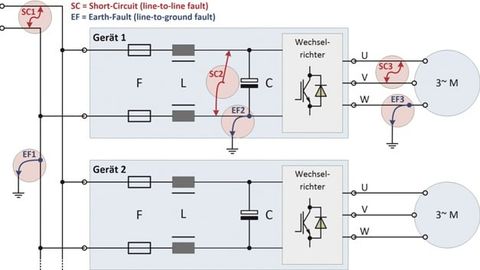
Figure 4: Representation of two devices in the DC grid with relevant components and possible fault locations: on the input side, inside the device and on the output side.
© LenzeFigure 4 shows two drive systems consisting of a drive inverter (device 1 and device 2) with one motor each. In the arrangement shown, short circuits (SC: Short Circuit) and earth faults (EF: Earth Fault) can occur at different points. While an earth fault (EF1 or EF2) on the AC side always leads to failure of the DC network, continued operation is possible with DC-side earthing (quasi-IT) regardless of the fault location. Here, neither +UDC nor -UDC have a low-resistance connection to earth potential. It is therefore only necessary to switch off the DC grid in the event of a second earth fault.
Fault SC3 is a short circuit on the motor side of an inverter. The conditions here do not differ in principle from AC-supplied devices; as a rule, the inverter will detect this fault itself and switch it off. Fault EF3 - an earth fault on the motor side of an inverter - is also usually detected by the inverter itself. The only difference between faults SC1 and SC2 is that in the case of SC2, device 1 is defective. The effects of SC1 and SC2 are identical for device 2. In both fault cases, the load zone is disconnected from the upstream DC grid by a protective device (DC feeder).
During normal operation, the DC link capacitors of devices 1 and 2 are charged to their operating voltage. If the SC1 fault occurs, the energy stored in the DC links is discharged directly via the short circuit. Resistive components in the resulting current circuit (line deposits, ESR of the capacitors, etc.) and parasitic inductances (line deposits, stray component of the common mode choke, etc.) dampen the rate of current rise and the pulse-like peak current. However, measurements have shown that a peak current of almost 1 kA can be expected for a device with 1 kW power, although the nominal operating current is less than 2 A. The capacitors in particular are subjected to considerable stress by the pulse current and must be designed in such a way that they can withstand this sufficiently often over their service life.
Another problem is caused by the inductances in the short-circuit circuit. After discharging the capacitors, these continue to drive the current and feed the energy back into the intermediate circuit (resonant circuit). This is then recharged to a negative voltage. The freewheeling diodes of the inverter then become conductive and take over the current depending on their conduction properties. The freewheeling diodes must also be able to withstand this fault sufficiently often.
Do not neglect mechanically stored energy
If a separately excited or permanently excited synchronous machine is connected to the inverter, this also feeds its short-circuit current into the fault location via the freewheeling diodes of the inverter. The thermal overload capacity of the inverter freewheeling diodes is therefore an important requirement for drives in an open DC grid. However, investigations carried out with semiconductor manufacturers have shown that drives can be designed in such a way that the faults described here do not cause damage to uninvolved other devices.
In summary, it can be said that The system concept developed jointly by the DC industry consortium creates a bidirectional energy network between all individual devices, such as inverters. The direct use of regenerative energy made possible by this allows energy savings of over 10%, particularly in the recuperation of dynamic drives. In addition, the losses in the supply lines are reduced: On the one hand, because less energy generally has to be transported to the system. On the other hand, there are fewer losses compared to AC with greater spatial expansion. Furthermore, load peaks are statistically better balanced out as the number of drives in a network increases.
Authors:
Frederic Blank is a development engineer at LTI Motion;
Werner Körner is Head of Advanced Development at Lapp;
Simon Puls is a doctoral student at Lenze.
As part of a multi-part series of articles, Computer & AUTOMATION takes a closer look at individual technologies that are essential for the implementation of the project funded by the German Federal Ministry for Economic Affairs and Energy (BMWI) (funding reference 03ET7558A to N):
- Protection and switching technology / load zone concept
- Planning and design tools / energy management


You might also be interested in
Project 'DC Industry' - Part 1
DC instead of AC in the production grid
Research and industry are working hard to redesign the power supply for industrial systems via a smart, open DC grid. The article describes the challenges of the 'DC Industry' project and the system specification developed so far.
 read more...
The lubricant problem in food production
Lubricants for components used in food production machinery must be safe for human consumption. However, as these are very expensive, alternatives are in demand - for example in drive chains.
read more...IO-Link for the vacuum
To make electric vacuum generators, grippers or compact ejectors visible for the smart factory, they must supply digital energy and process data in real time. This works using interfaces such as IO-Link, Ethernet or NFC in the vacuum components.
read more...Integrated microchips
Whether medical devices, product tracking, vehicle systems or 5G communication - the demands on safety, performance, documentation and user-friendliness are increasing. What is the significance of microchips integrated into connectors or cable...
read more...RJ45 - fit for the IIoT
Industrial-grade RJ45 connectors are a good solution for applications without increased protection against dust, dirt or splash water. What must the data interface look like so that the 'dinosaur of data transmission' can serve industrial...
read more...Engineering with a digital twin
There is simply not enough time for time-consuming activities such as drawing up parts lists based on circuit diagrams in control cabinet construction. How can the process - from planning to installation to operation - be optimized?
read more...The effects of the F-Gas Regulation
Can refrigeration units and chillers still be used when the F-Gas Regulation on climate protection comes into force on January 1, 2020? What do the bans on the use of refrigeration and air conditioning systems and new regulations for their...
read more...Choosing the right heat sink
In order to equip a data center with high-speed modules for optical interfaces, AFCI was looking for a suitable solution for cooling the high-performance servers. Pin heat sinks were the solution.
read more...(Ethernet) cables put to the test
The dynamic requirements for cables and the associated energy chains are high. How must (Ethernet) cables be designed so that they can be safely routed in energy chains even under the highest bending stress?
read more...