
Machine modularization
Motion control from the modular system
Modularization is not necessarily a new trend in mechanical engineering. However, Industry 4.0 approaches are now giving the topic a very special boost.
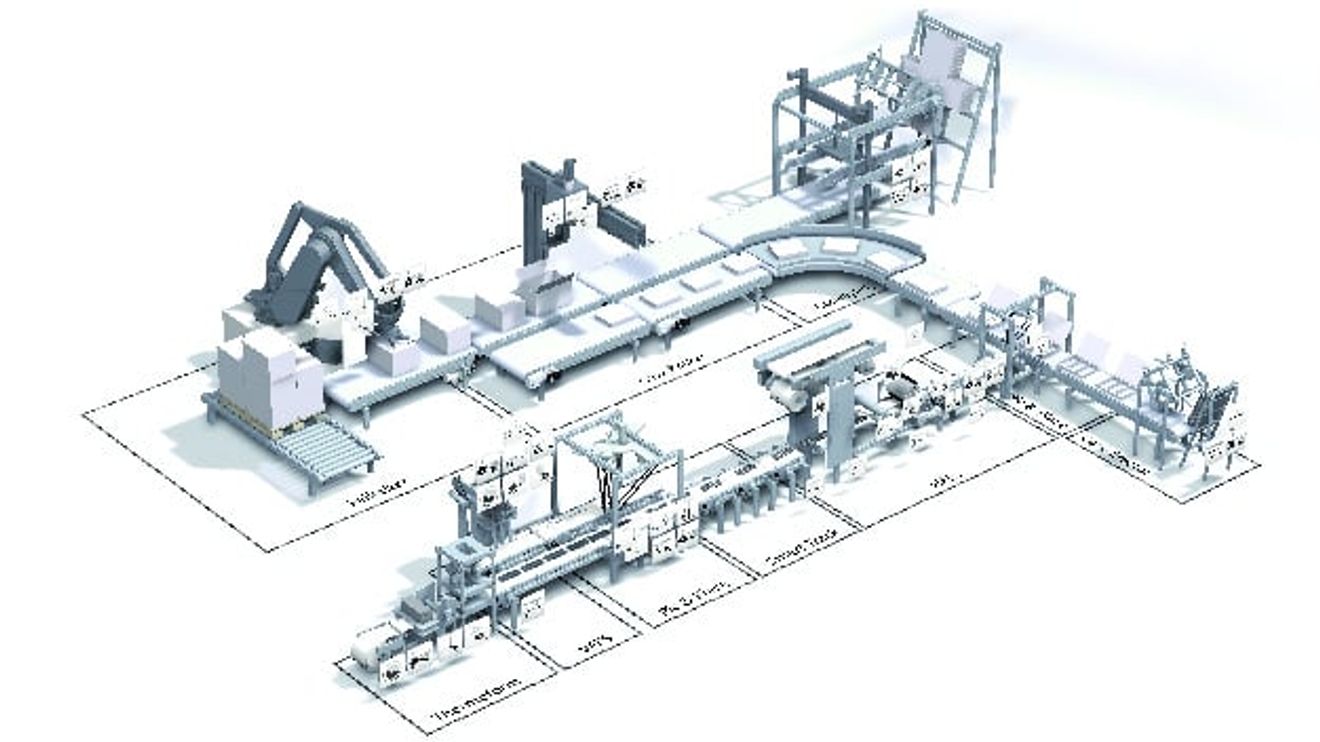
The modular design of production equipment has been an objective for over 20 years. Nevertheless, this trend has not really caught on to this day. Why is that? In order to consider modularization holistically, the software and electronics level must be modularized in depth in addition to the mechanics. However, it is precisely in these last two areas that this has not yet happened with the necessary consistency. Accordingly, the potential for improvement here remains high.
However, there seems to be no question that modular machines are increasingly outstripping monolithic solutions. For example, a 2014 market analysis by Quest TechnoMarketing on the development of machine automation engineering up to 2017 predicts that future growth will primarily result from the manufacture of modular machines, while the proportion of monolithic solutions will decline. At 36%, the number of modular machines will increase at twice the rate of general machine production. Even today, the proportion of predominantly modular machines makes up around half of total production. What are the underlying conditions for this development?
The answer to this question lies less in "What has changed?" and more in "What has been added?". It is important to note that modularization - as already mentioned at the beginning - was a mechanical topic for a very long time. At the same time, the mechatronic approach developed, which involves a simultaneous consideration of mechanics, hardware and software. It is now the consistent transfer of this mechatronic idea to modularization that will lead to a breakthrough.
Risks and restrictions
Modularization from A to Z means using a modular system right from the start. However, modular kits have the disadvantage that what they contain has a predefined function - which in turn limits flexibility accordingly. In addition, the result, which originates from one and the same construction kit, looks like it comes from a construction kit. This effect makes it more difficult to stand out from the competition. Standardization also has the effect that function and machine modules, for example, have clearly defined product properties - and consequently there is always the risk that there is more in them than is actually required for an application. This is why it is so important to scale the modules within themselves. And to stay with the limited individual adaptability: in practice, standardization at module level always poses the problem that there are actually too few different modules.
In view of the aforementioned developments that modern manufacturing is undergoing today with the mechanisms of Industry 4.0, the interfaces also have a limiting effect on freedom in mechanical engineering. Anyone intending to modularize has to create a uniformity of interfaces - and this has to be manufacturer-independent so that modules from different companies can be easily combined with each other. Interfaces here include mechanical couplings as well as the start and end points of communication. Even if the use of standardized communication and programming with standardized or standard-compliant languages certainly restricts freedom at work, it opens up the possibility of later combining machines from different manufacturers into an effective overall production system.
Differentiation not via standard functions
As strict as the requirements for the design of modules are, especially in terms of interfaces and software, and as tight as the corset in engineering is, modularization pays off - especially for standard functions. OEMs are therefore well advised to break down their machines into functional units, as this is the only way they will be able to handle recurring tasks with an off-the-shelf solution. This approach saves time for development and test runs. In addition, the error rate is reduced because standardized functional units are fully developed and tested, and last but not least, this way of working helps to ensure that the machines can be delivered more quickly.

For consistent modularization, the complex motion sequences must be consistently broken down into their functional units.
© LenzeA key prerequisite for consistent modularization of the machines is that the drive and automation solution for the machine modules is also functionally modularized and scaled - in terms of mechanics, hardware and software. In other words, the aim is to make frequently recurring standard functions reusable. Because no OEM will be able to differentiate itself in its market with standard functions. This statement leads to the conclusion that in future it will be increasingly important to use automation technologies that allow the standard to be completed quickly - leaving more time for the really important work.
Modularization in the area of hardware essentially means having technology available in a modular system that can be combined with each other as finely as possible in order to limit the disadvantages of the aforementioned oversizing. The study by Quest TechnoMarketing confirms this statement, as the majority of machine manufacturers prefer suppliers who offer a complete portfolio based on standard components. However, this must also allow for application-specific customization. This applies in particular to software solutions, which, according to the study, are now seen as an important competitive advantage by 92% of the machine manufacturers surveyed!
In response to these trends, Lenze, for example, is using its FAST concept to cast standard drive functions such as electric shafts, positioning or lifting into combinable technology modules. These are also structured in such a way that the machine manufacturer can also write their own modules.
While the approach described above concentrates on comparatively narrowly defined machine functions, the next step in modularization is to link these functions together in a standardized way. Communication standards such as Ethercat or CANopen are used on the horizontal level, while OPC UA or PackML from OMAC, for example, are used vertically. Ultimately, modularization in mechanical engineering can only fully exploit its advantages when data consistency within a production process is truly ensured - which brings us back to Industry 4.0.
Change modules with just a few clicks
In this context, the focus will also be on how modular projects can be realized in the future without complex software adaptations. Configurable machine concepts are required so that a module can be "quickly removed and then quickly reinstalled" in practice with just a few clicks. This means that, depending on the design of a machine type, the final expansion stage is determined by a configurator in which certain functionalities and therefore modules can be put together as required. Bus architectures, for example, must be prepared for the fact that certain modules and thus bus participants can be optionally added or eliminated.
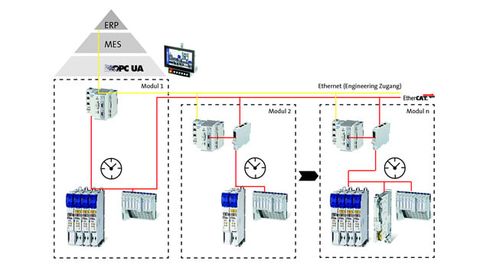
Interfaces and technologies based on standards ensure simple, manufacturer-independent integration of the modules in the machine and in the line.
© LenzeWhat does this mean in practice? With classically designed bus systems, developers have to know in advance which participants are on board and where they are located. However, this contradicts the required flexibility of modular machine construction. If a device is missing, the bus goes into error if it has not been reconfigured accordingly. This is what makes modularization in this area so complex. To counteract this, Lenze, for example, has now integrated the 'Optional devices' function into Ethercat. This principle enables users to accept the largest basic configuration - and to define a customized, slimmed-down variant by selecting or deselecting it. On the one hand, this procedure saves time and, on the other, clears the way for virtual machines including virtual commissioning.
With the 'Optional participants' procedure, the connected participants can be identified by comparing them with the configuration. This allows certain permissible bus topologies to be operated flexibly with a single machine program. It is also possible to enable identification by 'scanning' the actual Ethercat network - and then query individual identification features via device parameters. In this way, a very large number of possible bus topologies can be described with just a few rules. This increases the flexibility for extensions or changes and consequently saves valuable engineering resources during the machine's service life.
The method implemented in the Lenze master controller is based on the 'Second Slave Address' method standardized by the ETG. Because all Ethercat devices can be configured in plain text via a file (*.CSV file), different expansion stages with prepared configurations can be created without programming knowledge.
Who sets the pace?
When everyone is sitting in their seats on a bus, there is still the question of the driver, who sets both the direction and the departure times. Or to put it another way: there must be positions that specify the cycle and the only valid time stamp. This function, which is essential for synchronous production, is solved at Lenze by using an Ethercat bridge. This technical unit synchronizes the clocks of different participants, which also work individually in real time, but whose network lacks a master clock. The 'Sync Bridge' thus becomes the instance that watches the clock for everyone.
Technically speaking, the 'Sync Bridge' connects Ethercat segments by implementing separate Ethercat slave interfaces. This enables data to be exchanged between the individual networks. In order to synchronize the clocks of the individual segments - the Distributed Clocks (DC) - the bridge provides the exact difference between the time stamps as a CoE object. This allows the respective masters of the individual networks to synchronize their times. In this way, it is now possible to modularize consistently on all three levels mentioned - hardware, electronics, software - without restrictions.
In summary, it can be said that The novelty value lies in the possibility of now being able to modularize consistently at all three levels mentioned and remove the restrictions mentioned. While the current focus is still on integrating motion control functions such as cams, flying saws or electric shafts into engineering as individually adaptable standard modules, future developments will focus on combining individual technology functions into larger functional units.
We are then talking, for example, about ready-made solutions for a conveyor belt, a sealing station, a complete winder or a punching device. This raises the question: Are manufacturers of drive and automation technology thus increasingly taking away from their mechanical engineering customers by expanding the value chain? Not at all! Rather, in view of the increasing shortage of skilled workers, the industry can make a virtue out of necessity in this way. After all, thinking 'bigger' when it comes to modularization opens up the way to cutting down on time-consuming standard activities - and thus having more room to really stand out from the crowd.
Author: Kay Willerich is responsible for the Controls product area at Lenze Automation.


You might also be interested in
New board member for production and quality management
Bosch Rexroth appoints Dr. Christina Franke (49) to the Management Board with responsibility for Production and Quality Management as of April 1. She succeeds Reinhard Schäfer (60), who is retiring.
 read more...
Integrated measurement technology for condition monitoring
There are new variants of the high-precision motor feedback system 'EDS/EDM35' from Sick. Variants with additional sensors for monitoring vibration behavior and humidity supplement the standard variants.
read more...Drive controller with high-current variant
As a high-current variant, the 'SD4B' drive controller from Sieb & Meyer extends the range of possible applications: as a servo amplifier for operating rotary and linear low-voltage servo motors or as a frequency inverter for high-speed...
read more...Robust electric cylinders for indoor and outdoor use
With the 'LD' series, RK Rose+Krieger offers electric cylinders that are suitable for indoor and outdoor use.
read more...Easy to implement
Leantechnik rack and pinion gearboxes can be used to design all types of lifting and positioning systems. Integration into the application is easy thanks to the 3D product configurator from Cadenas.
read more...Increase in orders for the German electrical and digital industry
The German electrical and digital industry started the second half of 2024 with a fifth more orders (+20.8% year-on-year).
read more...Expansion of the Management Board
The Supervisory Board of Siemens has announced personnel decisions at Managing Board level in order to further expand its position as a leading technology company and to accelerate the increase in value.
read more...Relieving the load on large gearboxes with a new control strategy
The IMA at the University of Stuttgart has developed a new monitoring and control system that detects damage to large gearboxes and provides relief without affecting the overall performance of the system. Unscheduled maintenance is reduced.
read more...Precision gearboxes for the food industry
The gearboxes in the 'Neco' and 'RD-C' series from Nabtesco have a hygienic design with smooth surfaces and optimized seals, making them easy to clean
read more...