

Festo
Inspired by nature
Automation technology performs tasks such as gripping, moving and positioning goods as well as controlling and regulating processes in everyday factory life. Nature solves such tasks 'by the way'. So why not look at its phenomena and learn from them?
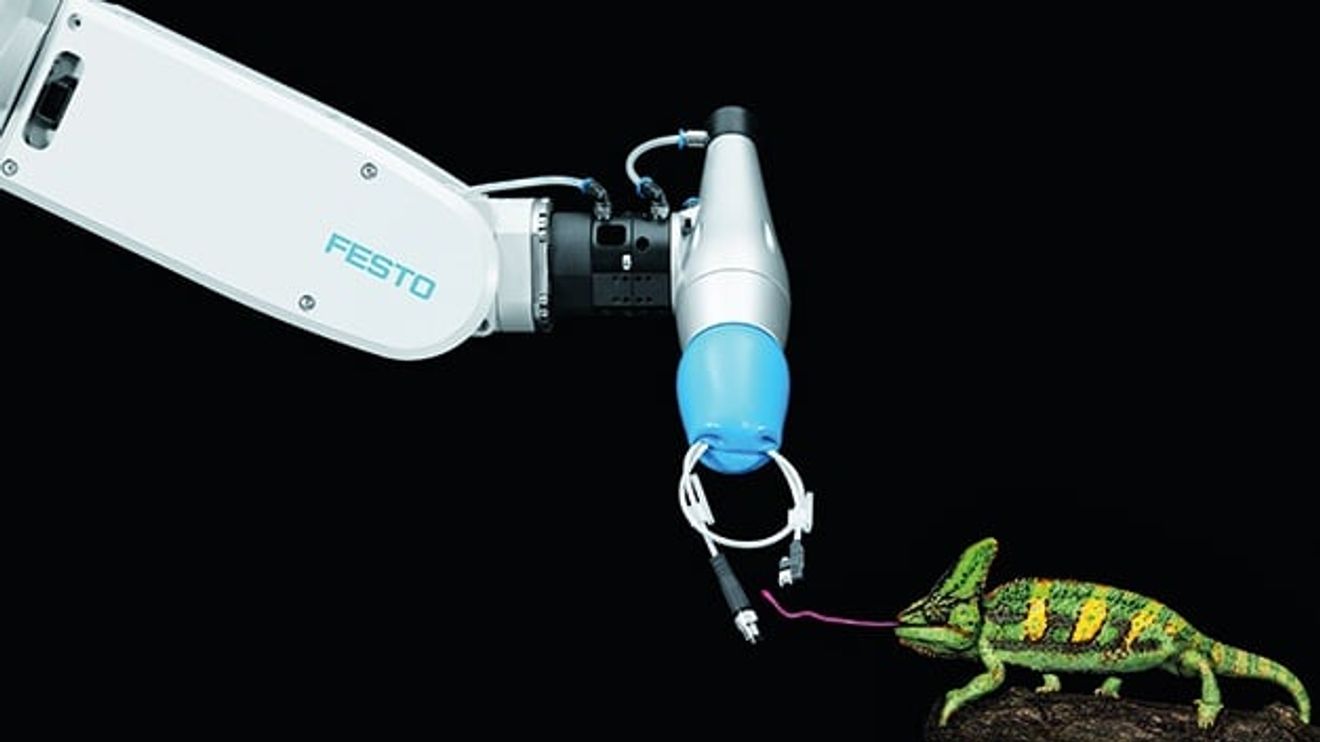
Since the early 1990s, Festo has been working intensively on the topic of bionics - the transfer of natural mechanisms and operating principles to technology. In 2006, the company set up an international research network with universities and institutes, development companies and private inventors: the Bionic Learning Network. The 'Future Concepts' of this network serve the manufacturer of pneumatic and electrical automation technology as development platforms that combine a wide variety of technologies and components - from manufacturing concepts and series products to software and control and regulation technology. To date, almost 60 projects have been developed within the Bionic Learning Network - such as the adaptive gripper finger 'DHAS'.
In the beginning was the fish fin
The adaptive gripper finger was the first object to go into series production as a catalog product. It is based on the amazing behavior of the fishtail fin: if you press against the side of the fin, it does not bend away but curves around the pressure point. The developers have technically implemented this so-called 'FinRay Effect' with the help of two flexible polyurethane bands that are connected to each other via intermediate bars. The stable but flexible gripper fingers adapt easily to the contour of the workpiece when gripping. This enables sensitive objects with irregular surfaces to be gripped gently and securely. The gripper finger is used in the food industry, for example when sorting fruit and vegetables. The adaptive gripper also handles tomatoes or raw eggs without crushing them.
The operating principle of the adaptive gripper was based on the 'Airacuda', one of the first stars of the Bionic Learning Network in 2006, which Festo floated in a giant water tank on its stand at the Hannover Messe. The Airacuda is pneumatically driven and follows its biological model in terms of construction, design and kinematics. Four fluidic muscles ensure the S-shaped movement and smooth steering of the tail fin.
As adaptable as a chameleon's tongue
Another series product that emerged from the development of the Bionic Learning Network is the adaptive form gripper 'DHEF'. Its operating principle is derived from the chameleon's tongue: To catch prey, the animal lets its tongue flick out like a rubber band. Shortly before the tip of its tongue reaches the insect, it retracts in the middle while the edges continue to move forward. In this way, the tongue adapts to the shape and size of the prey and can firmly enclose it.
The central element of the gripper is a silicone cap filled with slight overpressure, which is modeled on the chameleon tongue and fits flexibly and positively over the respective object to be gripped. This allows a gripped object to be enclosed and held. It is also possible to pick up several objects, such as screws from a bowl, using a corresponding control system with proportional valves.
Helpers for human-robot collaboration
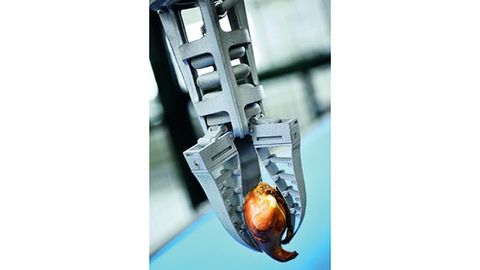
The adaptive gripper arrived just in time for the development of a new flower bulb sorting machine. A Dutch company uses the gripper to sort flower bulbs according to size and quality. What previously had to be sorted laboriously and inefficiently by human hands is now done by a gripper with DHAS adaptive gripper fingers.
© FestoIn order for us humans to perform a movement, the interaction of opposing muscles is always necessary. Festo's developers have technically implemented this principle of agonist (player) and antagonist (opponent) in all seven joints of the 'BionicCobot'. There are three axes in the shoulder area, one each in the elbow and forearm and two axes in the wrist. Each axis contains a pivoting wing with two air chambers. These form a pair of drive units that can be continuously adjusted by filling them with compressed air like a mechanical spring. This drive concept allows the force potential and therefore the degree of rigidity of the robot arm to be precisely determined. In the event of a collision, the pneumatic arm yields automatically and poses no danger to humans.
The BionicCobot is operated intuitively via a specially developed graphical user interface. Using a tablet, the user can teach the actions to be performed and sequence them as required. Via the open source platform ROS (Robot Operating System), the programmed motion sequences are transferred to the integrated 'Festo Motion Terminal', which controls and regulates the kinematics. Controlled pneumatics with piezo technology forms the basis of the control and regulation technology.
Bird flight decoded
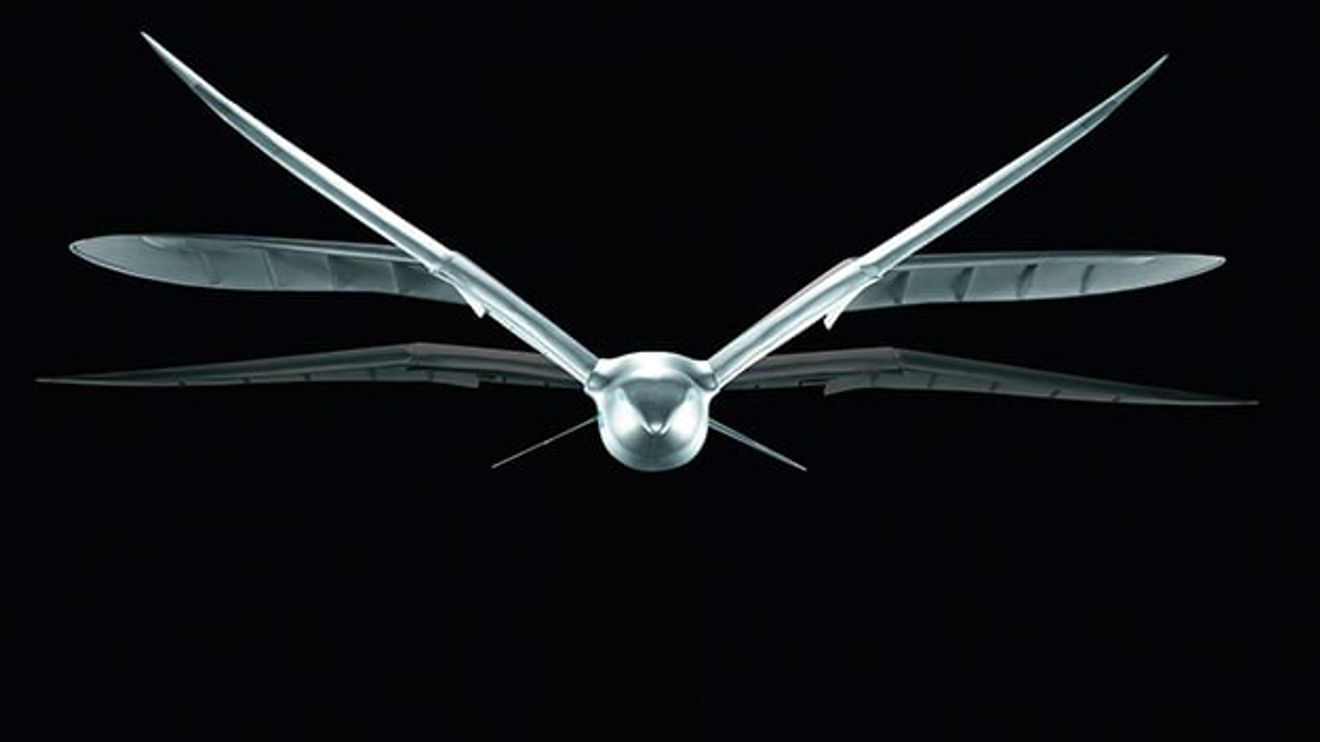
Back in 2011, the research team at the family-owned company Festo succeeded in solving the mystery of bird flight. The key is a very special movement that distinguishes the SmartBird from previous flapping wing devices and enables the ultra-light and powerful flight model to take off, fly and land independently.
© FestoWith the 'SmartBird', the Bionic Learning Network succeeded in decoding the flight of birds in 2011. The herring gull served as inspiration.
Like its natural model, the Smart Bird flies solely by flapping its wings. In contrast to comparable flying models, the ultra-light ornithopter can take off, fly and land by itself without additional propulsion. Made of carbon fiber, glass fiber and polyurethane foam, the SmartBird is an absolute lightweight at 450 g with maximum agility.
The SmartBird provides important insights for automation technology - especially in the field of aerodynamics. They can help to develop new components that require less installation space, are flow-optimized and are therefore more resource and energy efficient. The functional integration of coupled drives provides developers with information for the design and optimization of hybrid drive technologies. Possible areas of application range from lifting blade generators for generating energy from water to new actuators in process automation.
Algae as climate savers
Everything that mankind currently produces from crude oil with immense CO2 emissions could in future also be obtained sustainably from algae. With the 'BionicCellFactory', Festo is demonstrating the holistic bioprocess - from the optimized cultivation of algae with continuous monitoring and analysis to harvesting and the further processing and refinement of various components.
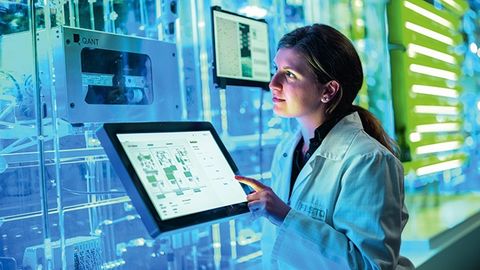
Transferring automation technology know-how to biological processes: Here too, nature is the great role model for Festo. Nature teaches resource efficiency, as it knows no waste and no waste. In the interaction of biological and technical processes, Festo scales and accelerates solutions from the laboratory format with the BionicCellFactory and brings them to industrial application.
© FestoLiving cells are the smallest factories in the world. Using photosynthesis, algae cells convert sunlight, carbon dioxide and water into oxygen and chemical energy sources or organic substances in their chloroplasts. Algae bind ten times more CO2 than land plants. Through their automated cultivation in bioreactors, this value can be increased by a factor of 100. The biomass obtained can be used in the chemical, food and pharmaceutical industries. This makes the BionicCellFactory a model factory for the biological transformation towards an environmentally friendly circular economy.
The modular structure of the BionicCellFactory is also reflected in the control architecture: each module is controlled by a Festo CPX-E controller. Individual parameters of the process steps can be monitored and controlled via dashboards on the respective control panel. Data is exchanged between the modules via OPC UA.
Production systems of the future

Festo sees the BionicCellFactory as a universal blueprint for holistic production systems with organic matter of the future. With the help of the company's automation technology, it can be scaled up to any size. Bioreactors with a capacity of several thousand liters are needed to meet the future demand for renewable raw materials. Expertise in process automation is required to ensure that the plants can reliably produce the desired quantities of biomass. Festo therefore works with customers to develop intelligent control cabinet solutions for bioreactors. The process control enables optimized gassing and feeding strategies, control algorithms, soft sensors for determining biomass in real time and system concepts for bio-based production processes. Here too, the Bionic Learning Network is a driving force for the automation technology of the future.


You might also be interested in
Honored with the German Sustainability Award
The German Sustainability Award in the hydraulics, pumps and compressors category went to Festo in 2023. The award is based on the goals of Agenda 2030 and thus on key areas of transformation such as climate, biodiversity, resources, supply chain...
 read more...
Motor for individual drive systems
At Motek, ebm-Papst will be presenting new drive solutions, such as the modular drive system, for automation in a new performance class.
read more...25 years of Computer&Automation - The e-paper
For 25 years, Computer&Automation has accompanied the growing influence of IT in automation technology. Ultimately, IT and automation can no longer be clearly separated. In this anniversary issue, you can read about the importance that...
read more...Double-digit growth in the 2022 financial year
The Festo Group achieved double-digit growth for another year in a row: its turnover rose by 13.4% to EUR 3.81 billion in 2022 (previous year: EUR 3.36 billion).
read more...Biomass on an industrial scale
At the Hannover Messe, Festo is presenting the 'BionicCellFactory', the next step on the way to industrializing biological transformation in order to cultivate biomass efficiently, resource-efficiently and on a large scale.
read more...Pneumatics makes technological leap
With Festo's 'Controlled Pneumatics' compressed air technology, the 'VTEP' proportional valve terminal achieves sensitive pressure control down to less than 1 mbar. According to the supplier, the technology also uses piezo valves to reduce...
read more...Autonomous flying in a swarm
The 'BionicBee' is an ultra-light flying object from Festo that can fly in large numbers and completely autonomously in a swarm. The BionicBee performed its first air show at the Hannover Messe 2024.
read more...Expansion in North and South America and India
After years of strong growth, 2023 was a year of consolidation for Festo. At around 3.65 billion euros (- 4.3%), turnover was just below the previous year's level
read more...Phoenix Contact at the Hannover Messe
Strategic technology partnership with Festo
Festo will use PLCnext Technology, the open ecosystem from Phoenix Contact, in future intelligent devices. In this way, both companies want to combine their innovative strength with the aim of taking industrial automation to a new level.
read more...