

Analog Devices
The MicroPlyer Microstep Interpolator
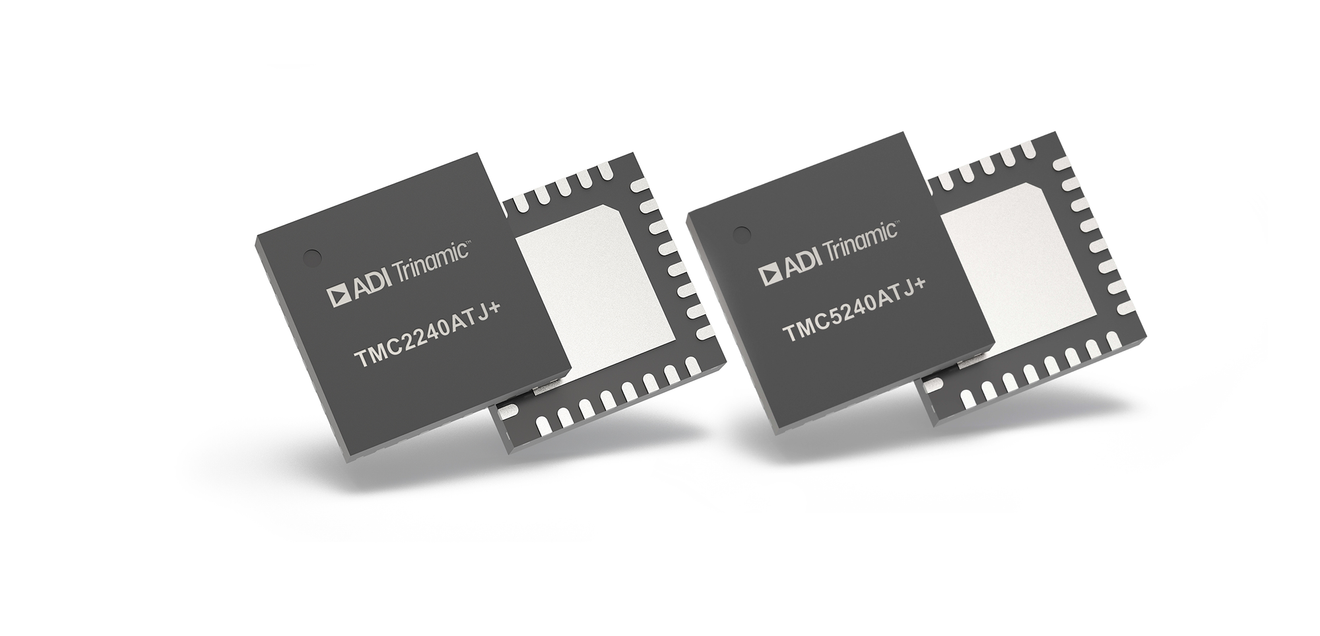
Some Trinamic components are equipped with MicroPlyer technology. This interpolation technique allows existing systems with low microstep resolution to be upgraded to a higher resolution without modifying the motion control logic.
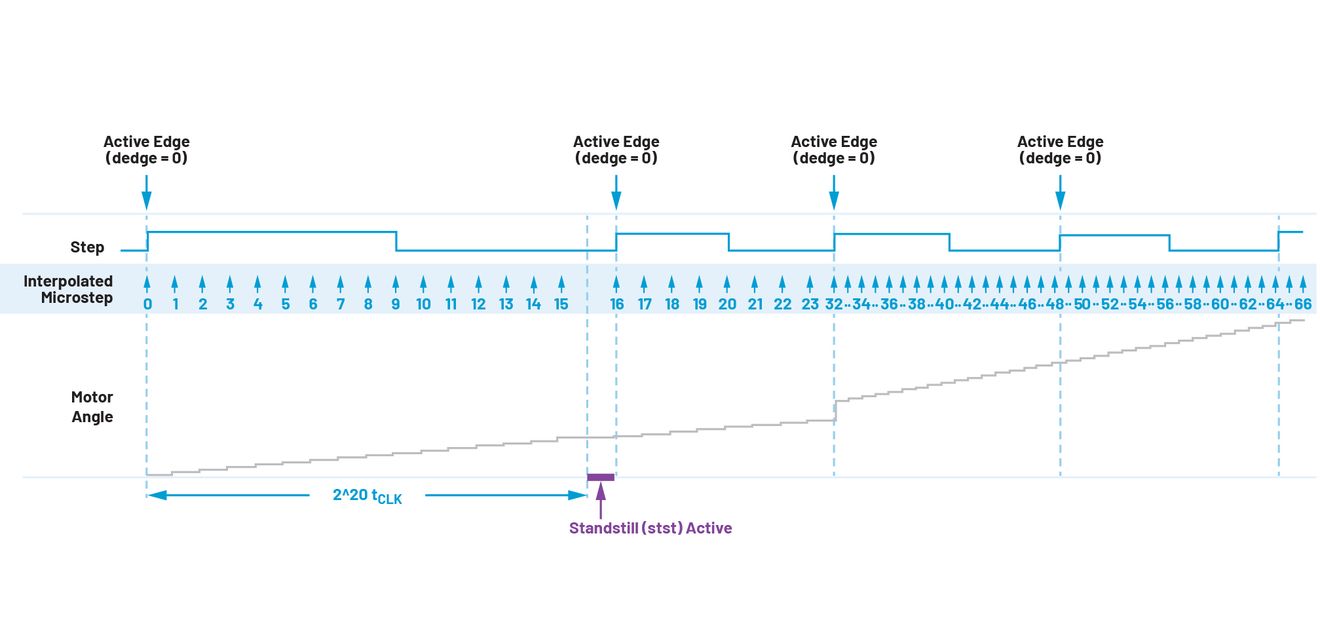
Not all stepper motor drivers support a resolution of 256 microsteps. Trinamic products’ MicroPlyer technology enables an increase in step resolution without altering the existing STEP signal. The technology interpolates additional current steps between step pulses by measuring the duration of the previous step period and dividing it into equal segments. This creates an internal STEP signal with 256 microsteps, even if the original signal has a lower resolution.
For example: A system with a 16-microstep driver operating at 10 revolutions per second (RPS) and a step angle of 1.8° requires an input STEP signal of 32 kHz. Achieving 256 microsteps would demand a signal frequency of 512 kHz, which can be too high for some host controllers. A Trinamic driver with MicroPlyer technology can maintain the original 32 kHz signal and internally interpolate it to 256 microsteps.
Stepper Motor Drivers TMC2240 and TMC5240
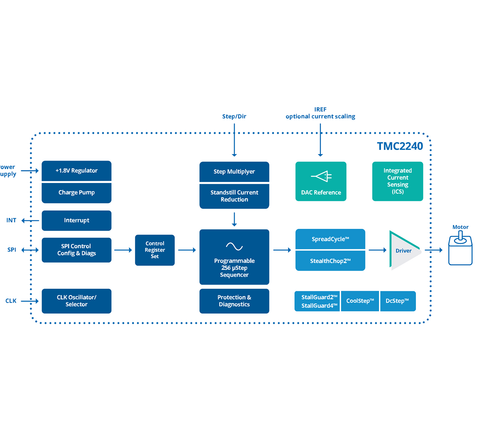
The driver ICs TMC2240 and TMC5240 support serial communication interfaces (SPI, UART), microstep interpolation via MicroPlyer technology, and integrated current sensing (ICS).
The drivers offer features such as:
-
CoolStep: Dynamic current adjustment for energy savings
-
StallGuard2/StallGuard4: Sensorless load and stall detection
-
StealthChop2: Ultra-silent operation
-
SpreadCycle: Enhanced current control to reduce torque ripple
The SpreadCycle and StealthChop2 modes enable ultra-quiet performance across a wide speed range. The TMC5240 also features an 8-point motion ramp to minimize vibration and reduce the computational load on the host controller.
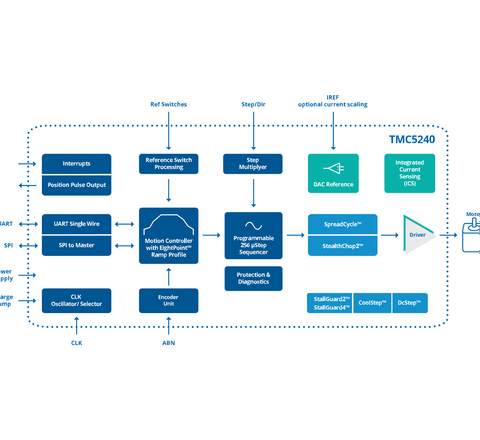
Protection features include overcurrent protection, overtemperature protection, and undervoltage lockout (UVLO).
Possible applications include medical instruments, laboratory and factory automation, surveillance cameras, security systems, and 3D printers.
Stepper Motor Drivers TMC2160 and TMC5160
The TMC2160 and TMC5160 drivers offer 256 microstep resolution and MicroPlyer interpolation. The TMC5160 includes integrated motion control with SixPoint ramping technology to enhance positioning accuracy.
Since these ICs do not contain integrated FETs, external FETs can be used to meet higher current or voltage requirements. The drivers are suitable for applications ranging from battery-powered devices to high-voltage industrial systems.
Application areas include medical technology, textile machinery, robotics, surveillance cameras, and factory automation.
Stepper Motor Driver TMC2300
The TMC2300 is a low-voltage stepper motor driver for battery-powered two-phase stepper motors. It supports CoolStep, StealthChop2, StallGuard4, and SpreadCycle, and offers 256 microstep resolution.
StealthChop2 ensures quiet operation for portable systems and office equipment. The TMC2300 features a STEP/DIR interface and an optional UART interface for configuration.
Thanks to its high-efficiency power stage and extremely low standby current of just 0.03 µA, it extends battery life. The driver can operate from two AA batteries or a single lithium-ion cell.
With its compact 3 mm × 3 mm package, the TMC2300 is ideal for IoT systems, handheld devices, and portable medical equipment.
Reference:
George Beauchemin: “Microstepping Myths,” Machine Design 75, No. 19, October 2003.


You might also be interested in
Modularized EMS Automation with ASi-5
With 'EMS modular with ASi-5', SEW-Eurodrive is expanding its 'Movi-C' modular automation system to include an automation solution for electrified monorail systems.
 read more...
Strategic Minority Interest in Synapticon
The Swiss Maxon Group is expanding its expertise in the field of motion control through a strategic partnership with the German company Synapticon. The aim of the collaboration is the joint development of high-performance drive solutions with...
read more...A Framework for modern Robot Applications
The ROS1 driver for Trinamic motor controllers from Analog Devices enables the seamless integration of intelligent actuators into ROS-supported robot systems. This article describes features, configuration options and application scenarios for...
read more...International network expanded
With the complete takeover of EME Motor 2008, S.L., Mayr Antriebstechnik now has its own subsidiary in Spain.
read more...Preparation for business picking up
Bosch Rexroth closed the 2024 financial year in a difficult market environment with significantly lower sales than in the two very strong previous years. Sales in 2024 amounted to around 6.5 billion euros. That is 13.6 percent less than in 2023.
read more...Stephan Schech is Managing Director for the GSA Region
The specialist in motion control and positioning systems, Aerotech, has announced new leadership: Stephan Schech has been appointed as the new Managing Director to further strengthen and expand the company’s presence in the GSA region.
read more...New Vice President of Sustainability
Rockwell Automation has appointed Emmanuel Guilhamon as Vice President, Sustainability, effective July 1. Guilhamon will report to Becky House, Senior Vice President, Chief People and Legal Officer.
read more...TSN/A Conference 2025 | September 24, 11:30...
IEEE TSN Stream Configuration in UAFX Connection Manager
This talk elaborates on the OPC UA FX adoption of IEEE TSN as a transport layer, reflecting on UAFX integration of the CNC/CUC concept and network configuration.
read more...TSN/A Conference 2025 | September 24, 02:30...
IEEE TSN and Industrial Ethernet adoption challenges
It becomes evident that TSN adoption will happen over a period of time where new technology will coexist with legacy Ethernets and fieldbuses.We would like to challenge the existing testbeds, plugfests, and IA vendors with accommodating the missing...
read more...