

VDMA-Kienbaum study
New skills are in demand
What new skills does the digital transformation in mechanical and plant engineering require from employees? A joint study by Kienbaum and VDMA gets to the bottom of this question.

The mechanical and plant engineering industry is characterized by digital change. New technologies are being introduced that are changing existing processes and redefining value chains. Companies must react flexibly to these changes. Interdisciplinary work, agility and a willingness to change play a particularly important role here.
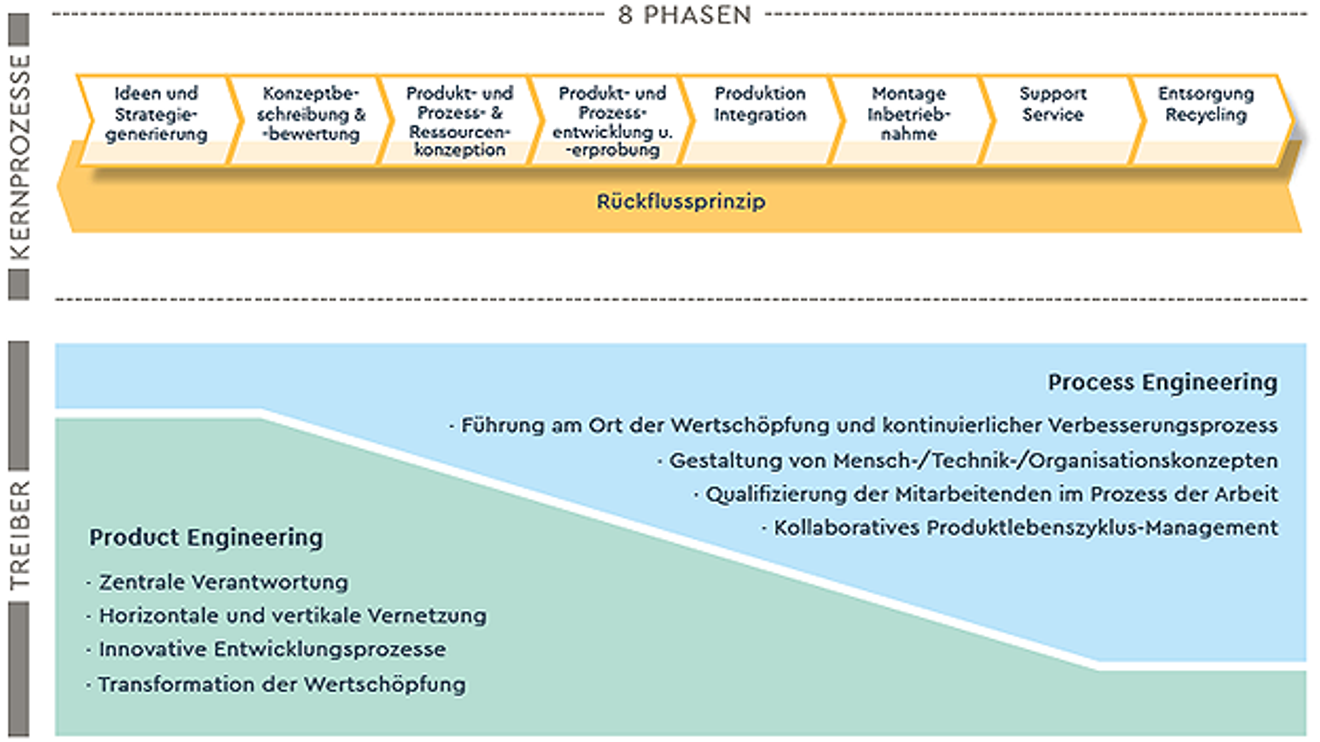
In order to do justice to the industry-relevant skills in the context of digital transformation, the study is based on the value creation process in mechanical and plant engineering.
© VDMAIn the study "Future Skills in Mechanical and Plant Engineering", the VDMA, in collaboration with the Kienbaum Institute@ISM at the International School of Management (ISM), analyzed these changes in more detail. To this end, 148 specialists and managers from the industry were surveyed. The study has now been published.
The results at a glance
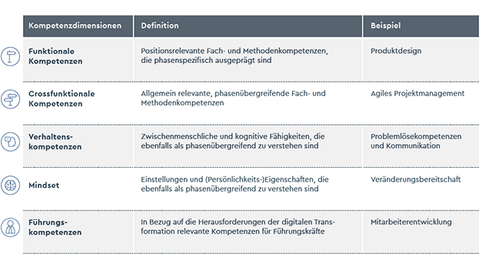
In addition to the product life cycle, the study organizers selected suitable competence dimensions for structuring and classifying certain competences.
© VDMA- Of the companies surveyed, 90% are undergoing technological, organizational and/or procedural change processes. However, only 17% of the companies surveyed reported changes to their corporate culture.
- Due to the shortage of skilled workers, four out of five companies see themselves confronted with a so-called "skills gap" and state that they will have to build up the required future skills over the next five to ten years.
- Those surveyed see the greatest potential for development in interdisciplinary work, agility and a willingness to change
- With system engineers, technical product managers and I.4.0 service technicians, the companies name what they consider to be the three most important job profiles.
- In order to ensure the necessary skills, around 80% of companies rely on recruiting new specialists with the relevant skills.
Further training is considered to be just as important: 80% of companies also upskill their skilled workers. Retraining (reskilling) is used by 56% of companies for employee qualification. - For the majority of companies, leadership primarily means the development of employees. Virtual leadership and the development of digital strategies and digital business models are other important management tasks
You can download the VDMA-Kienbaum study "Future Skills in Mechanical and Plant Engineering" here:


 4.7 MB
You might also be interested in
Family businesses create more jobs than DAX companies
The rise in energy prices is fueling fears of companies moving abroad. According to a new study, family-owned companies are more loyal to Germany as a business location than listed companies without a controlling family.
 read more...
Foreign specialists for mechanical and plant engineering
Karl Haeusgen calls on politicians to allow the recruitment of foreign skilled workers by recruitment agencies. In a letter to Nancy Faeser and Hubertus Heil, the VDMA President calls for every possibility to be considered in order to get the...
read more...Growth depends on energy and China - total failure Russia?
As one of Germany's most important export sectors, the mechanical engineering industry is pinning its hopes this year on energy security and an easing of trade problems in China.
read more...Daniel Sahl-Corts becomes Managing Director
Daniel Sahl-Corts will become Managing Director of the VDMA Capital Office in Berlin on August 1, 2022.
read more...Job expansion planned in mechanical engineering
The core workforce is to be increased, additional jobs created and the range of apprenticeships and dual study programs expanded. This is what the majority of German machine and plant manufacturers want. However, there is a problem.
read more...Diversity as a success factor
Diversity is not a fad. Diversity is one of the cornerstones of a successful company. Why is that? Coach Martin Kruse explains.
read more...Individual employee training 4.0
Vizendo uses the digital training environment from Siemens to train automotive employees on new models long before the first prototype is produced. This accelerates the time-to-market after product and process changes.
read more...Authorized distributors made visible online
Lapp is expanding its digital service portfolio and is the first B2B industrial company to provide its authorized distributors with a verifiable online seal from authorized.by. The company aims to create more transparency and security for buyers and...
read more...Flexible analog mix module
The analog mix module 'AM 821' from Sigmatek's S-DIAS series has eight analog differential inputs with 16-bit resolution and two analog outputs.
read more...