
Torque measurement
Securely bolted
Securing bolting processes in production? Absolutely necessary! Because: According to the automotive industry, around 70% of warranty costs are at least indirectly attributable to faulty screw connections!
Hardly a month goes by without a car manufacturer being forced to issue a recall due to faulty bolted joints. According to estimates by the US consulting firm Archetype Join LLC, the automotive industry assumes that 70% of warranty costs and 20% of all recalls are caused directly or indirectly by faulty bolted joints. Although the number of bolted joints in automotive construction has decreased as a result of the trend towards lightweight construction, the number of safety-critical joints has increased at the same time. In a van, for example, there are more than 1500 joints in total!
Three risk classes
The VDI guideline 2862 divides bolted joints into three risk classes:
- Risk class A includes safety-critical bolted connections whose failure poses a risk to life and limb - such as in the chassis area of a car.
- Function-critical bolts that could cause the car to stall, for example, belong in risk class B.
- Screw connections that 'only' cause annoyance to the customer if they fail are assigned to risk class C.
The supposedly simple process of connecting two or more parts with a screw is a challenge in series assembly. This is because consistent quality must be guaranteed in a specified cycle over a certain period of time. Of course, all influencing variables - such as the condition of the assembly tools or the quality of the fasteners - are regularly checked in order to maintain these variables in the assembly process. However, at the end of the process, the assembled screw is finished, the parts are connected and the previous process must be checked and evaluated. What matters now is how all the influencing variables and tolerances have interacted and whether the bolted joint holds reliably.
The standard work for calculating and designing high-strength bolted connections is the VDI 2230 guideline "Systematic calculation of highly stressed bolted connections - Cylindrical single-screw connections". However, even if bolted joints are designed in accordance with the specifications, they can loosen and loosen on their own, which is always due to a complete or partial loss of preload force (preload force refers to the required force in the axial direction, which is necessary as a target value of the bolting process to ensure safe operation).
The friction coefficients of the surfaces of the fastening partners are among the decisive parameters for achieving the desired fastening quality in the production process. It is therefore essential to test and monitor them. The coefficient of friction plays a major role in relation to the internal forces of the screw. Roughly speaking, around a third of the applied torque is required to overcome the friction in the thread - and around half of the torque is required to overcome the friction under the screw head. The higher the friction, the lower the preload force generated.
Laboratory systems can be used to determine the partial friction coefficients on screws under the screw head and in the thread separately. However, even if the screw exhibits coefficients of friction that are within the specified tolerances in the laboratory test, this does not necessarily mean that the screw will also maintain these coefficients of friction under load conditions: Higher temperatures, for example, can change the frictional behavior of the fasteners. Relative movements of the assembled parts or local plastic deformations are also possible.
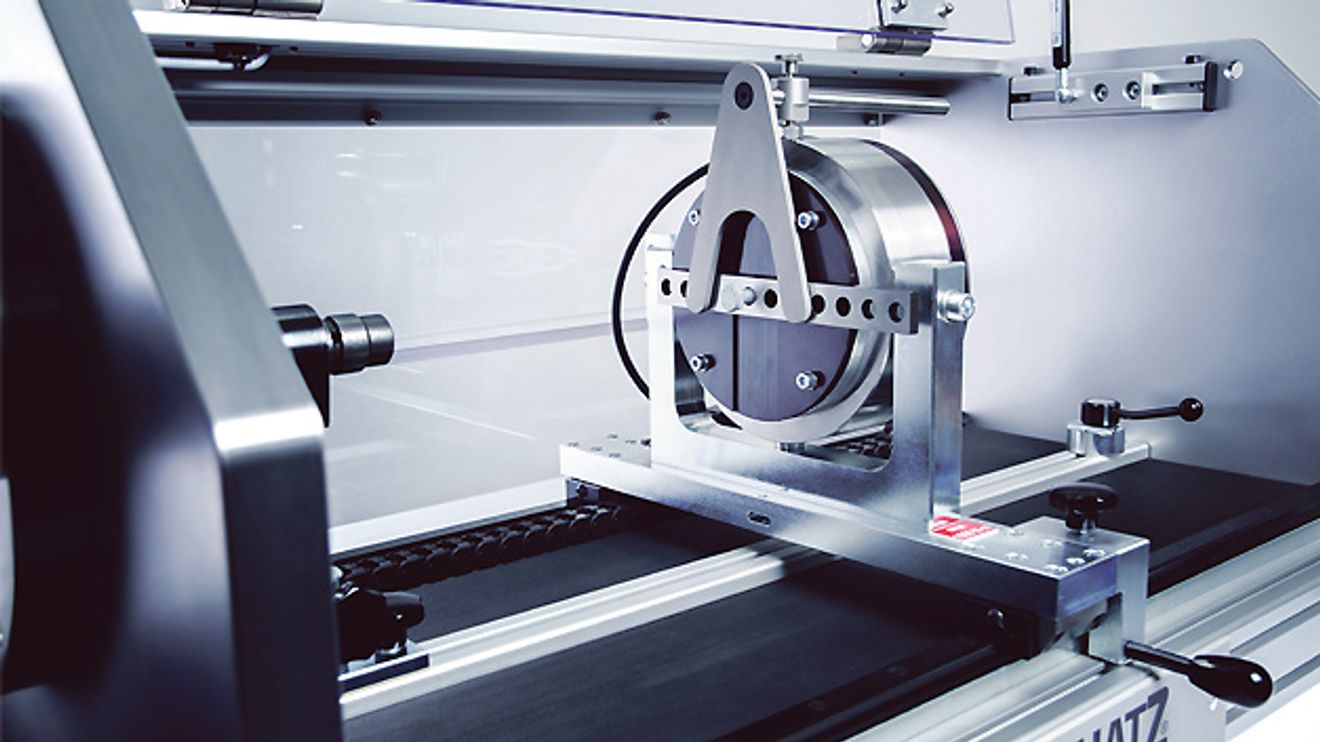
With the 'Schatz-Analyse' laboratory system, the screw-in behavior can be analyzed in detail.
© Kistler GroupThis can be remedied by special analysis systems, such as those offered by Schatz. They can be used to monitor the functional properties of bolted joints - such as friction coefficients - in the laboratory in a reproducible and standard-compliant manner. The computer-controlled design and integration of sensors, measurement and control technology, software, drives and mechanical components ensure the performance of such analysis systems.
First and foremost, precise sensors are essential for accurate and reproducible measured values. In the case of Schatz systems, the traceable quality of the torque, torque/angle of rotation, preload force and preload force/thread torque sensors is ensured by the company's accredited DAkkS calibration laboratory.
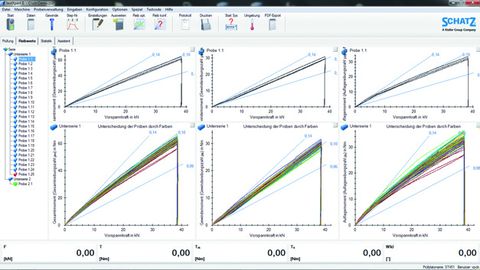
The various measured variables are determined using a special measuring and control unit that records and processes all measured values and performs control tasks. These tasks are carried out in real time and the measurement curves are simultaneously displayed graphically using the 'Testxpert' software.
In combination with the measuring device, a power and control unit takes over the control of the various drive units (servo geared motors and drive spindles). A direct connection of specific production spindles to the system is possible through cooperation with manufacturers of servo screw spindles for use in production lines. The production spindles are controlled by the power and control unit and enable tests with the real influence of the screwdriving spindles used in production. The computer-controlled design of the mechanics can be adapted to user and standard requirements. The systems meet the requirements for maximum torsional rigidity in order to rule out any influence on the results achieved.
The 'Testxpert' operating and evaluation software combines the functions required for a test. It maps the complete processes from the user-specific or standard-compliant creation of the test sequence with any number of sub-steps and definitions of the target values and speeds for the individual sub-steps, as well as taking over the machine control for the test itself.
Processes seamlessly mapped

The portable testing system 'Inspectpro' is used to analyze torque and preload force on site during assembly.
© Kistler GroupThe evaluation of the results with statistical parameters and graphical representations is also implemented in the software. Data export and the creation of test reports are also integrated, so that the complete testing and evaluation can be carried out without the need for time-consuming switching between software platforms.
But how can it be ensured that the bolted joints not only comply with the specified values in the laboratory, but also in production? This is where consistency of systems is required: on the one hand with laboratory systems for analyzing fasteners and on the other hand with portable testing systems for measuring torque and angle of rotation. The 'Schatz-Analyse' laboratory system can be used to determine the interaction of torque and preload force as well as the mechanical and functional properties of fasteners.
All influencing variables are recorded with the mobile measuring device 'Inspectpro' for direct testing of the fastening process during assembly. Various torque/rotation angle sensors are available for this purpose, which are adapted directly in front of the specific fastening tool.
Once the measuring device is connected to the sensor, it transmits its characteristics via 'Autocode' so that no further settings are necessary and the measurement can be carried out immediately. The screen displays the measured values graphically within the tolerances. It is also possible to display measurement curves in order to identify effects during screwing, joining or assembly.
The measuring device has a statistics module for evaluating the measurement results. All data - numerical values and graphical measurement curves - are saved so that a statistical evaluation of the recorded data can be carried out at a later date. The measured data can then be further processed via PC and software.
The continuous IT-supported monitoring of the screwdriving processes in the laboratory and production is ultimately not only the key to higher quality screwdriving processes, but also a cornerstone for the smart factory in the age of Industry 4.0 thanks to real-time processing and visualization: If errors occur, it is possible to react quickly, identify risks early on and initiate preventative measures. The end-to-end transparency of the bolting process also supports the continuous improvement process.
Author:
Christoph Bodensteiner is Sales/Project and Product Manager at Schatz in Remscheid.


You might also be interested in
Testing on a new level
In a research project, Kistler is investigating the possibilities of fully automated optical quality assurance in injection molding production. In addition to the system design, the project is looking at how data synchronization and the adaptation...
 read more...
These are your winners!
We put 96 products in twelve categories to your vote in December, and now the winners have been chosen! The trophies were presented at a 'Winner's Dinner' at the Seehaus in Munich. These are your "Products of the Year 2024"!
read more...Measurement technology - The winners
The winners in the 'Measurement technology' category could not be more different: a handheld device for force measurement, a current collector system and a pressure transducer impressed the readers.
read more...Growth despite a difficult environment
With sales of CHF 465 million, the Kistler Group recorded growth of 7.1 % in 2023, or 14.2 % adjusted for currency effects. However, the original growth expectations were not met.
read more...The e-paper special: looking for products of the year 2024
They've earned it: all 96 nominated products from 12 categories in their own e-paper. Browse through the individual areas and make your personal selection. You can also find out more about the companies and their solutions in the accompanying video...
read more...Flexible monitoring with measuring amplifier
The '5073B' charge amplifier from Kistler offers users a high degree of flexibility thanks to its individually configurable data acquisition and the internal calculation and weighting of multiple sensor signals, according to the manufacturer.
read more...Handheld family for on-site measurements
The handheld family for measuring forces from Kistler is user-friendly and can be used on site.
read more...Growth course continued
At € 434 million, the Kistler Group's turnover in 2022 was 5.5% higher than in the previous year. In 2023, the company aims to achieve double-digit growth thanks to technological innovations and the expansion of the Chinese market.
read more...Measurements including temperature compensation
The 4017A piezoresistive absolute pressure sensor from Kistler is suitable for engine development as well as hydraulic and pneumatic applications in both cold and hot environments.
read more...