
Alpha-Omega Technology
IoT trends 2024
The sensor-based Internet of Things (IoT) enables practical solutions for rural areas, preventive maintenance for industry and the sustainable use of resources. Alpha-Omega Technology identifies three trends for the IoT in 2024.

The digitalization of rural communities requires solutions that are tailored to a low population density - be it smart local lighting, temperature measurement on the mountain or the monitoring of water levels and water quality.
© Alpha-Omega TechnologyAlpha-Omega Technology, operator of an online store for products in Low Power Wide Area Networks, LPWAN for short, has been implementing projects for a sensor-based Internet of Things (IoT) under realistic conditions together with the municipality of Martinfeld in Eichsfeld, Thuringia, for more than five years. In the 'SMARTinfeld' model village, it is possible to experience how IoT solutions work for an entire community and thus make village life sustainable for the future. The model location was one of the winners of the 'Digital Places in the Land of Ideas 2023' innovation competition.
The company's experts see the following trends in the market for sensor-based IoT applications in 2024: IoT enables low-threshold and practicable solutions for smart villages, preventive maintenance for industry in combination with machine learning (ML) and, in principle, efficient use of resources in terms of sustainability. Long Range Wide Area Network, LoRaWAN for short, as a wireless technology for IoT remains particularly important for use in rural regions.
Trend 1: IoT for digital solutions in smart villages
Smart city projects are usually limited to urban environments and do not take into account the special needs of rural communities. In order to advance digitalization here, solutions are needed that are tailored to a low population density - be it smart local lighting, temperature measurement on the mountain or monitoring water levels and water quality. Jan Bose, founder and CEO of Alpha-Omega Technology, explains: "Distance sensors offer a good response to rising water levels for the latter application. This can reduce flood damage and save considerable costs." The aim of IoT applications must be to maintain a rural way of life while integrating technology and innovation. Rural communities differ from urban areas not only in terms of use cases. As a rule, several municipalities and therefore authorities are involved - the need for coordination increases. In addition, people in rural areas often identify strongly with their municipality.
The answer could be IoT applications based on LoRaWAN wireless technology. According to Alpha-Omega Technology, the advantage of this technology for transmitting the collected data lies in the minimalist data volumes. They ensure low power consumption and at the same time offer sufficient data protection because only the data that is absolutely necessary is used. LoRaWAN also has an enormous range - in rural areas this can be up to 10 km. "By positioning the gateways higher up, the municipalities achieve excellent coverage. In addition, roads do not have to be torn up to lay cables in order to put the network into operation. What is needed is a scalable, license-free IoT technology with a wide range of applications such as LoRaWAN and open source software," emphasizes Jan Bose.
Trend 2: Integration of ML in industrial IoT

ML-based LoRaWAN sensors record environmental information in industrial plants, analyze it and provide personnel with information on when and where action is required.
© Alpha-Omega TechnologyIndustrial companies in Germany are under pressure to increase efficiency and find qualified personnel in times of a shortage of skilled workers. "Of course, machine learning is not a panacea here. However, the technology can relieve the burden on employees by taking over specific tasks. It also saves the company resources and therefore money," says Jan Bose. ML-based LoRaWAN sensors record environmental information, analyze it and provide staff with information on when and where action is required. This includes, for example, the maintenance of large machinery. The sensors can learn the vibration patterns emitted and use this vibration signature to recognize whether maintenance is due. "Instead of either carrying out maintenance too often and therefore not using working time efficiently, maintenance is only carried out when necessary. At the same time, the probability of system failure is significantly reduced because a deviating vibration signature is used to warn of possible faults," explains Jan Bose. IoT technologies with an open ecosystem such as LoRaWAN offer the advantage that they can be used where they are needed. Companies can also find a wide range of sensors and applications on the market. This makes them independent, as they do not have to be tied to one provider. Further advantages are the low-threshold use and the transparency of which data is collected and evaluated.
One example of this use case is the 'BoB Assistant' vibration sensor from the manufacturer Watteco. The device analyzes the vibration signature of industrial systems and machines. Subsequent deviations in the various vibration patterns indicate undesirable conditions and wear and tear at an early stage. Preventive maintenance can thus be optimized, reducing downtimes to a minimum. The sensor transmits the analysis results and running times of the machine via the energy-saving LoRaWAN protocol. The vibration sensor is typically used in water pumps, compressors, air filters, concrete mixers and transformers, for example.
Trend 3: IoT for sustainability and environmental protection
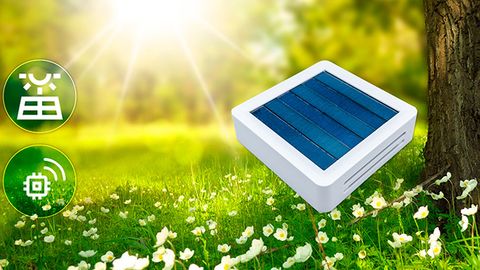
IoT sensors for monitoring the environment within projects for greater sustainability are increasingly in demand.
© Alpha-Omega TechnologyMore and more IoT companies are adapting to the trend towards sustainability. First of all, this includes the products themselves, which, for example, have their own integrated solar power supply or whose housings are made from recycled materials. "In addition, we are seeing increasing demand on iot-shop for sensors for monitoring the environment within projects for greater sustainability. Typical areas of application include monitoring the soil moisture of specially protected trees or monitoring work sites in order to deploy personnel on an ad hoc basis rather than on a rota basis. In this way, not only is the human resource conserved, but accompanying circumstances can also be optimized," reports Jan Bose.
Problems such as increased heating costs can also be addressed comparatively quickly and cost-effectively with the support of IoT sensor technology: Automated heat control can be implemented within a short time, even in a large building. As a rule, it is not necessary to remove the old heating technology and install a new one. This is because the IoT technology can be installed on top of the old system. Even the radiators do not need to be replaced in order to implement digital, automated heating control. It is sufficient to retrofit the heating valve with an IoT heating valve.


You might also be interested in
Technologies for precise data and analytics
From June 9 to 11, 2026, Sensor+Test once again brought together trade visitors from the fields of sensor technology, measurement, and testing in Nuremberg. With its focus on these core technologies and the wide range of application areas, the trade...
 read more...
Sensors and measurement technology
Application start for AMA Innovation Award 2026
The AMA Association for Sensors and Measurement (AMA) is inviting scientists and developers from industry and research to apply for the AMA Innovation Award 2026. We are looking for research and development results in sensor and measurement...
read more...3D surface inspection and defect detection
The '3D ReflectControl' sensors from Micro-Epsilon are used for surface inspection and defect detection on highly reflective and transparent surfaces.
read more...Double focus
With the 'DCR 1048i OCV', Leuze is expanding its Simple Vision portfolio with a further functionality: The sensor can both read 1D/2D codes within an application and check the quality of a print using the OCV method.
read more...Mourning for Gisela Sick
Gisela Sick passed away on November 1, 2024 at the age of 101. She supported the company from the very beginning until it became the global group it is today.
read more...Record figures for Vision 2024
Vision, the world's leading trade fair for machine vision, will kick off with a record number of exhibitors on October 8, 2024. Around 500 exhibiting companies - more than ever before - will showcase their new developments and innovations to an...
read more...Parameterizable system solution
The 'VO330570' optical displacement measuring system from ipf with a scanning range of 15 to 60 mm detects all moving objects without contact and therefore without slippage, regardless of material or color.
read more...Automated real-time measurement of ship emissions
'Digitization and Verification of Marine Live Emission Data' is the name of a research project launched by a consortium led by Sick. The aim is to develop a solution with which emission data from ships can be digitally collected and verified in real...
read more...Quantum minimalists
How do you turn a highly complex physical laboratory setup into a marketable product? The art lies in reduction, as the start-up Quantum Technologies shows.
read more...