

Fraunhofer IPMS
Smart and compact sensor technology thanks to edge AI
In the 'InSeKT' project (development of intelligent sensor edge technologies), the TH Wildau, the Leibniz Institute for Innovative Microelectronics (IHP) and the Fraunhofer IPMS are working together on new hardware, software and sensor solutions to make better use of artificial intelligence at the edges of IT networks.

Artificial intelligence systems have to process large amounts of data as quickly as possible. The project of the Technical University of Applied Sciences Wildau, the Leibniz Institute for Innovative Microelectronics (IHP) and the Fraunhofer Institute for Photonic Microsystems IPMS aims to enable complex calculations directly at the point of origin of the data, for example directly at the sensor itself.
Data processing using AI is currently often carried out via centralized cloud computing solutions. The data is calculated on central servers, which means that large amounts of data are transmitted over long distances. This can repeatedly lead to data leaks and thus to opportunities for unauthorized third parties to attack. Decentralized data processing not only improves data protection, but also enables real-time capability of the systems, as data transfers over long distances are avoided.
Advanced sensor technology to solve material and integration problems
The 'Integrated Silicon Systems' branch of the Fraunhofer IPMS in Cottbus is working on the functional expansion and integration of existing MEMS sensors for edge AI applications. Signal processing is integrated directly into the sensor and data can be collected directly where it is generated. The aim is to increase the adaptability of sensors to different application scenarios without having to replace the underlying hardware.
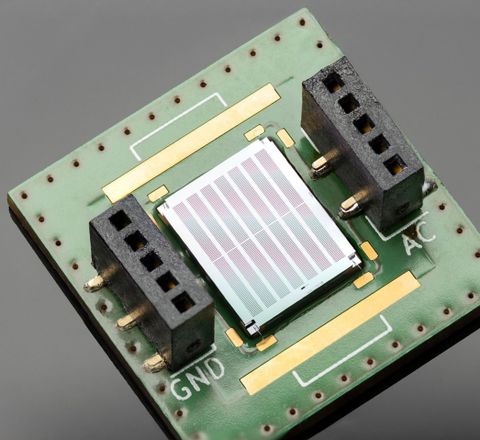
One of the first key areas of development at Fraunhofer IPMS is gas analysis using ion mobility spectrometers (IMS). An IMS makes it possible to detect ionizable analyte substances directly in the air, even at very low concentrations. Existing approaches lack sufficient miniaturization. A first IMS demonstrator, which is based on a FAIMS approach (field asymmetric-waveform ion mobility spectrometry), has flexible electrode spacing, making it possible to overcome this hurdle.
Furthermore, the goal of a data-supported evaluation of photodetectors for the near-infrared wavelength range is being pursued. These are used, for example, in material analysis and recycling and even make it possible to analyze through packaging. In particular, the focus here is on improving an Al-TiN-Si Schottky detector component with cylindrical pyramidal structures for higher sensitivity and better scalability using cheaper materials.
A third area deals with the adapted use of capacitive micromechanical ultrasonic transducers (CMUTs) for improved imaging. CMUTs are highly sensitive ultrasound receivers due to their size and capacitive operating principle. Signal evaluation close to the sensor enables faster imaging. "In the future, it will be possible to carry out very precise analyses of hand movements using an ultrasound signal based on that of bats, as well as measuring blood sugar levels using ultrasound," explains Dr. Sebastian Meyer, Head of the Integrated Silicon Systems division at Fraunhofer IPMS.
The TH Wildau and the Leibniz IHP will then use the generated data to train edge AI systems for fast and precise data processing. The results of the project will enable further steps to be taken towards more intelligent and compact sensor systems.


You might also be interested in
Extended three-member Management Board for Deutsche Messe
Deutsche Messe AG is reorganizing its personnel and consistently focusing its Management Board on the further development of the company and the exhibition grounds in particular. With an expanded three-member Management Board, the company is...
 read more...
Optical Sensors in a Compact Design
di-soric is launching optical sensors from the 'O-33/O-34' series in a compact design. The performance features, functional principles and ranges are the same for the sensors in both full series. The difference lies in the packaging: the O-33 series...
read more...Digital Intelligence meets Production
What does modern production look like when sensor technology, the cloud and IIoT work together seamlessly? A look behind the scenes at ifm shows how the Group not only develops its own IIoT platform 'moneo', but also consistently uses it in its own...
read more...System-on-chip for optical absolute encoders
New from IC-Haus is the 'iC-RT2624' system-on-chip (SoC) for optical encoders with contamination-tolerant scanning.
read more...Nobel Prize for Quantum Technology
This year's prizewinners showed that quantum effects can influence not only tiny particles, but also larger systems. Their experiments in a handy electronic circuit open up new perspectives for quantum computers and sensors.
read more...Endress+Hauser acquires full ownership of CodeWrights
Endress+Hauser is now the sole owner of the software company CodeWrights. The Swiss provider of measurement and automation technology acquired the remaining 33 percent of Pepperl+Fuchs' shares with effect from July 1, 2025. Endress+Hauser held two...
read more...From the factory floor to the dishwasher
Cognitive robots collect huge amounts of data - thanks to 5G technology, they will be able to react almost in real time in the future. Vodafone and Neura Robotics are entering into a partnership to make robots suitable for everyday use.
read more...Millions invested in new plant
The Jumo Group officially opened the new Plant 2 ('Sensilo') in Rodges near Fulda on May 22, 2025. At around 48 million euros, the new building is the largest investment in the company's history. In addition, around 21 million euros will be invested...
read more...Business development adapted to challenging market environment
Sick, an international provider of sensor-based automation solutions headquartered in Germany, achieved a solid result in the challenging financial year 2024: Group sales and profit were down, investments in research and development remained high.
read more...