
'AMA Innovation Award 2019'
Four in the final round
Once a year, the AMA Association for Sensors and Measurement presents the 'AMA Innovation Award', which is endowed with 10,000 euros. The award honors creative inventors who have significantly advanced the state of the art. Four teams have been nominated for the final round.

Four sensors and measurement technology products made it to the final selection.
© Who is Danny | Shutterstock.comOnce again, according to Prof. Andreas Schütze, the jury was able to evaluate very interesting solutions: "We agree that many of these innovations are the technical basis for the challenges of tomorrow," commented the jury chairman from Saarland University. "All four have one thing in common: they are characterized by their convincing scientific performance and clearly recognizable market relevance."
A total of 38 applications were received, 13 of which came from abroad. 11 teams also competed for the special prize for the best young company in the form of a free exhibition stand at Sensor + Test. The conditions for this: no longer than five years on the market, fewer than 50 employees and an annual turnover of less than 10 million euros. The winner was Senorics GmbH with its compact analysis device for small breweries, which also made it to the final four nominees for the final round of the Innovation Award. The winner(s) of the award will be announced on June 25, 2019 at the opening event of Sensor + Test 2019 in Nuremberg. The four nominees in detail:
Fraunhofer IPM: Interferometer for machine tools
Today, cutting machine tools must work with micrometer precision. The dimensions of the produced parts must be constantly checked, and the machine must be adjusted accordingly in the event of deviations from the target value. Until now, measurement has only been possible outside the machine. To do this, the workpiece has to be removed and inserted into the measuring apparatus. This is time-consuming and costly, which is why it is often only done on a random basis. In many cases, however, this is not enough and each component must be measured individually. Machine manufacturers want to carry out the measurement directly in the machine.
Tobias Seyler at the Fraunhofer Institute for Physical Measurement Techniques in Freiburg had a groundbreaking idea for this. The 'HoloPort' sensor head developed by his working group can be gripped like a tool by the spindle in the machine between two machining steps and carry out the measurement without contact(Figure 1 in the picture gallery). The measuring principle works interferometrically and holographically and therefore achieves a very high level of accuracy.
An expanded laser beam illuminates the entire surface to be measured and the reflected beam is superimposed on the original laser beam. The resulting interferogram contains all the necessary 3D information about the surface. The image is recorded with a CMOS camera and subjected to a Fourier transformation. This results in a detailed height image of the examined surface.
However, older systems of this type only have a very small unambiguity range of half a wavelength, i.e. around 300 nm. A trick has been used here to significantly increase this range. Instead of just a single wavelength, several are used simultaneously - with a spacing of a few picometers to a few nanometers. Synthetic wavelengths are created between these at the beat frequency of the individual wavelengths. This allows the uniqueness range to be extended to several millimeters. By cleverly nesting several synthetic wavelengths, absolute repeatability in the range of 100 to 300 nm can be achieved. Using narrow-band diode lasers - frequency-stabilized to better than 150 MHz - the synthetic wavelengths can be set very flexibly and accurately to within a few nanometres.
This means that the apparatus can now measure rough surfaces that could not previously be measured holographically, such as those that typically occur in machine tools. Thanks to the high computing power of modern graphics cards, more than 100 million 3D measuring points per second can be evaluated with high accuracy. The measuring field is typically 20 x 20 mm², the lateral scanning ranges from 5 to 20 µm(image 2 in the picture gallery). Thanks to beam folding and modular design, the sensor head is much more compact than previous versions, allowing it to be integrated directly into the machine tool. It works wirelessly and can be easily gripped by the spindle and guided into the measuring position.
The big advantage is that the workpiece can remain in the machine set-up for measuring. Interfering influences caused by removal and reinsertion are eliminated. The practically simultaneous measurement and control of the machining results can significantly reduce the set-up times of machine tools for new products, which ultimately results in enormous cost benefits and makes genuine 100% quality control economical for the first time. HoloPort can thus make an important contribution to maintaining the technological leadership of German high-end machining technology.
Senorics: Analyzer for small breweries
Biological processing requires constant monitoring and readjustment of the controlling parameters to ensure that the quality of the end result remains as consistent as possible due to the natural fluctuations of the starting materials. This is particularly important in breweries; "vintage beers" similar to wine are undesirable. The decisive parameters here are the alcohol and sugar content of the fermenting mixture. The measuring equipment used to date is either very simple and inexpensive, but extremely inaccurate, or highly accurate and therefore extremely expensive, and only affordable by very large breweries. This puts small breweries at a competitive disadvantage. There is a gap in the market here: There is a need for a simple, inexpensive device that nevertheless measures accurately.
The usual measuring principle is spectroscopy in the near infrared. The medium to be examined is irradiated with broadband light. In the reflected or transmitted light, certain spectral lines that have been absorbed by the substances to be measured are attenuated. The strength of the attenuation is a direct measure of their concentration. Each molecule has its own characteristic "fingerprint" in the spectrum.

Conventional spectrometers that work in the near infrared are based on a grating monochromator in combination with a line sensor made of indium gallium arsenide. Both are very expensive to manufacture; the prices of such devices can run into the five-digit euro range. However, the high resolution of a few nm achieved by these devices is not absolutely necessary for alcohol and sugar measurement. Here the requirements can also be lower.
Dr. Ronny Timmreck and his team have found a practicable solution for an extremely cost-effective sensor at Senorics GmbH in Dresden. The company is a spin-off from the Institute of Applied Photophysics (IAPP) at the Technical University there. The invention does not require expensive InGaAs detectors and gratings, but uses spectrally selective detectors made of organic semiconductors - a key area of research at the IAPP.

On a 20 x 20 mm² substrate, 16 individual elements are placed, all made of the same material but with different thicknesses - just enough to fit vertically half a wavelength of a very specific infrared line(Fig. 3). In this way, such a structure acts as a wavelength-selective IR detector; the achievable half-wavelength widths of 20 to 30 nm are narrow enough for the intended purpose. The individual elements are dimensioned in such a way that they just detect the IR spectral lines relevant for alcohol and sugar.
In order to achieve accuracy in the sub-percent range, the evaluation of a few wavelengths is sufficient for most applications - a maximum of 20, typically 4 to 10. Only very small sample quantities are required. The signals of the individual elements are digitized with 16-bit resolution. A microprocessor applies the various chemometric models to the measured values and uses them to determine the sugar and ethanol content. The final result is a handy, easy-to-use device at a price of less than 300 euros(Fig. 4), affordable for even the smallest brewery.
STMicroelectronics: Computing core for machine learning
Inertial sensors in MEMS technology, which record accelerations and rotations in three coordinate directions, are already widely used. They are often found in battery-powered devices - smartphones, wearables, etc. - where they monitor body movements, for example, and then transmit the measurement data somewhere.
The raw data recorded in the process can quickly grow to considerable volumes. Sending it directly would require a lot of energy because the transmission stage in the device is the largest power consumer. The battery would quickly run out. Prior evaluation and concentration could save a lot here, but would require a lot of computing power in the processor, which would also require a lot of energy. So not much would be gained.
STMicroelectronics has therefore developed a fundamentally different approach in the 'LSM6DSOX' component. A normal microprocessor is not ideally suited for the special calculations to be carried out here. Finite state machines (FSM) work much more efficiently, with up to 16 of them integrated on the same chip, all independently programmable and designed for deductive algorithms. A machine learning core (MLC), optimized for inductive algorithms, is also integrated. Both can also be coupled together. Figure 5 shows the block structure of the module.

These elements manage with much less operating current. A rough estimate: At a data acquisition rate of the inertial sensor of 100 Hz, the 16 FSMs and the MLC together only consume around 10 to 15 µA. A normal processor with an ARM M4 core and 100 MHz clock rate would require around 20 mA for the same tasks, more than a thousand times as much.
The calculations in question are mainly pattern recognition algorithms. What physical activities does the user perform: resting, walking, running, cycling, riding, weight lifting, etc.? The sensor module compares the registered movement sequences with previously stored characteristic patterns and then recognizes what the wearer of the device is currently doing. It can then decide - on the basis of previously entered threshold values - whether or not it should transmit the recorded data. For example, it could differentiate between normal sport and a fall.

Not only competitive athletes will be among the users. There are also countless potential applications in industry. For example, on an assembly robot, where the number of movements or processed parts can be determined as information on wear and tear and for predictive maintenance.
As the power-hungry microprocessor now has much less to do, it can remain in sleep mode most of the time and is only woken up when special tasks have to be carried out that exceed the capabilities of FSM and MLC. This saves a lot of power. The battery or the entire device can become smaller, or the operating time per charge can be extended. Other features: Up to four external sensors for other variables can be connected to the module. Data is transmitted via an I³C interface. The size is 3 x 2.5 x 0.8 mm³(Fig. 6). The current consumption is only 0.55 mA.
Trinamix: Fiber optic sensor for absolute distance measurement
Distances have to be measured in countless industrial applications. There are already a variety of measurement methods available today, but there are always cases where the established methods are not suitable and special solutions are required - for example in environments with high temperatures or strong electrical or magnetic fields. This is where fiber optic sensors are advantageous. With these, no currents flow at the actual measuring point, but only in the optical transmitters and receivers at a greater distance.
There are two different types: With "intrinsic" ones, the fibre itself reacts to the measured variable; with "extrinsic" ones, it only serves as a feed line to the sensor element; a physical effect takes place in the latter, in which the measured variable influences the light in some way - for example in amplitude, phase, polarization direction or spectrum, after which it flows back to the evaluation station either via the same or a different fibre.
The 'XperYen' distance sensor developed by Dr. Celal Mohan Ögün and his team at Trinamix GmbH in Ludwigshafen belongs to the extrinsic class. It uses a new measuring principle called beam profile analysis, invented at BASF. After this concept proved to be extremely promising, the division was spun off as a separate subsidiary. In contrast to the common triangulation method, the optical transmitter and receiver are located in the same housing. Only a very small measuring head is located at the actual measuring point, which only contains a mechanical holder for the fiber ends and a simple imaging lens. It has a monocular design, i.e. the single lens is used both to collimate the transmitted light beam and to collect the light reflected from the object being measured.
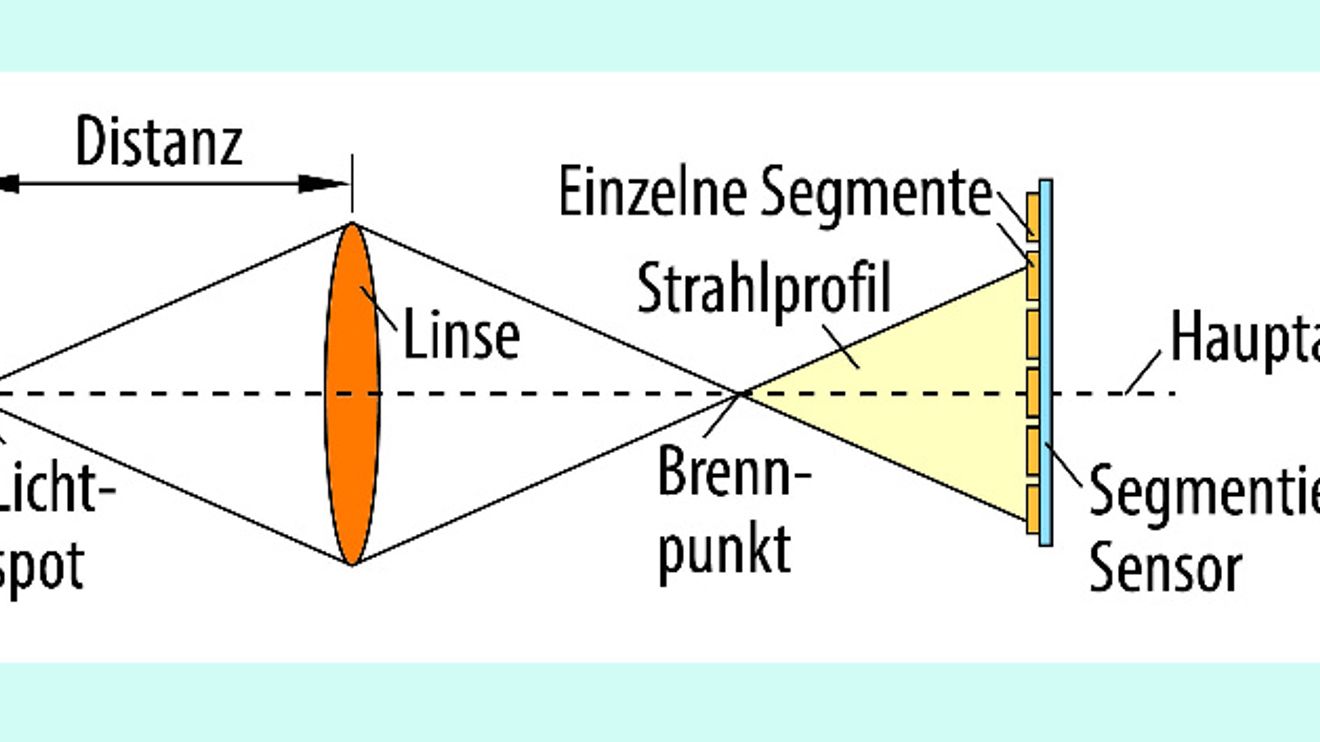
In the evaluation unit, a light source emits visible or infrared light into a central transmission fiber that leads to the measuring head, where it is bundled by the lens and falls onto the object to be detected. The very small spot of light is imaged onto the surface of an optical sensor using the same lens - deliberately not in the focal plane, but deliberately blurred so that it expands into a larger circle.
The light then enters the ends of several receiving fibers around the center in the same optical cable(Fig. 7), runs through them to the evaluation unit(Fig. 8) and falls on a suitable optical detector. In principle, this could be a normal CMOS image sensor; however, such a sensor would be too slow for many fast industrial processes and would also require complex software for analysis. Several single-cell photodiodes in a sophisticated arrangement are more favorable; they react significantly faster and manage with simple analog electronics.

The key feature of beam profile analysis is that it works completely independently of the diameter of the light spot. This means that both a diverging LED and a collimated laser can be used as a light source. The starting point for calculating the distance is the relative intensity distribution between the individual measurement paths. The absolute light intensity and the color or reflectivity of the object do not play a role, nor do the properties of the fibers such as type, length or material. It is therefore possible to use inexpensive plastic fibers and temperature-stable glass fibers, as well as single or multi-mode fibers of any length. Moving mechanical parts such as adjustable lenses or iris diaphragms are not required. The measuring range is 25 to 120 mm, the linearity error remains below 1 mm.
The potential applications of XperYenZ are primarily in the field of highly automated production, where concepts such as Industry 4.0 are to be implemented. In the packaging industry, a typical example is checking whether there is a product in every cookie or tablet pack. The savings potential of a closely monitored and fully automated production process exceeds the costs of XperYenZ fiber sensors many times over.


You might also be interested in
"The industry needs a trade fair like this"
Sensor+Test presents itself with a number of new features, but remains true to its successful concept as a special interest trade fair. Holger Bödeker, Managing Director of AMA Service GmbH and organizer of Sensor+Test, explains what is important.
 read more...
Measurement technology / sensors
Sensor+Test 2019 focuses on process automation
This year's Sensor+Test from June 25 to 27, 2019 will bring around 530 international exhibitors to Nuremberg. Among other things, they will be providing information on this year's special topic of process automation.
read more...News from the field of sensor technology
In the smart factory of the future, nothing will work without sensor technology as the 'bottom floor'! Sensor technology remains indispensable as the basis of industrial production systems. Computer&AUTOMATION presents current trends in the...
read more...AMA Association for Sensors and Measurement
Positive development in the 1st quarter
In the first quarter of 2024, sensor and measurement technology companies generated sales growth of 2% compared to the previous quarter. This was the result of the quarterly survey of the AMA Association's 450 members on economic development.
read more...Innovation Prize 2024 awarded
This year's AMA Innovation Award from the AMA Association for Sensors and Measurement (AMA) honors the development team around Stanislav Aksarin. The prize was awarded at Sensor+Test 2024 in Nuremberg.
read more...Sensors and measurement technology generates sales growth
In January 2024, the AMA Association for Sensors and Measurement (AMA) surveyed its members on the economic development of the past financial year. According to the survey, companies generated a 6% increase in turnover compared to the previous year.
read more...Start of applications for the AMA Innovation Award 2024
The AMA Association for Sensors and Measurement (AMA) invites innovative minds from science and industry to apply for the AMA Innovation Award 2024. We are looking for innovative research and development results in sensor and measurement technology.
read more...Positive summary after three days at the trade fair
The exhibitors at Sensor+Test 2023 and organizer AMA Service have drawn a consistently positive conclusion from the event: over 5,000 trade visitors from Germany and abroad came to the Nuremberg exhibition halls, around 20% more than in the previous...
read more...Quantum Technologies wins innovation and special prize
On May 8, 2023, the AMA Association for Sensors and Measurement (AMA) presented the AMA Innovation Award to the winning team from Quantum Technologies for an all-optical quantum magnetometer.
read more...