
Sensors 4.0
Focus on the 2nd channel
Every intelligent sensor needs a way to transfer process data to a higher-level intelligence system. A single-channel data output - as has been common up to now - no longer does justice to the topic of Industry 4.0.
The aim of Industry 4.0 is to make processes in both production and the flow of goods more effective, faster and safer. In order to achieve this goal, the classic, strictly hierarchical automation pyramid must be broken up. This usually consists of different and separate levels: the field level (input/output signals), the control system (PLC), the process control level (SCADA), the operations control level (MES) and the corporate management level (ERP).
An essential prerequisite for Industry 4.0 is that the data flow is not only possible at one level. Rather, bidirectional access through and between all levels must be realized. Although this is already technically feasible today, it requires a great deal of effort at each level to transfer the data from one level to the next.
What does this mean in concrete terms for sensor technology? Every intelligent sensor that determines process data in any form, such as measurement and position data or code information, already transfers its data to a higher-level intelligence. What is new is that in future, sensors will also send diagnostic data to an ERP system in parallel, for example to report an impending failure, with the aim of activating a timely check of the sensor before it no longer supplies data.
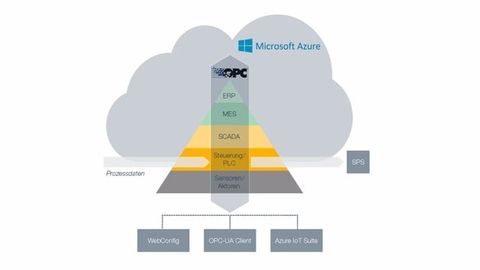
Characteristic of Industry 4.0 is the flow of data through all levels of the automation pyramid into the cloud.
© LeuzeTo ensure all this, systems that can operate both channels must be available at all levels. Accordingly, the sensor must be able to transfer its process data to the PLC on the horizontal level and also be able to send a pre-failure message on the vertical level in the sense of condition monitoring.
In order to be able to operate both communication levels simultaneously and independently of each other, the sensor must already have the basic technologies for this in its hardware. As only Ethernet enables the required two-channel communication, only those sensors and systems that provide more than just binary data, such as measurement, positioning or identification data, will be considered below.
Industry 4.0-capable sensors are systems with a dual structure in terms of processor technology. This means that one processor is responsible for calculating and evaluating the data; the second is primarily concerned with making the data obtained available at the interface. Whether this takes place in just one processor or whether two separate processors are actually used depends very much on the required performance of the products.
If a sensor is now technically capable of supplying process data on one channel and diagnostic or status data on a second channel, it must ultimately be determined how the data is to be transferred. At the process level, this is clearly described and defined by protocols such as Profinet or Ethercat. At the same time, communication standards such as OPC UA are currently gaining acceptance. This makes it possible to communicate data through all levels and into all levels - right up to a data cloud.
Once in the cloud, this data can then be analyzed as required. Microsoft, for example, offers a special solution tailored to the industry for this purpose: the Azure Cloud. Not only is it possible to collect and evaluate data, but the user can also use it to access a device directly - for example to update the firmware. The sensor uses the Azure Cloud's 'IoT Hub' for this purpose. Access to the data stored in the cloud is independent of location and user. If you do not want to use cloud technology, the data can alternatively be evaluated very easily via an 'OPC UA Client' on any PC.
Leuze describes a sensor that sends process data to the controller, is parameterized by a controller and can simultaneously send diagnostic data via protocols such as OPC UA or HTML as a sensor with 'integrated connectivity'. A sensor is also Industry 4.0-capable if condition monitoring data is also available. This means that it must not only be possible to make the data available everywhere. Rather, the sensor itself must also be able to determine and provide relevant data. One example: for an optical sensor to function properly, the optics must be free of dirt so that sufficient light energy can pass through. If the optics are dirty, faults can occur. An Industry 4.0-capable sensor can ultimately determine whether the pane is permeable or dirty and output this information itself. This opens up the possibility of servicing the sensor in good time and cleaning the sensor's optics when the machine is not in use.
The information that the optics need to be cleaned is sent from the sensor to the cloud via OPC UA communication in parallel with the actual process data, where it is evaluated and displayed. The cloud therefore not only stores the data, but also reacts to the incoming information and reports the maintenance of the sensor to the maintenance department for the next shift change. It is also conceivable, for example, that a sensor could report in good time that it has reached the end of its product life - before it fails. As device data such as manufacturer, article number and article designation can also be made available via the cloud, a company's purchasing department can order a new device in advance with the notification, thus eliminating the cost of stocking spare parts and ensuring that the sensor is replaced in good time before it fails.
For simple, binary switching sensors, 'integrated connectivity' cannot be offered for reasons of space and cost. This type of sensor does not contain a processor and usually does not have its own data interface. A simple M12 connector is therefore sufficient for contacting.

The alternative for binary sensors
A product with integrated connectivity technology, on the other hand, must contain at least one simple processor with a data interface and provide the appropriate separate contacting. However, this requirement requires space and incurs costs. In addition, the user benefit is not recognizable in this case.

Leuze is therefore taking a different approach here, but with the same goal: the combination of I/O-Link-capable sensors and an intelligent I/O-Link fieldbus master. Both the process data and the parameterization and diagnostic data can be called up via the I/O-Link connection. The I/O-Link fieldbus master therefore combines both technologies in one product.
It is not possible to parameterize the connected sensor directly from the controller and save the set parameters in the controller. However, as the parameterization data is stored in the I/O-Link master, the new sensor is automatically parameterized when it is replaced. Alternatively, with this approach the sensors can also be parameterized and diagnosed using a tool such as 'Webconfig' from Leuze Electronic. This is an operating system-independent user interface based on web technology for applications in which the component does not have to be directly connected to a fieldbus and which works in parallel with Ethernet-based fieldbuses.
Author:
Matthias Göhner is Product Marketing Manager at Leuze Electronic.


You might also be interested in
The e-paper special: looking for products of the year 2024
They've earned it: all 96 nominated products from 12 categories in their own e-paper. Browse through the individual areas and make your personal selection. You can also find out more about the companies and their solutions in the accompanying video...
 read more...
Products of the year 2023 - your vote counts!
96 products in 12 categories are up for election for the "Products of the Year 2023"! Take part and win Saturn vouchers worth €500, among other things!
read more...Protection class IP67 accordingly
The 36 series sensors from Leuze are suitable for intralogistics, packaging technology and the automotive industry. They detect objects with different optical properties even at great distances, vibrations, ambient light or soiling.
read more...The interactive e-paper of the winners
The interactive e-paper Computer&Automation "Products of the Year 2022" offers twelve categories, 36 winners and video interviews with the award winners at a glance! Click right in and experience the industry's pacesetters up close.
read more...These are your "Products of the Year 2022"!
Here they are, the winners of the "Products of the Year 2022" readers' poll! Find out which products and solutions from 2021 impressed our readers!
read more...Safety & Security - The winners
They ensure safety in production in different ways - the winners in the Safety & Security category.
read more...Ethernet-based I/O modules
The MD7 system from Leuze can be used to implement automation in the Smart Factory via IO-Link masters, hubs and sensors.
read more...Safety thanks to radar
Safe 3D systems are used to monitor hazardous areas - even in harsh environments such as sparks, dirt and dust, for which optical sensors have not yet provided a reliable solution. A radar system is now set to change this.
read more...Safety in harsh environments
With the LBK radar system, Leuze is expanding its safety range with a safe 3D system for monitoring hazardous areas, even in environments with dirt, welding sparks, sawdust, smoke or moisture.
read more...