
Balluff
Flexible via radio
IO-Link is a central building block for the factory of the future: as a digital interface, it enables a fieldbus-independent point-to-point connection and seamless communication between the sensor and automation system. What are the benefits of the wireless version?

High demands are placed on automation solutions in the industrial environment. The resulting challenges influence whether and how data can be generated and transported. Particularly in confined spaces or mobile and dynamic applications, the cabling of sensors and actuators is often the biggest hurdle when implementing a wide range of use cases. This is where switching to wireless technology comes in handy, as contactless data transmission makes wires and cables obsolete. The use of wireless technologies can also make sense when retrofitting or converting existing systems, as there is no need to interfere with the existing system architecture.
IO-Link is a central building block for the factory of the future and the Industrial Internet of Things (IIoT). As a digital interface, the communication standard enables both a fieldbus-independent point-to-point connection and seamless communication between the sensor and automation system. The addition of a wireless IO-Link variant opens up new fields of application.
Wireless in industrial automation
IO-Link Wireless is an international radio standard that uses the 2.4 GHz ISM frequency band, meaning that this standard can be used worldwide without a license. But for which application scenarios?
In robotics, for example, dynamic motion sequences on three axes are the order of the day. Cabling is often complex and costly due to these difficult conditions. If sensors and actuators are hard-wired, there is also a risk of cable and contact fatigue or breakage due to torsional forces. The result: machine downtime. Contactless data transmission enables new applications for robot arms - in combination with contactless power supply, completely new applications are conceivable in the future.
IO-Link Wireless is also a solution for generating valuable data for driverless transport systems. If the transport systems operate at high speeds, it was previously not possible to use sensors due to the need for fixed wiring and cabling on the carriage. Using IO-Link Wireless, sensors can now also be installed in such transport systems in order to transfer data to the next controller without contact. For this purpose, the base unit maintains contact with the installed components at all times with a range of 10 to 20 m and collects the required data in order to make it available for further analysis.
Generally speaking, IO-Link Wireless is particularly suitable for applications where there is little space for sensors but a high level of process reliability is required. Without the need for cabling, condition monitoring sensors can also be installed in places that are difficult to access - for example as a retrofit on existing machines and systems.
With the addition of a wireless IO-Link variant to the portfolio, a new communication standard for intelligent factory automation is being established. What does this actually look like at Balluff?
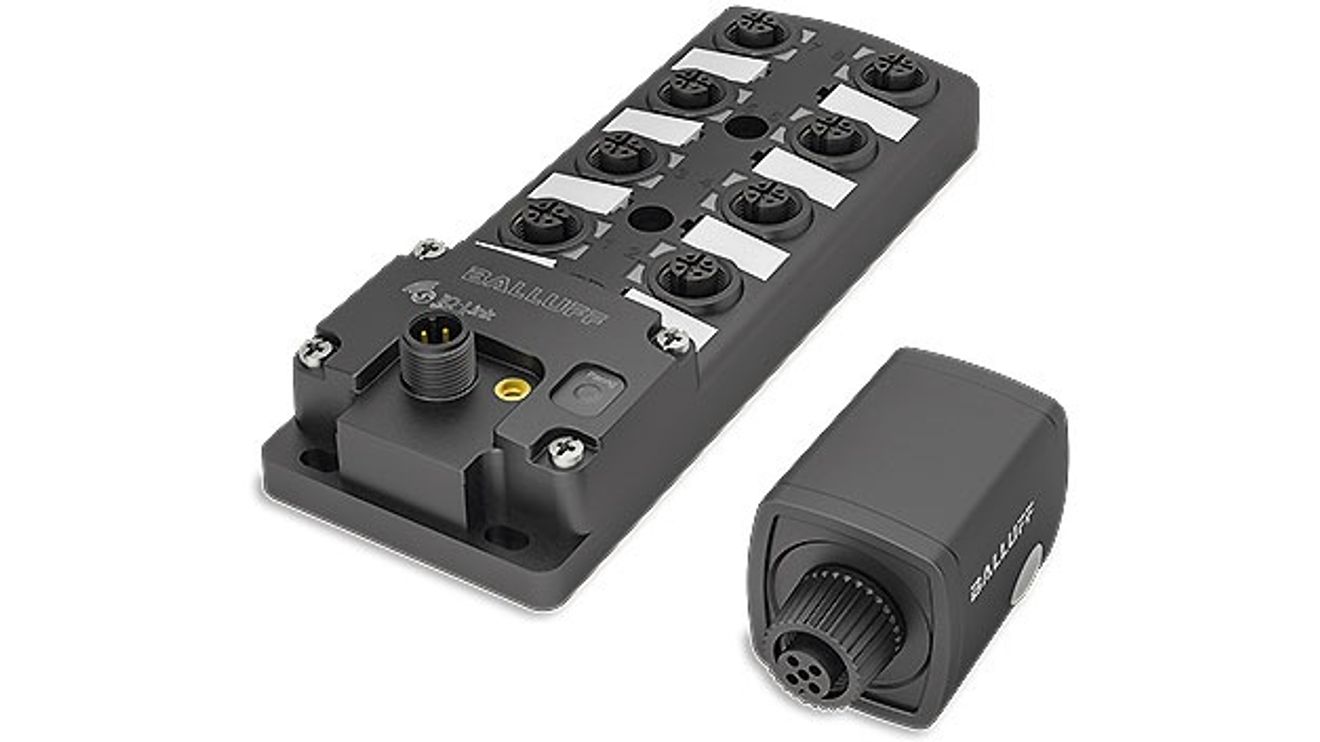
Instead of using a cable, the wireless master from Balluff receives the sensor data wirelessly via a bridge or a hub. IO-Link Wireless is based on the standardized IO-Link technology (IEC 61131-9) and thus meets all the requirements of factory automation. As IO-Link Wireless can be used worldwide without a license in a frequency range of 2.4 to 2.483 GHz, interference caused by the simultaneous operation of WLAN systems, for example, is ruled out. The implemented frequency hopping function makes it possible to avoid overloaded frequency channels. Additional blacklisting can also be used to directly exclude known channels that are already in use.

The intelligent sensors and actuators are connected to the control system via the IO-Link master.
© BalluffThe devices communicate directly with the controller via a node (IO-Link master), which ensures a stable and continuous connection from master to device. IO-Link Wireless is more flexible than wired variants and offers high scalability. With an IO-Link master with five tracks, a total of 40 IO-Link devices can be connected via eight ports. Additional devices can be connected via an additional master, depending on the requirements of the application.
During the development of IO-Link Wireless, Balluff placed great emphasis on high reliability: A latency of 5 ms and a packet data error rate of 10-9 enable a direct connection as well as fast and reliable data transmission - with the same communication stability as with the wired IO-Link standard. This means that the error rate is significantly lower than with other wireless technologies such as WLAN, Bluetooth or 5G. As only process data is usually transmitted via IO-Link - both wired and wireless variants - an unencrypted connection is sufficient. With a range of 10 to 20 m, the data also moves in a limited operating environment - questions about data security therefore do not arise when using the system.
Simple retrofitting in existing systems
All IO-Link wireless components - master, bridge or hub - are particularly suitable for retrofit solutions, as they can be integrated into existing systems regardless of the existing machine architecture. In contrast to wired variants, no cable ducts need to be opened up or the existing architecture interfered with. Product Manager Michael Zahlecker explains: "The intervention is minimally invasive, so to speak. Only a power supply is required to implement IO-Link Wireless. However, this is already available in existing machines - so additional cables are not necessary".
In terms of commissioning, all devices can be configured via the integrated web server. IO-Link Wireless is also ideal for modular system concepts, as additional components can be added at any time without any costly intervention in the machine architecture.
Supplement to wired solutions

The author: Sandra Nippert works in the Corporate Communication department at Balluff in Neuhausen a.d.F.
© BalluffIncreasing flexibility in modern manufacturing will lead to an increase in the proportion of wireless solutions in the industrial environment, which will complement wired solutions. The combination of different solutions in particular opens up a wide range of possibilities: User requirements play a key role here: where will the data be sent - wirelessly to a cloud or to the nearest base station? Is data first transported to the next controller, as with IO-Link Wireless? Or does data need to be available in real time? All these questions influence the combination of different wireless or wired solutions. This means that IO-Link Wireless is in no way in competition with wired solutions, but rather represents a promising extension. The transmission rate is one byte every 5 ms - a higher data volume can slow down the speed slightly.
Every field of application should therefore be based on a thorough analysis of the initial situation. Issues such as power transmission, reliability and data transmission in real time are factors that should be considered and weighed up.


You might also be interested in
Half a billion in turnover in 2021
With total sales of 504 million euros, the sensor and automation specialist Balluff achieved a record result in the 2021 financial year.
 read more...
Wireless data transmission
Balluff is launching a wireless IO-Link variant on the market: IO-Link Wireless is used wherever classic data transmission was previously not possible or only possible with difficulty.
read more...Hans Seifert to Become Chief Sales Officer
Sigmatek has appointed Hans Seifert as Chief Sales Officer (CSO). His area of responsibility includes international sales, marketing, application engineering, and support.
read more...CC-Link certification for modular I/O system
Weidmüller has received the CC-Link Partner Association (CLPA) certificate for its modular I/O system 'u-remote'. This makes u-remote the first modular I/O system with official CC-Link IE safety certification for CC-Link IE TSN.
read more...Profibus & Profinet International
MTP Specification 2.0 published
Profibus & Profinet International (PI) announces the official release of the Module Type Package (MTP) Specification 2.0. The MTP 2.0 standard creates the basis for true cross-industry interoperability as well as more flexibility and efficiency...
read more...New analog input modules
MicroControl is launching the next generation of compact analog input modules. The new modules are µCAN.4.ai-BOX for voltage/current, µCAN.4.sg-BOX for strain gauge sensors and µCAN.4.ti-BOX for temperature sensors.
read more...Profibus & Profinet International
Profinet leads the field in industrial Ethernet protocols
A recent analysis by the market research institute Omdia confirms that Profinet is the leading technology in the field of industrial Ethernet protocols. In addition to its broad market penetration, Profinet's consistent focus on security is...
read more...Dual leadership in Shanghai
Stefan Becker has been appointed Managing Director of Eckelmann Automation Technology in Shanghai and will manage the subsidiary together with Zhongwei Huang.
read more...Smart control cabinets thanks to new Ethernet/IP technology
Rockwell Automation is launching an Ethernet/IP control cabinet solution. The aim of this further development is to meet the growing demand for smarter, faster and better networked production processes.
read more...