
Mushroom
Cool management of hot spots
Burner management systems for the fully automatic operation of a burner system have a complex structure. Due to the high risk potential, strict regulations apply to avoid safety-relevant process conditions. How can these be implemented and complied with?
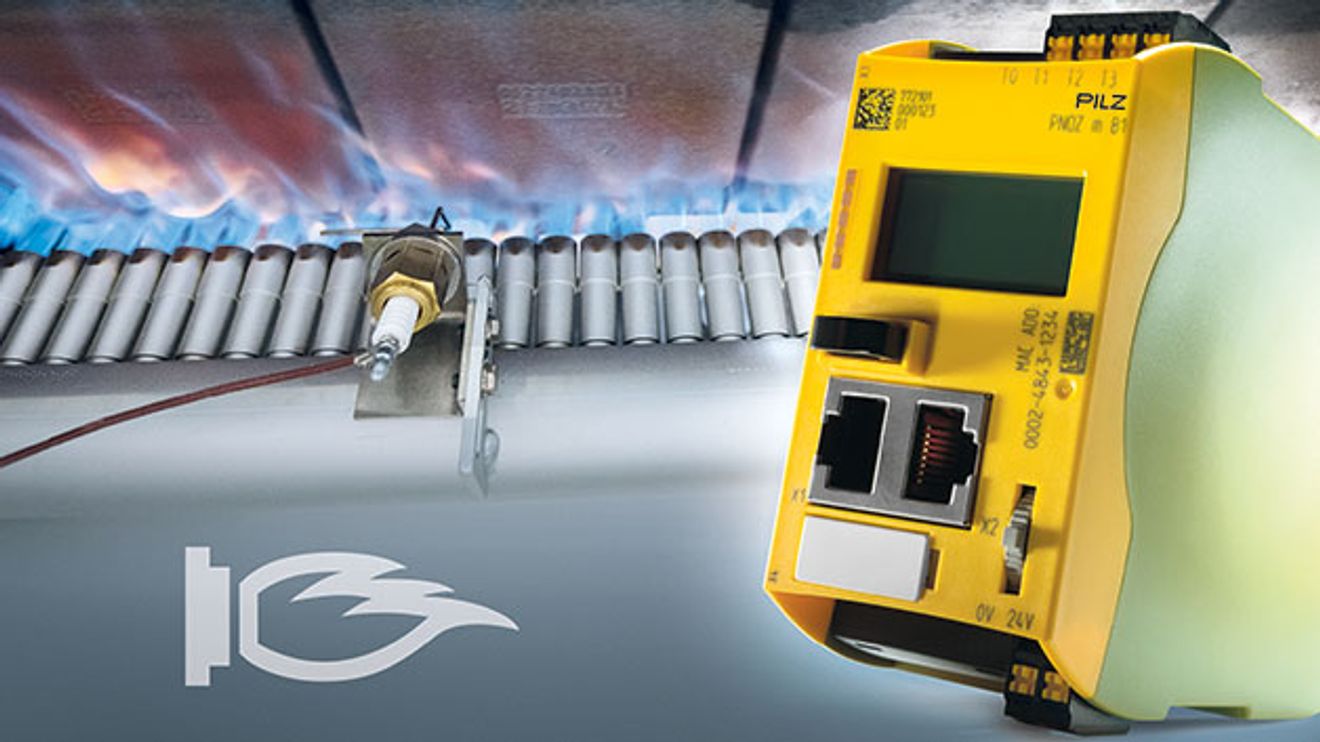
Burner control units ensure the safe operation and monitoring of firing sequences for gas and oil burners in industrial thermoprocessing systems. For example, they offer variable safety times for opening the fuel valves, allow the pre-ventilation time to be adjusted for freely selectable blower outputs and boiler rooms and carry out a gas valve test (leak test) in accordance with EN 1643 with two main gas valve outputs. Their task is to reliably manage the subsequent safety functions in the monitoring sequence: pressure, temperature and flame monitoring, safe start-up, for example pre-purge and ignition, as well as shutdown, for example afterburning or shutdown, of the burner system. Safe monitoring of the emergency stop chain is also the task of a burner control unit. Other functions that are safely monitored are the fuel/air ratio, the activation of valves, dampers and actuators, the start-up and shut-down of valves and the high-temperature system. In addition, the automation also ensures secure data exchange and the visualization of operating states and diagnostic messages. A modern control system can supply all status and diagnostic data, which can be displayed and evaluated locally or remotely for other devices via fieldbuses or Industrial Ethernet.
Safety for boilers and co.
Burner management in the baked goods industry: The Austrian wafer baking machine manufacturer Bühler Haas uses the configurable small controller 'PNOZmulti 2 Burner': It takes over the 'functional safety' and 'burner control' tasks of the previously separate burner controllers in a single system.
© MushroomThis monitoring sequence can be found in all Process Heat applications, regardless of whether they are single burners, burner groups or interlinked systems. One requirement always remains the same: the automation solution must solve the tasks of safety and automation technology as well as being convenient and easy to use. Manufacturers such as Pilz therefore offer systems that can be adapted to different applications in terms of their complexity and take into account the specific requirements of combustion technology in terms of hardware and software. In industrial gas and oil firing systems, for example, all functions along the gas control path, safety-relevant flame monitoring and all other system-related safety functions can be monitored, controlled and visualized.
Safety all-inclusive
In simple and less interlinked systems, small controllers take over the monitoring of safety in heating process applications. For example, the base unit 'PNOZ m B1 Burner' of the safe, configurable small controller 'PNOZmulti 2' from Pilz can be used as a safety controller to safely monitor and control not only the burner itself with its safety functions, but also the entire plant. Using predefined and certified function blocks, the monitoring can be adapted to different burner applications - for example pilot burner or non-guide burner, direct or indirect ignition, low or high temperature operation. The mini control unit also controls the safety valves of a burner in accordance with standards; an extension module has four safe, diverse relay outputs in accordance with EN 50156-1. Even complex safety applications can be implemented with this system, which has integrated diagnostics - one basic device monitors up to twelve burners.
However, small controllers reach their limits where long furnaces with dozens of burners are common - for example in the metal, glass and ceramics industries. In such plants, a large number of inputs and outputs are required, which are distributed over large spatial areas. Here, control systems such as 'PSSuniversal PLC' from the 'PSS 4000' automation system enable the safe management of all the burners present in an application. There are also complex, interlinked systems in which control systems with the appropriate software for burner management take over the safety of the system. For example, the integrated diagnostics can be used to display the status of the burner. As burners have to pass through various stages and sequences in accordance with the standard and have to meet certain conditions, the visualization must ensure that the operating personnel can read the status at a glance via a display or HMI. An additional graphical display of the flame parameters for all burners in a system and a display of the sensor data in the system display are part of the extended scope of diagnostics. Comprehensive diagnostics are particularly important for industrial systems that are distributed over a wide area, so that a quick response is possible if a fault occurs anywhere in the overall system.
Software modules for burners

The 'PNOZmulti Configurator' software tool for the small controller 'PNOZmulti 2' supports project planning, configuration creation, documentation and commissioning of safe combustion plants, including extensive diagnostics options.
© MushroomAll safety functions relevant to burner management are available in approved and encapsulated modules via software. Only the available process signals and the input/output modules are decisive for how many monitoring and control functions can ultimately be used. The function modules can be used several times within the hardware limits and thus offer various options for optimizing the system - beyond the individual burner for a burner network or even the entire system.
The base unit 'Burner' of the small controller 'PNOZmulti 2', for example, supports a burner function block of the software tool 'PNOZmulti Configurator'; a maximum of twelve burner function blocks can be configured per base unit. This software element emulates the extended functionality of a flexibly configurable electronic burner control unit. It is available for configuring the base unit 'PNOZ m B1 Burner' and is certified in accordance with the relevant European standards, including EN 298 and EN 50156.
The software for control systems, such as 'PAS4000' in the automation system PSS 4000, can be characterized by hardware-independent programming. It can be used to configure function blocks that focus on specific application scenarios of a burner application. The 'Burner Management Software Package' can be used to implement programs for controlling different burner types and at the same time execute safety functions such as safety door contacts, emergency stops and light curtains. As the function blocks for burner management are prefabricated and TÜV-certified, they are easy to install and validate.
The standards situation
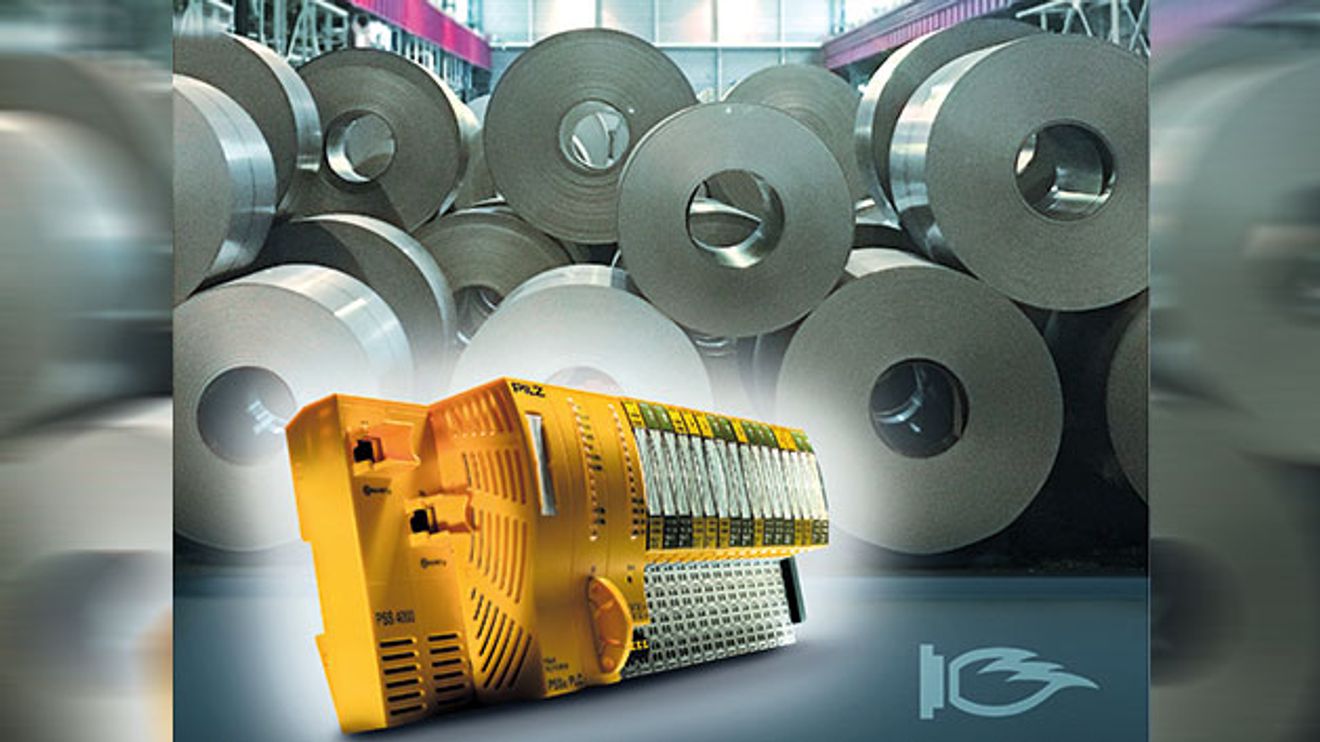
As with the Belgian steel giant Arcelor Mittal, the automation system PSS 4000 from Pilz can be used in widely ramified plants: The burner management software package of the automation system takes over the tasks of the burner control module.
© MushroomEU directives for combustion plants have only existed since 2004. Until then, national standards were applied, which have only gradually become established at European level. For example, industrial thermoprocessing plants are classified as machinery under the Machinery Directive, where they fall under EN 746, the standard for 'industrial thermoprocessing plants'.
For combustion plants that are not classified as industrial thermoprocessing plants and are not used to heat process liquids and gases in the chemical industry, the European standard EN 50156-1 exists as a general standard for electrical equipment.
According to the safety classification by the TÜV, the design of the burner controls must comply with the following standards: the international standard EN IEC 61508, the specific standard for firing systems EN 50156 based on it or the international standard EN ISO 13849, which is well known in mechanical engineering.
A large number of international standards for thermal processes, steam boiler systems, automatic burner controls and burners apply to burner systems worldwide. UL 60730-1 and UL 60730-2-5, which are valid in the USA and Canada, deal with automatic burner controls that are used for the automatic control of burners with oil, gas, coal or other combustible materials. In addition, there are the requirements of the US National Fire Protection Association (NFPA): NFPA 85, 86 and 87. NFPA 85 focuses on increasing the operational safety of boilers, NFPA 86 focuses on minimizing the risk of fire and explosion in furnaces, and NFPA 87 provides safety guidelines for liquid heaters and related equipment.

An interview with Armin Glaser: "The new Machinery Directive makes industrial security mandatory for the safety of machines!"
© MushroomThe Australian Gas Association (AGA), in particular the EN 298-2012 standard, is also relevant for the certification of burner management systems.
Burner control systems that have UL or other international certifications give companies and users access to these markets. The systems can ensure safe processes in a wide range of industries: in metalworking, the food and confectionery industry, cane sugar or ethyl alcohol production, the paper industry or the automotive sector. It is also important for the petrochemical or gas processing industries that energy is neither wasted nor hazardous - and safe automation can play its part in this.
| Intuitive and safe - an interview with Armin Glaser |
|---|
|
Nowadays, safe combustion monitoring is mainly based on fixed logic functions. Armin Glaser, Vice President Strategy and Cooperation at Pilz in Ostfildern, explains the benefits of a freely programmable or configurable safety controller. Mr. Glaser, what are the benefits of such a safety controller for safe combustion monitoring? Armin Glaser: First of all, to clear up a common misconception: changing the safe evaluation logic in the user program of a programmable safety controller does not necessarily lead to recertification! In a safety controller, all blocks, libraries, commands, safe arithmetic operations and predefined functions are certified and approved by the certification body. This approval always relates to a 'package' consisting of hardware, firmware and the engineering tool used. All individual combinations of different hardware modules, function blocks and commands carried out by the user are only carried out within the framework of the approved overall system. This module test and the safety-related verification of all combinations is part of the verification procedure of the control system manufacturer vis-à-vis the approval authority. Users are thus completely relieved. What is the added value for operators of firing systems? Glaser: The certification of the devices ensures that users can only use approved combinations; they are completely spared any organizational effort. They can concentrate fully on the safety-relevant functions of the machine or system. If the safety functions of the system or machine require approval, a newly added safety function must be tested. And here, too, it is crucial that this is as easy as possible for the user to implement: proof of unchanged parts of the program logic can be provided simply by means of a checksum of the relevant area. This checksum is automatically generated by the system in the background and is part of the documentation. In this way, responsibility limits and released areas can be easily traced and documented. In industrial safety technology, the user with his interests and skills is always part of the project and involved - because only applicable safety is stable and accepted safety! I am happy to repeat myself: the manufacturer is clearly responsible for ensuring that the devices function correctly in terms of safety. Plus: The user must stay within the limits described in the safety manuals. This is why the documentation for the device is always part of the safety-related acceptance procedure. In this way, the manufacturer and the certifying body work together to ensure that users in the world of combustion technology are always clearly and easily informed of their handling steps and limits of responsibility. And what does that mean in technical terms? Glaser: Users in the world of combustion technology can make changes to the safety function of a safety controller completely independently and with the least possible effort. Support from the control unit manufacturer is not necessary. Is the burner control unit a safety function in accordance with the Machinery Directive? Glaser: A quick look at the Official Journal of the European Union will help here - it lists EN 267:2009 for automatic forced draught burners for liquid fuels and EN 676:2003+A2:2008 for automatic forced draught burners for gaseous fuels. This means that burners are subject to the relevant standards due to their use and the equipment used. More precisely, EN 746', EN 676 'Gas burners' and EN 12067 'Gas/air ratio control' in accordance with the Gas Appliances Directive, EN 230 'Automatic burner controls for oil burners', EN 267 'Oil burners' and EN 298 'Automatic burner controls for gas burners and gas appliances with and without fans' and also the 'Industrial thermoprocessing equipment' of the Machinery Directive. The consequence of this is that all control and monitoring functions must be designed in accordance with the safety requirements of these standards and provided with a CE mark by the manufacturer - within the defined framework of the - still - valid Machinery Directive. So what characterizes a future-proof solution in the process heating industry? What role does the new Machinery Directive play here? Glaser: The new Machinery Directive takes into account the growing importance of digitalization and industrial security. What is fundamental is that protection against manipulation of the safety-related control system and defense against cyber threats is becoming an essential requirement. The Machinery Ordinance therefore makes industrial security mandatory for the safety of machinery! These new requirements also affect combustion technology and must be taken into account accordingly. |


You might also be interested in
In focus: Connection technology
The e-paper of issue 07/23
Communication and networking is the central theme of the current issue: first insights into the program of the TSN/A-Conference 2023, the cover story is all about SPE at field level and the "Digital Twin" series deals with the digital twin as an...
 read more...
Cybersecurity as a duty
On June 29, 2023, the "Machinery Regulation (EU) 2023/1230" (hereinafter: Machinery Regulation) was published in the Official Journal of the European Union. Machine manufacturers and operators have 42 months to comply with the new requirements for...
read more...Safety - The winners
The winners in the Safety & Security category demonstrate the broad spectrum of functional safety: from risk assessment to emergency stop switches.
read more...CC-Link certification for modular I/O system
Weidmüller has received the CC-Link Partner Association (CLPA) certificate for its modular I/O system 'u-remote'. This makes u-remote the first modular I/O system with official CC-Link IE safety certification for CC-Link IE TSN.
read more...Dynamic alarm display and secure input processes
Hima, provider of safety-related automation solutions, and Deuta, provider of certified display and safety technology, are jointly launching a solution that includes Hima safety systems and function block libraries as well as a safety-related...
read more...CEO appointed for Sella Controls
The Hima Group has appointed Carl Ramsden as CEO of Sella Controls with effect from October 1, 2025. According to Hima, this newly created position represents an important milestone in the further integration of the British company into the Group.
read more...Innovation partner for automation
Bihl+Wiedemann is a medium-sized, owner-managed company - founded in 1992 by Jochen Bihl and Bernhard Wiedemann in Mannheim. It develops and manufactures complete solutions for functional safety and data communication in machines and systems.
read more...Growth course continued
The Hima Group, a provider of safety-related automation solutions, grew significantly in the 2024 financial year, driven in part by international expansion and an increasing focus on digital solutions.
read more...Single-axle drive module for high performance
The modular, dynamic multi-axis servo system 'DIAS-Drive 2000' from Sigmatek has been reinforced: The 'MDP 2200-L-01' single-axis module for controlling synchronous servo motors provides up to 20 A rated current.
read more...