

Robotics
Welding in batch size 1
The idea of fully automated welding of different components just-in-time in batch size 1 without the need for set-up is occupying production engineers around the globe. At Doka, an Austrian manufacturer of formwork solutions, this vision is already a reality.
Doka, based in Amstetten, employs more than 6000 people in over 70 countries. Founded in 1958, the company provides formwork solutions worldwide - impressive construction projects such as the Burj Khalifa, the world's tallest building at 828 meters, the Three World Trade Center in New York or the Lotte World Tower in Seoul were built using system solutions from the Lower Austrian company. Doka aims to set technological standards not only for the formwork itself, but also for the way it is produced. For this reason, the long-established and time-consuming manual welding of certain components for the various formwork systems was to be a thing of the past. With this in mind, the plan to install a fully automated robot welding cell came to fruition.

In fixtureless welding, one robot guides the workpiece while the other takes over the joining.
© Ralf HögelErwin Schwarzl, production technician at Doka, explains the overriding aim of this investment project: "We wanted to produce the large number of individual parts that had to be welded manually more economically. The requirement was to switch from cost-intensive warehousing to just-in-time production of various components. This task was to be performed by a jigless robot cell, which has to complete different production orders up to batch size 1, even in unmanned shifts."
Jigless robot welding offers significant advantages simply by eliminating tedious clamping and tacking processes as well as the possibility of autonomous welding in unmanned shifts, but places high demands on the robotics: "Jigless is one of the most demanding disciplines in automation technology. Such cells are true guarantors of flexibility - but only if they are optimally designed, the appropriate robots are used and the user has the relevant expertise," emphasizes Sepp Hautzinger from Yaskawa Europe.
Doka met these entry-level requirements to a sufficient degree. The Austrians have been using robots since 1980. Today, well over 100 robots work in production at the Amstetten plant. Even before investing in the new cell, the Doka production team and the welding experts from Yaskawa jointly checked the complete range of welding tasks to be carried out for their jigless suitability, as not every component can be welded freely in space simply by positioning it with a handling robot. To put it simply, small tolerances of the components to be welded and a low expected distortion speak in favor of jigless welding, while, on the other hand, large production-related deviations from target contours and particularly difficult joining constellations can make the process significantly more complex or even impossible.
Once the feasibility was beyond question, the next step was to design the high-tech cell. The result is currently setting standards for automated welding: "The jigless cell at Doka is one of the most modern robotic welding systems in the world," Hautzinger is convinced. It uses the latest DX 200 robot controller from Yaskawa, a state-of-the-art Fronius welding power source including a new, fully automatic torch neck changing system, the MotoSense laser-based seam tracking system, also from Yaskawa, an application-specific modified Kardex shuttle feed system, a fully automated gripper changing system for the handling robot and a higher-level PLC.

The Motoman MH280 with 280 kg load capacity placing a component on the rotary indexing conveyor system. The Kardex shuttle for feeding up to 60 components can be seen in the background.
© Ralf HögelThe actual system layout: The components to be welded can be fed either via a rotary indexing system with 16 workpiece carriers or via the tower shuttle system. While the rotary indexing system is primarily intended for the production of small to medium series, the shuttle system pays off in unmanned shifts. With its 60 positions, it guarantees autonomous system operation for far more than one shift. The 'bosses' in the cell are two six-axis robots: a Motoman MH280 II handling robot and the MH24 welding robot. While the former precisely positions the component to be welded, the welding robot takes care of the joining.
On the robot side, optimum path behaviour and high precision are required, while the DX200 controller ensures perfect synchronization and coordination of the two six-axis robots. The large working radius of just under 2.5 m for the handling robot and 1.73 m for the welding robot ensures that all positions are reached and that all welds are carried out in the optimum trough position.
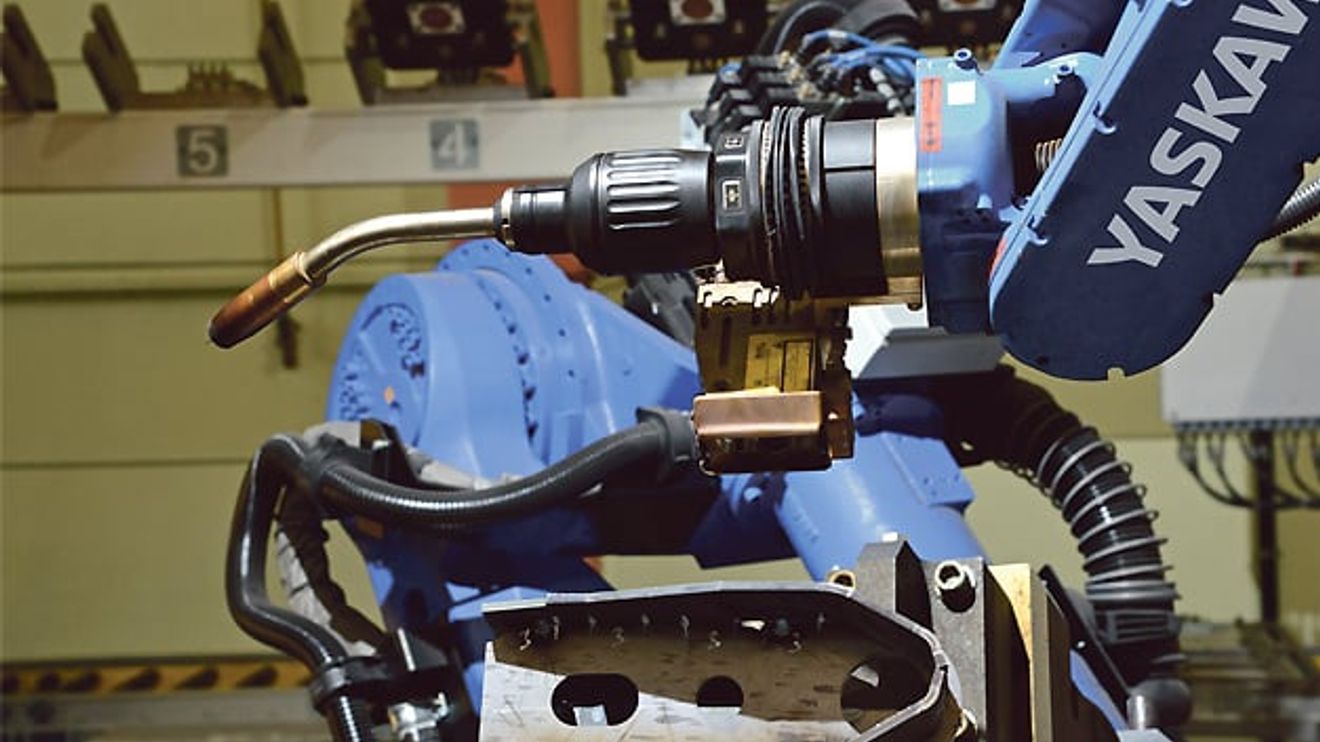
The MH24 is equipped with the MotoSense camera system for perfect weld seams. This laser-based vision system enables the robot to detect and track seams in real time.
Seam tracking in real time

Diagram of the Doka automatic climbing formwork (right). The marking shows the location of the composite shoe (detailed image, left) with the laser-welded seams.
© DokaIntegration takes place via a direct interface to the robot controller. As absolute component positioning is no longer necessary with this system, it is ideal for jigless applications and ensures optimum welding results even for complex tasks. According to Schwarzl, the Fronius TPS500i welding power source also makes a significant contribution to the high quality of the weld seams: "It ensures much better penetration and significantly higher welding speeds. This has a positive effect on process times." Both the handling robot and the welding robot are equipped with automatic changeover systems to ensure that non-productive times are as short as possible in addition to process times. The handling robot automatically fetches the required gripper from the gripper station integrated in the cell. The same applies to the welding robot: it is programmed to cyclically replace the torch neck currently in use with a new one at the changing station. This ensures trouble-free operation with maximum welding quality, even during unmanned shifts.
Despite the large number of digitally networked components, the system not only achieves high availability, it also sets standards in terms of user-friendliness: at the cell, the operator essentially only has to insert the parts, select the correct program and remove the finished parts again, which can be carried out in parallel with the process. Programming the system with the two cooperating robots is more demanding, but the experienced Doka team has mastered it with ease. Among other things, a powerful offline programming system including 3D simulation with collision detection is available for this purpose. In addition, welding programs for up to 1000 components can be stored in the robot controller and called up again as required.
Costs versus benefits
For production technician Schwarzl, the jigless welding cell fulfills the expectations placed in it with flying colors: "With jigless robot welding, we are up to three times faster than with manual welding, depending on the component. We also achieve a previously unknown level of flexibility, as we can produce in order-related batch sizes of 1 in unmanned shifts. Economically, this is a direct hit, as expensive warehousing will be largely eliminated in future and manufacturing costs will also fall." It is therefore not surprising that Doka is already considering investing in further jigless robot cells.
Admittedly: At first glance, investing in the jigless system appears to be more capital-intensive due to the higher number of robots. However, Sepp Hautzinger counters this: "Depending on the batch sizes and number of variants, in practice there are conventional welding systems for which hundreds of clamping fixtures exist. These have to be designed, built, stored and maintained. The costs for manual clamping and tacking work are added to this. Another advantage of fixture-free welding is that there is no need for time-consuming and costly adjustments to the welding fixtures when changing components. Taking all these aspects into account, jigless technology also quickly gains an advantage on the cost side."
Last but not least, jigless offers incredible flexibility. Hautzinger: "We have already implemented some systems that can work completely autonomously for an entire shift. However, these ghost shifts require reliable control of all processes in order to ensure long-term trouble-free operation. Therefore, it is not only the expertise of the plant manufacturer that is required here; the user should also already have a sound knowledge of robotics.
Author:
Ralf Högel is a freelance author from Stadtbergen.
Adaptive welding with laser sensors

The laser-based MotoSense camera system eliminates the need for absolute component positioning.
© YaskawaRobots follow programmed control commands - highly precise, but initially 'blind'. In the case of a welding application, this means that the workpieces to be welded must be arranged precisely and always in the same position so that the robot can place the weld seam correctly.
Combining the robot with an optical detection system allows for more flexibility. Thanks to the 'eyes' of the sensor system, the robot is able to act in a situation-specific manner and also take changing gap dimensions into account during welding, for example.
However, such a combination is technically complex: the signals recorded by the sensors must be evaluated in real time and processed in such a way that the robot controller can process them and pass them on to the manipulator or welding tool as movement commands. The realization of the necessary interfaces requires special know-how on both the camera and robotics side. Depending on the specific requirements, there are two fundamentally different detection methods to choose from: Comparatively simple vision systems use static cameras to capture individual images in 2D. Laser-based sensor and camera systems are used for more sophisticated applications. These allow a 3D measurement of the surface and thus clear statements about the contour - not only statically, but also dynamically, i.e. with permanent detection. Finally, dynamic seam detection and tracking also provides the basis for adaptive welding applications: The recorded data is then linked to the welding process in such a way that the robot, for example, dispenses the filler material precisely depending on the respective contour.
The laser-based MotoSense camera system, which is also used at Doka, can be used in all three operating modes: static, dynamic and adaptive. It can be used for MIG/MAG, TIG and plasma welding technologies and can process a wide range of materials, including stainless steels and aluminum. The system communicates directly with the Motoman robot controller into which it was developed: The interaction of prepared macro jobs and suitable vision algorithms ensures perfect results even for the most complex welding tasks.


You might also be interested in
Clever air conditioning
To protect electrotechnical components in control and switch cabinets from excessive temperatures, the heat must be efficiently dissipated from the cabinet. Instead of an active air conditioning component, passive heat dissipation is often...
 read more...
The material makes the difference
Every application is different - this also has an impact on cables and connectors and the materials used. But what should be considered in detail when selecting connection systems?
read more...The five attributes of a smart factory
On the road to the smart factory, the question is no longer 'if' digital transformation will happen, but rather 'how'. Which technologies play a key role in this?
read more...On the trail of the product
When was which part produced where? This is often an essential question - especially for quality management. Individual part traceability creates a new form of transparency.
read more...In the jungle of platforms
There are more and more IoT platforms on the market. But which solution is suitable for which application? How do they differ from each other and what is their focus? An overview.
read more...IUNO research project - Part 1
The technology data marketplace
The opportunities offered by I40 remain untapped, particularly in SMEs. One reason for this is that the IT used in companies to date is often not geared towards the security requirements of networked production. This is where the IUNO research...
read more...Karlsruhe Institute of Technology
More 'sensitivity' for the robot
Intelligent robots perceive their surroundings and react to them. To do this, they need sensors that simultaneously detect various physical events. This is a topic that researchers at the Karlsruhe Institute of Technology (KIT) are currently working...
read more...Stäubli presents autonomous driving system
Last year, Stäubli presented its approach to autonomous robot systems for the first time and initially tested the concept extensively in its own production facilities. Now 'HelMo' - the name of the solution - has 'grown up'.
read more...Energy supply for 6-axis robots
Protective hose versus energy chain
The energy supply system is the umbilical cord of the robot. With flexible 6-axis kinematics in particular, the question often arises: Which is the better solution - a protective hose or a modular 3-axis energy supply chain?
read more...