
Karlsruhe Institute of Technology
More 'sensitivity' for the robot
Intelligent robots perceive their environment and react to it. To do this, they need sensors that simultaneously detect various physical events. This is a topic that researchers at the Karlsruhe Institute of Technology (KIT) are currently working on.
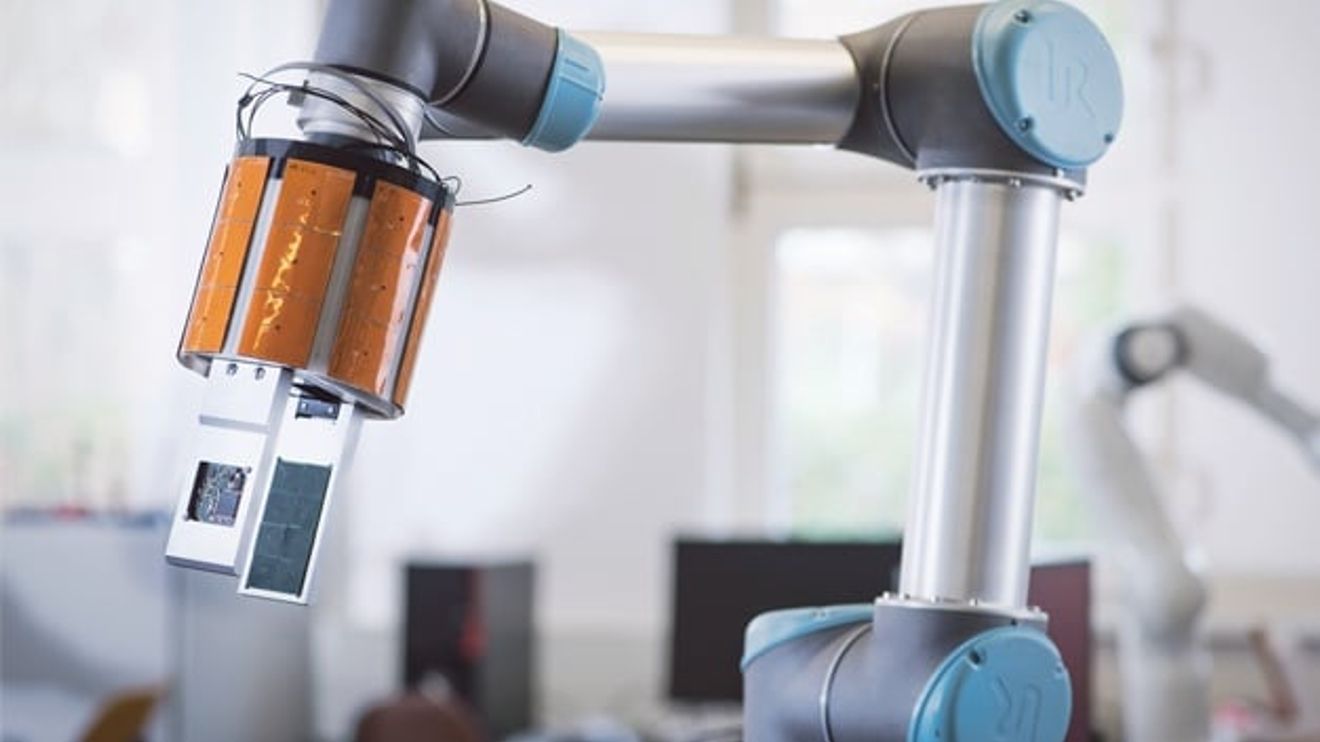
The multimodal TNS technology is not intended to replace other sensor systems such as cameras, but rather to expand the perception capabilities of robots.
© KITRobots can relieve humans of monotonous, arduous or dangerous tasks. Their use has long been established in many areas of the economy, such as industrial production, maintenance, logistics and agriculture. An intelligent robot is characterized by the fact that it can perceive its environment and react to it. This enables it to perform complex tasks, such as grasping unknown objects, while acting flexibly and interacting safely with humans.
Just as a human uses different senses simultaneously and links the individual perceptions in the brain to form an overall picture, an intelligent robot must be able to simultaneously detect and evaluate different physical events using so-called multimodal sensor technology. Stationary and mobile robots often have 2D or 3D cameras and laser scanners to visually perceive their environment. However, the accuracy of these optical systems is often impaired by unfavorable lighting conditions or obscuring objects.
Against this background, researchers at the Institute of Anthropomatics and Robotics (IAR) - Intelligent Process Automation and Robotics (IPR) at the Karlsruhe Institute of Technology (KIT) have developed sensors that complement the established optical systems. The supplementary sensors previously used on the arms and grippers of robots are usually limited to one function: they either detect movements caused by the approach of an object or contact in the form of pressure. In contrast, the 'capacitive tactile proximity sensors' - TNS for short - developed at KIT combine both functions: They detect both movement and touch - and both at the same time if required.
A single sensor module consists of three layers: A flat ground electrode forms the bottom layer. The insulating intermediate layer is made of a compressible material, such as foam. The top layer is made up of several geometric, regularly arranged cover electrodes. The number and shape of the cover electrodes can be varied depending on the application. The controlling electronics can be installed separately from the sensor modules.
When an object approaches the robot, the electrical field surrounding the sensor changes. This information is evaluated as proximity information. This is how the sensor detects movements. In contrast, contact that leads to mechanical compression of the intermediate layer is recorded as a change in the electrical capacitance between the electrodes.
Compromise between range and spatial resolution

Professor Björn Hein: "I imagine that robots will react sensitively and intelligently to the presence of humans in the future."
© KIT"The cover electrodes can be combined as required," explains Professor Björn Hein, head of the Intelligent Industrial Robots Group (IIROB) at KIT's IAR-IPR. "Depending on the situation, a suitable compromise can be found between the range and the spatial resolution of the sensor." The sensor modules themselves can be networked to form sensor surfaces of different sizes - from small areas on grippers to large-area robot skin.
Among other things, the capacitive tactile proximity sensors are intended to help improve the safety of human-machine interaction by detecting and localizing approaching people and generating warning signals as soon as predefined safety distances are exceeded. The speed at which the task is performed is then reduced or the robot is even stopped.


You might also be interested in
Clever air conditioning
To protect electrotechnical components in control and switch cabinets from excessive temperatures, the heat must be efficiently dissipated from the cabinet. Instead of an active air conditioning component, passive heat dissipation is often...
 read more...
The material makes the difference
Every application is different - this also has an impact on cables and connectors and the materials used. But what should be considered in detail when selecting connection systems?
read more...The five attributes of a smart factory
On the road to the smart factory, the question is no longer 'if' digital transformation will happen, but rather 'how'. Which technologies play a key role in this?
read more...On the trail of the product
When was which part produced where? This is often an essential question - especially for quality management. Individual part traceability creates a new form of transparency.
read more...In the jungle of platforms
There are more and more IoT platforms on the market. But which solution is suitable for which application? How do they differ from each other and what is their focus? An overview.
read more...IUNO research project - Part 1
The technology data marketplace
The opportunities offered by I40 remain untapped, particularly in SMEs. One reason for this is that the IT used in companies to date is often not geared towards the security requirements of networked production. This is where the IUNO research...
read more...Stäubli presents autonomous driving system
Last year, Stäubli presented its approach to autonomous robot systems for the first time and initially tested the concept extensively in its own production facilities. Now 'HelMo' - the name of the solution - has 'grown up'.
read more...Energy supply for 6-axis robots
Protective hose versus energy chain
The energy supply system is the umbilical cord of the robot. With flexible 6-axis kinematics in particular, the question often arises: Which is the better solution - a protective hose or a modular 3-axis energy supply chain?
read more...What exoskeletons can do
They combine human intelligence with machine power by supporting or amplifying the wearer's movements - we are talking about exoskeletons. Initially developed for medical and military purposes, they are now on the cusp of industrial use.
read more...